

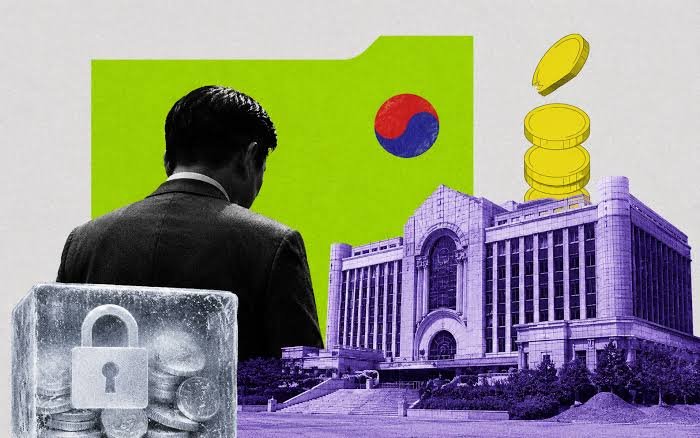

A South Korean court has sentenced the chief executive of collapsed cryptocurrency lending platform Delio to fifteen years in prison, closing a prosecution that examined how the firm defrauded more than 1,100 investors of roughly 70 billion won, or approximately $50 million, in digital assets. The Seoul Southern District Court’s ruling against the executive, identified in reports only by his surname Jeong, marks one of the more consequential outcomes yet in South Korea’s ongoing reckoning with a string of major crypto platform failures.
The case is notable not only for the scale of the fraud but for what it reveals about how easily a licensed, seemingly legitimate digital asset business can misrepresent its actual holdings to regulators while continuing to solicit deposits from the public. Delio marketed itself as something akin to a digital asset bank, and its collapse has left questions about accountability for crypto custodians hanging over South Korea’s broader virtual asset industry.
From High-Yield Promises to a Frozen Platform
Delio operated as a centralised cryptocurrency deposit and lending service, accepting Bitcoin and Ether from customers with promises of attractive yields on their holdings. That model unravelled on June 14, 2023, when the platform abruptly suspended customer withdrawals overnight, leaving depositors unable to access assets they believed were readily available. The company was ultimately declared bankrupt in November 2024, more than a year after the freeze first left customers stranded, with liquidation proceedings still working through the courts.
The Seoul Southern District Court found that Jeong had fraudulently obtained Delio’s virtual asset trading licence while operating the platform, and that an accounting report submitted during the registration process overstated the company’s coin holdings by roughly 47.6 billion won, equivalent to about $34 million. Judges concluded that Jeong had secured the licence dishonestly and continued promoting services Delio was not actually capable of delivering, a finding that goes to the heart of how the fraud was sustained over an extended period without detection.
A Sentence Short of What Prosecutors Sought
Prosecutors had originally pushed for a twenty-year prison term and alleged that as many as 2,800 investors had been defrauded, a considerably larger figure than the 1,100 victims the court ultimately recognised in its ruling. The gap stemmed partly from the court’s decision to exclude certain evidence on procedural grounds, a development that narrowed the scope of the case even as it upheld the core fraud and false-registration charges against Jeong. He was ordered detained immediately following sentencing, with the court citing a risk that he could otherwise flee the country.
Jeong’s legal team is expected to appeal the sentence, meaning the final outcome of the case, including any adjustment to either the prison term or the recognised scale of the fraud, remains open. For Delio’s depositors, meanwhile, recovery of their frozen assets continues to depend on the separate and often slower liquidation process rather than the criminal proceedings against its former chief executive.
Part of a Wider Pattern in South Korea’s Crypto Industry
Delio’s collapse did not occur in isolation. Its troubles emerged alongside a parallel crisis at Haru Invest, a sister platform that halted withdrawals the same month in 2023 and was separately declared bankrupt, with investigators later linking it to alleged investor losses running into the hundreds of billions of won. The Delio case also follows South Korea’s most infamous crypto collapse, the May 2022 implosion of Terraform Labs’ TerraUSD stablecoin and Luna token under co-founder Do Kwon, which erased an estimated $40 billion in investor wealth and reverberated across global markets. Separately, in 2022, seven executives of the exchange V Global received prison sentences over a $1.7 billion fraud scheme, with its former chief executive handed a 22-year term.
Taken together, these cases have pushed South Korean regulators and courts towards a more assertive posture on crypto custodians, particularly platforms that combine deposit-taking with lending or yield-generating activities reminiscent of traditional banking, but without comparable oversight or capital safeguards. The Delio verdict adds to a growing body of legal precedent establishing that operators of such platforms can face serious criminal liability when customer assets are misrepresented, mismanaged or rendered inaccessible.
For jurisdictions still shaping their own regulatory approach to crypto custodians, South Korea’s experience offers a cautionary reference point on how quickly investor trust can evaporate once a platform freezes withdrawals, and how long recovery through bankruptcy proceedings can take even after a criminal conviction is secured.
Follow for daily updates on cybercrime, corporate fraud, DFIR, hacking, investigations, and digital forensics
