

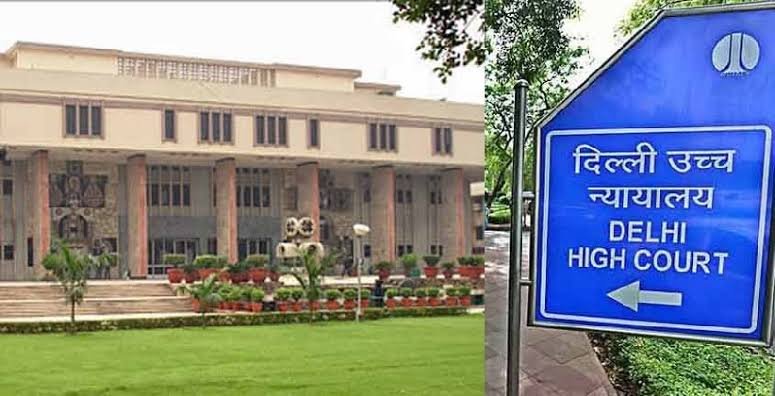
The Delhi High Court has directed the State Bank of India (SBI) to pay ₹1 lakh as compensation to a former employee whose termination was found to be illegal, while setting aside a Labour Court order that had directed his regularisation. The Court held that violation of labour laws does not automatically grant a worker the right to permanent employment.
Justice Shail Jain, hearing the matter as a single judge, observed that the Labour Court had exceeded its jurisdiction by ordering regularisation. The Court clarified that reinstatement and regularisation are separate legal remedies and cannot be considered identical.
Court Finds Employer-Employee Relationship Established
The case was filed by Umed Singh, who claimed that he worked with SBI as a peon from July 1994 to May 1995, although the bank records described him as a water supplier. He alleged that his services were terminated on June 1, 1995, without prior notice or payment of retrenchment compensation.
SBI disputed the claim and argued that Singh was not an employee of the bank. The bank stated that he only supplied drinking water to the branch and was occasionally reimbursed for travel expenses related to delivering official documents.
After examining records, travel vouchers and other evidence, the High Court found that Singh had performed several official duties, including delivering cheques and correspondence, visiting the Reserve Bank of India and other institutions on behalf of the branch, and assisting in the records department during office hours.
The Court held that the evidence showed Singh worked under the supervision and control of the branch manager, establishing an implied employer-employee relationship.
Termination Violated Labour Law Requirements
The High Court observed that Singh had completed more than 240 days of continuous service as defined under Section 25B of the Industrial Disputes Act, 1947. It held that SBI had terminated his services without complying with the mandatory requirements of Section 25F, including notice and statutory retrenchment compensation.
The Court therefore concluded that the termination was illegal. However, it noted that the illegality of termination alone does not create an automatic right to permanent employment.
The Court relied on the Supreme Court’s judgment in Secretary, State of Karnataka v. Umadevi, which held that regularisation cannot be granted where appointments were not made through a recognised recruitment process or against sanctioned posts.
Compensation Granted Instead of Regularisation
The High Court noted that Singh had not specifically sought regularisation as a relief in the industrial dispute and that the dispute had remained pending for more than three decades. Considering that Singh had worked for around 11 months, the Court adopted a practical approach and awarded lump-sum compensation instead of directing permanent employment.
Accordingly, SBI was ordered to pay ₹1 lakh compensation within eight weeks. The Labour Court’s direction for regularisation was set aside.
The ruling reinforces the distinction between relief for illegal termination and entitlement to permanent employment, holding that labour law violations must be addressed within the limits of applicable legal principles.
