

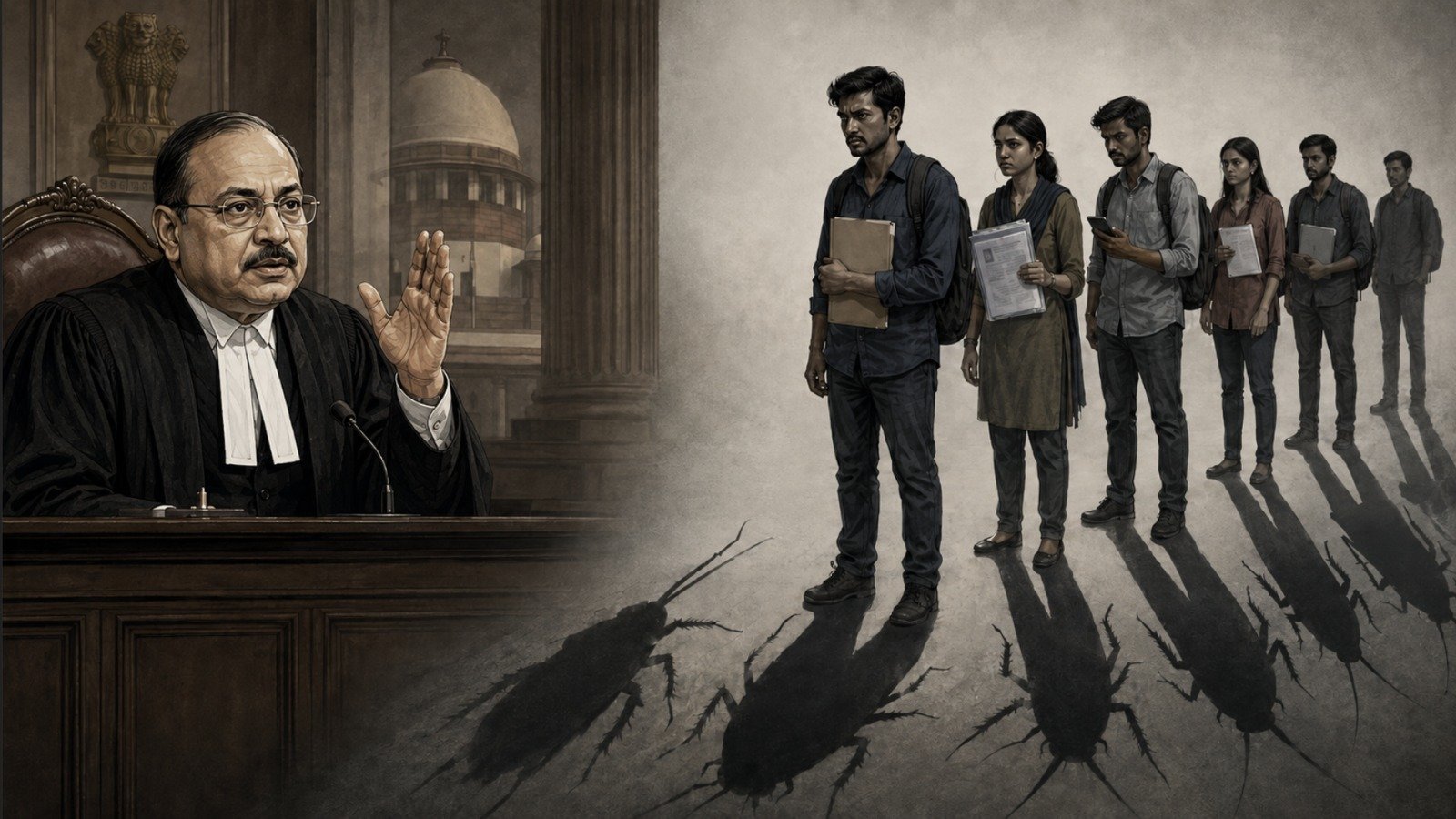

The Supreme Court on Friday delivered an unusually sharp rebuke during a hearing on senior advocate designations, with Chief Justice of India Surya Kant criticizing what he described as growing attacks on the judiciary and the legal system. But the language used in court, including references to “cockroaches” and “parasites,” has itself raised difficult questions about judicial restraint, public criticism and the anxieties of an institution increasingly under scrutiny.
The remarks came from a Bench of CJI Surya Kant and Justice Joymalya Bagchi while hearing a petition filed by advocate Sanjay Dubey. The plea sought contempt action over an alleged delay by the Delhi High Court in implementing Supreme Court guidelines governing the designation of senior advocates.
The Bench refused to entertain the plea. It also strongly disapproved of the petitioner’s conduct, questioning whether senior designation was being pursued as a matter of prestige rather than as a professional distinction conferred by the court.
At one point, the Bench told the petitioner that “the entire world may be eligible to become senior advocate, but at least you are not entitled.” The petitioner later apologized and sought permission to withdraw the plea, which the court allowed.
FCRF’s Flagship Cyber Law Certification Returns With a New Four-Week Cohort
A Hearing on Senior Designation Turns Into a Rebuke
The immediate issue before the court was narrow: whether contempt action should be initiated over the alleged delay in the Delhi High Court’s implementation of guidelines on senior advocate designation.
But the hearing quickly moved beyond procedural delay. The Bench appeared troubled by the petitioner’s conduct, particularly his decision to approach the court in a manner that, in the court’s view, suggested he was actively pursuing a designation that is meant to be conferred, not claimed.
“You are pursuing it. Does it look proper?” the Bench asked, while questioning whether the senior advocate tag was being treated as an ornamental status symbol.
Justice Bagchi also questioned the purpose of the designation, asking whether it was merely a status symbol or a recognition meant to reflect meaningful participation in the justice system.
The court’s frustration appeared to deepen when it referred to language allegedly used by the petitioner on Facebook. The CJI warned that such conduct was inconsistent with the discipline expected from members of the legal profession.
“Let people understand the kind of language you are using on Facebook. I will show you what is the meaning of discipline in the profession,” the CJI said.
The ‘Cockroaches’ Comment and the Language of Institutional Anger
The most striking part of the hearing came when the CJI referred to some unemployed youngsters as “cockroaches,” saying they did not get employment or a place in the profession and then became media, social media, RTI activists or other activists, attacking institutions.
The court also said there were already “parasites” in society attacking the system and asked whether the petitioner wanted to “join hands with them.”
The remarks were plainly intended as a rebuke against what the Bench saw as irresponsible attacks on institutions. But the choice of words is likely to invite scrutiny because criticism of courts, even when uncomfortable or exaggerated, exists within a democratic space where judicial power must coexist with public accountability.
Courts are entitled to protect their dignity. They are also entitled to insist on professional discipline from lawyers. But when criticism of institutions is described through language that appears to sweep in media, social media users, RTI activists and unemployed young people, the distinction between reckless attack and legitimate dissent can become blurred.
That is where the controversy lies. A judiciary that commands constitutional authority does not merely resolve disputes; it models institutional conduct. Its language carries weight beyond the courtroom. Words spoken from the Bench are not ordinary comments. They shape how citizens understand the permissible boundaries of criticism.
Fake Degrees, Black Robes and the Bar’s Accountability Crisis
The hearing also moved into another sensitive area: the presence of lawyers allegedly possessing fake or dubious degrees.
The CJI observed that there were “thousands of fraudulent people wearing black robes” with serious doubts about their degrees, adding that the Central Bureau of Investigation needed to do something. The Bench suggested that the issue of fake law degrees ideally required investigation by the CBI.
The court also expressed skepticism about whether Bar Council bodies would act firmly, observing that they were unlikely to do anything because “they need their votes.”
This part of the hearing points to a genuine and longstanding institutional concern. The legal profession depends on the credibility of those permitted to practice before courts. If persons with fake degrees or dubious credentials are entering the profession, the problem is not merely administrative. It affects litigants, court functioning and public confidence in justice delivery.
But the court’s comments also revealed a deeper frustration with self-regulation in the legal profession. Bar Councils are expected to maintain standards, discipline lawyers and protect the profession from fraudulent entry. If the court believes they are structurally constrained by electoral considerations, that is a serious indictment of the professional regulatory system.
The difficulty is that such concerns require more than courtroom anger. They require verifiable data, institutional inquiry, due process and structural reform. A sweeping observation may capture the problem, but it cannot substitute for a transparent mechanism to identify fraud, protect legitimate lawyers and punish those who entered the profession through deception.
The Thin Line Between Defending Courts and Discouraging Dissent
The hearing ended with the petitioner apologizing and withdrawing the plea. In procedural terms, the matter closed. But the remarks made during the hearing are likely to travel much further.
The judiciary has, in recent years, faced growing criticism from lawyers, activists, litigants, political actors and ordinary citizens on social media. Some of that criticism is informed and necessary. Some is reckless, personalized or abusive. Some is motivated by genuine concern; some by grievance, ideology or publicity.
The challenge for courts is to distinguish between these categories without appearing hostile to scrutiny itself.
A strong judiciary cannot be one that is immune from criticism. Nor can a serious legal system allow its officers to use abusive, reckless or dishonest methods to attack courts. The balance lies in preserving institutional dignity without turning judicial displeasure into a broad denunciation of public questioning.
That balance appeared strained in Friday’s hearing.
The court’s concerns about professional misconduct, status-seeking litigation and fake legal credentials deserve attention. But its broader language about “cockroaches,” “parasites,” activists and social media critics risks shifting the focus from the petitioner’s conduct to the judiciary’s own posture toward criticism.
For an institution that draws its legitimacy from constitutional reason, the central question is not whether courts may rebuke. They can, and sometimes must. The question is whether the language of rebuke strengthens the authority of justice or makes it appear anxious, defensive and intolerant of scrutiny.
In that sense, the hearing was about more than one lawyer’s withdrawn plea. It became a moment that revealed the judiciary’s struggle with a new public sphere, one in which courtrooms no longer speak only to lawyers, but to a country watching, recording, reacting and questioning in real time.
Follow for daily updates on cybercrime, corporate fraud, DFIR, hacking, investigations, and digital forensics
