

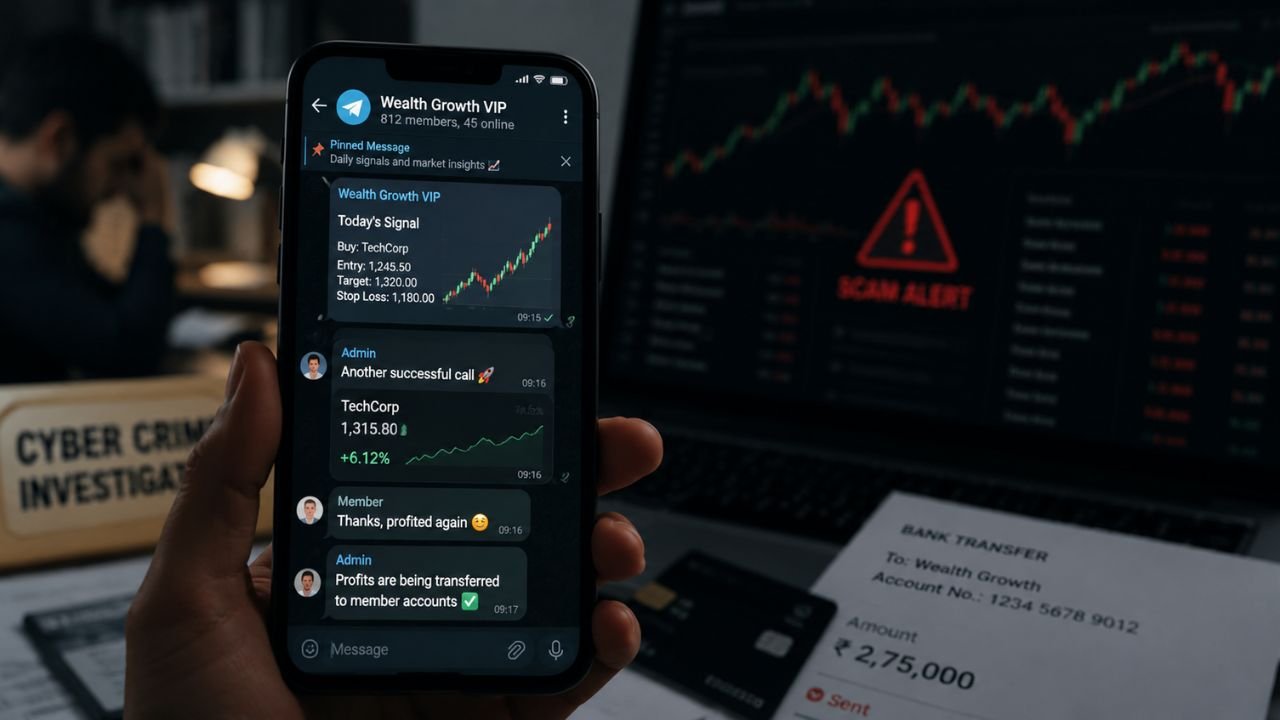

Belagavi | In yet another case highlighting the rising threat of online investment frauds in Karnataka, a college lecturer has allegedly been cheated of nearly ₹14 lakh by cyber criminals operating through a fake investment group on Telegram.
The case involves a 52-year-old lecturer from Davangere, who has filed a complaint with the Cyber, Economic Offences and Narcotics police station. According to the complaint, the victim was added to a Telegram group by unknown individuals, which initially appeared to be a platform discussing stock market investments and trading advice.
FCRF Academy Launches Premier Anti-Money Laundering Certification Program
Within the group, several members posed as experienced traders and financial experts, claiming that investors could earn “guaranteed high returns” through stock trading strategies. To gain trust, the fraudsters shared fabricated profit screenshots, fake charts, and misleading success stories, making the scheme appear legitimate.
Believing these claims, the lecturer began transferring money in multiple installments to various bank accounts shared by the group members. Over time, he allegedly transferred around ₹14 lakh, expecting significant returns on his investment.
However, no profits were credited, nor was the principal amount returned. When the victim started questioning the delays, the accused allegedly began giving excuses and continued pressuring him to invest more, promising even higher returns.
The situation turned suspicious when several members of the Telegram group suddenly disappeared or stopped responding altogether. At this point, the victim realized that he had likely been trapped in a coordinated cyber fraud operation.
He immediately approached the police and lodged a formal complaint. A case has been registered, and an investigation has been launched into the bank accounts and digital transactions used in the scam.
Preliminary findings suggest that the fraud may be part of a larger organized cybercrime network using social engineering techniques to manipulate victims. The modus operandi involves building trust through small gains and fake investment dashboards before extracting large sums of money.
Cybercrime experts note that such groups often use fake identities, edited screenshots, and fabricated trading platforms to create a convincing illusion of legitimate investment activity. In reality, no actual trading takes place, and the entire setup is designed to defraud victims.
In a similar warning, renowned cyber crime expert and former IPS officer Professor Triveni Singh stated that such scams are highly systematic in nature. He said, “Cybercriminals first build trust, then lure victims with small profits, and gradually push them into larger investments. The most dangerous aspect is that victims often realize the fraud only after significant financial loss.”
He further cautioned that terms like “guaranteed returns” are a major red flag in digital investment schemes and should immediately raise suspicion.
Experts also highlight that cyber fraud networks increasingly rely on fake profiles, mule bank accounts, and cross-border digital operations to hide financial trails and avoid detection. These accounts are frequently used to route stolen money across multiple layers, making recovery difficult.
Over the past few years, Karnataka and other parts of India have witnessed a sharp rise in Telegram-based investment scams, particularly those involving stock trading and cryptocurrency-related promises. Fraudsters exploit growing public interest in financial markets to lure unsuspecting individuals.
Authorities suspect that the network involved in this case may be operating across multiple states and could be part of a wider organized cybercrime syndicate. Investigators are currently tracking the financial transactions and digital footprints linked to the fraud.
Police have urged the public to remain cautious while joining any online investment groups and to verify the authenticity of platforms before transferring money. Citizens have also been advised to avoid schemes offering unrealistic or guaranteed returns.
Officials further stressed the importance of immediately reporting suspicious online activities to cybercrime helplines to prevent further losses.
The investigation is ongoing, and authorities are hopeful that analysis of banking transactions and digital evidence will help identify the individuals behind the scam.
