
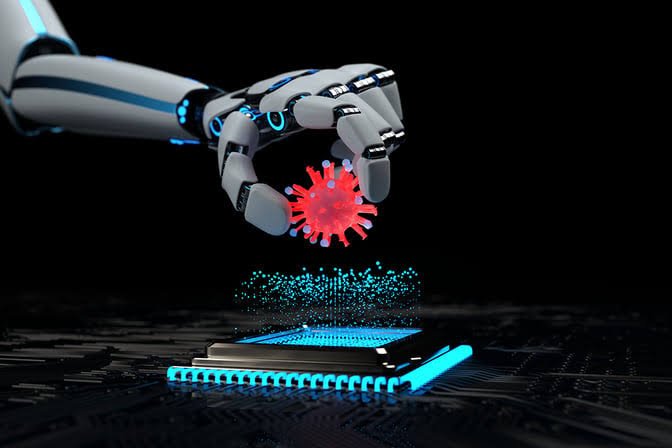

Artificial intelligence is changing how malware is detected, moving antivirus software away from simply asking whether a file has been seen before and towards a harder question: what is this program actually doing?
Traditional antivirus relied heavily on signatures — distinctive patterns taken from known malicious files. If a downloaded file matched something already in the antivirus database, it could be blocked immediately.
That method still works well against known threats.
The problem is that modern malware can change its appearance faster than defenders can create new signatures. AV-TEST says more than 4,50,000 new malware and potentially unwanted application samples are registered every day.
Why old antivirus signatures are no longer enough
A malware signature works much like a fingerprint.
Security researchers analyse a malicious file, identify a distinctive hash or code pattern and add it to a database. Antivirus software then checks files against those known indicators.
Attackers learned to work around that system.
Malware can be repacked, encrypted, padded with irrelevant code or altered slightly so that the file hash changes even though the underlying malicious behaviour remains similar.
MITRE describes polymorphic malware as code capable of changing its runtime or structural footprint to avoid signature-based defences. It specifically notes that machine-learning and behavioural techniques can be more effective than relying only on traditional indicators.
Modern attacks can also avoid dropping an obvious malicious file altogether.
Some abuse legitimate tools already installed on the computer, while others execute scripts or operate largely in memory. That gives a conventional file scanner far less to detect.
AI looks for patterns instead of one known fingerprint
Machine-learning systems approach the problem differently.
Rather than asking whether a file exactly matches known malware, a model can examine multiple characteristics at once.
These may include the structure of the executable, system calls it makes, processes it launches, network connections it opens and how it interacts with other software.
The model then estimates whether the behaviour resembles malicious activity.
That makes it possible to flag a new malware variant even if defenders have never seen that exact file before.
MITRE says modern antimalware can combine signatures, heuristics and behavioural analysis, including monitoring for unusual file encryption, privilege escalation and suspicious network activity.
This is especially useful against ransomware.
A previously unknown ransomware sample may have no recognised signature, but its actions can still look suspicious if it suddenly begins opening hundreds of documents, encrypting files and deleting recovery copies.
The security system can potentially stop the process because of what it is doing rather than because of its name.
Microsoft’s AI agent shows how far detection could go
Microsoft’s Project Ire provides one of the clearest examples of the next stage.
Rather than simply assigning a machine-learning risk score, Ire acts more like an automated malware analyst.
Microsoft says the system can take an unknown binary, reverse-engineer it, examine individual functions and build an evidence chain before reaching a malicious-or-benign verdict.
In June, researchers tested Ire against a LOTUSLITE variant.
When Microsoft obtained the sample on May 28, only one of 72 security vendors listed on VirusTotal detected it. By June 4, seven of 70 were flagging it.
Microsoft said Ire independently analysed the file and concluded that it was malicious by examining its behaviour rather than relying on an existing indicator list.
That does not mean AI has solved malware detection.
But it demonstrates how automation may eventually perform parts of reverse engineering that once required skilled human analysts working manually.
Cloud systems turn millions of devices into shared sensors
Another major shift is happening behind the scenes.
Older antivirus largely analysed files locally on the computer.
Modern endpoint-security products can send hashes, behavioural telemetry and other metadata to cloud systems, where much larger models and threat databases can examine them.
That means suspicious behaviour detected on one computer can potentially help protect another device elsewhere.
The freeCodeCamp analysis describes this as turning protected machines into distributed sensors: endpoint agents collect information such as process launches, file hashes, registry changes and network connections, while cloud systems compare those signals across a much larger population.
This allows security companies to identify clusters that may be invisible on a single computer.
If thousands of unrelated devices suddenly encounter the same unknown process or suspicious domain, that pattern itself becomes valuable intelligence.
AI malware detection can still make mistakes
AI does not eliminate the need for traditional security controls.
One major problem is false positives.
Legitimate software sometimes behaves unusually, and an aggressive detection model can block harmless programs.
Attackers can also deliberately try to confuse machine-learning systems.
The larger cyber arms race is now moving in both directions. Google Threat Intelligence Group said this month that attackers are increasingly moving from basic AI prompting towards agentic workflows and automation, compressing the time defenders have to react.
Google has also reported AI being used in vulnerability exploitation, reconnaissance and malware-development workflows.
That means defenders are using AI against attackers who are increasingly using AI themselves.
For this reason, the strongest security systems still rely on several layers.
Known threats can be caught instantly through signatures. Behaviour monitoring can identify suspicious activity. Machine learning can recognise unfamiliar variants, while human analysts remain necessary for difficult or ambiguous cases.
AI is therefore not replacing antivirus.
It is changing what antivirus means.
What this means for you: Do not judge security software only by whether it advertises “AI protection”. Look for products that combine real-time behaviour monitoring, web and download protection, cloud threat intelligence and regular updates alongside traditional malware scanning.
The420 Insight: The biggest change in malware defence is not that machines have become better at recognising bad files. It is that security systems are learning to recognise bad behaviour even when the file itself has never been seen before — an increasingly important advantage as attackers automate malware creation and constantly change its appearance.
Follow for daily updates on cybercrime, corporate fraud, DFIR, hacking, investigations, and digital forensics
