
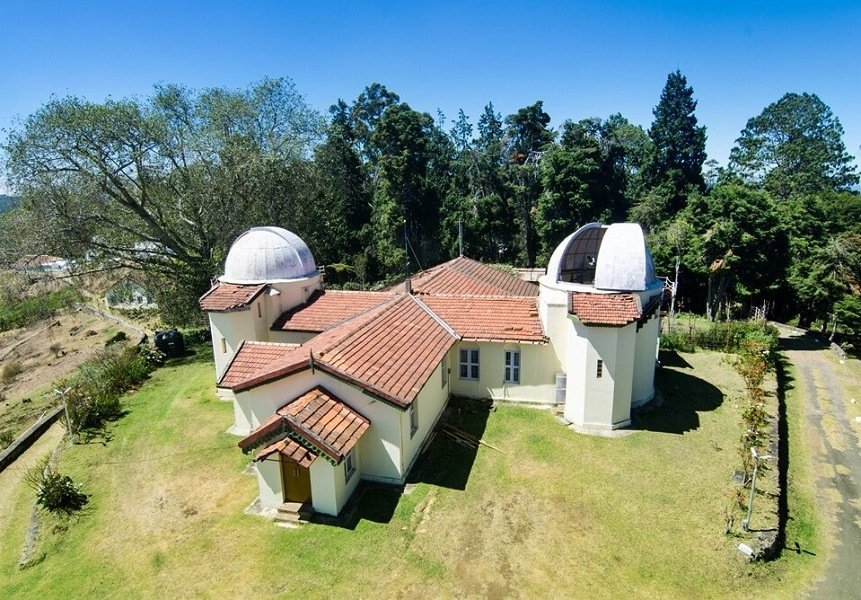

Researchers have used artificial intelligence to analyse more than a century of hand-drawn solar observations from the Kodaikanal Solar Observatory, creating one of the longest continuous records of the Sun’s magnetic activity and offering fresh insights into how solar cycles evolve over time. The study, led by Dibya Kirti Mishra of the Aryabhatta Research Institute of Observational Sciences, an autonomous institute under the Department of Science and Technology, demonstrates how machine learning can transform historical astronomical records into genuinely usable scientific datasets. The research, carried out in collaboration with the Indian Institute of Space Science and Technology, the Southwest Research Institute in the United States, and the Indian Institute of Astrophysics, has been published in The Astrophysical Journal.
The underlying problem the study addresses is a familiar one in long-term scientific observation: the Sun’s magnetic activity follows periodic cycles that influence sunspots, solar flares, and eruptions, phenomena capable of affecting satellites, navigation systems, communication networks, and power grids on Earth. Yet long-term studies of these cycles have historically been limited by incomplete or inconsistent historical observations, a gap that becomes particularly acute the further back in time researchers try to look.
Teaching a Machine to Read a Century of Sunspots
To address this, the researchers applied a U-Net-based supervised machine learning model to digitised versions of the observatory’s hand-drawn “suncharts,” daily solar observation records spanning from 1904 to 2022 that document sunspots, plages, filaments, and prominences. The AI model first identified the Sun’s disc in each scanned image, accurately determining its centre, size, and orientation, before automatically detecting and mapping plages, the bright, magnetically active regions on the Sun, across observations spanning 1916 to 2007, covering nine full solar cycles.
Using this extracted data, researchers generated a time-latitude “butterfly diagram,” a visualisation that illustrates how solar magnetic activity migrates across different latitudes during successive solar cycles. Kodaikanal’s archive is scientifically significant precisely because of its unusual consistency. The observatory’s century-long record, gathered under the same experimental conditions across a hundred years, is a feat that very few observation sites anywhere in the world have matched, making it an unusually valuable dataset once its handwritten inconsistencies can be reliably standardised.
The study found that the plage patterns identified from the hand-drawn charts closely matched observations derived from the observatory’s separate Ca II K solar images, an independent dataset, confirming the reliability of the historical hand-drawn records and validating the AI model’s outputs against a known scientific benchmark.
Why a Fragile Paper Archive Matters for Modern Space Weather
The broader significance of this work lies in what it makes possible going forward. According to the Department of Science and Technology, converting these century-old drawings into machine-readable data will help bridge historical observations with modern space-age measurements, enabling scientists to better understand long-term changes in the Sun’s magnetic behaviour. Long-term records of solar magnetic activity of this kind are essential not merely for historical interest, but for improving predictive models of the Sun’s behaviour, reconstructing past solar activity with greater precision, and enhancing understanding of space weather, which carries direct and growing implications for satellite operations, communication systems, and critical infrastructure on Earth.
This is not the first attempt to extract scientific value from the Kodaikanal archive. Prior research using the observatory’s Ca II K photographic archive, covering the same 1904 to 2007 period, has previously reconstructed butterfly diagrams and studied phenomena such as the north-south asymmetry of solar activity, finding that the northern hemisphere dominated plage areas during certain solar cycles while the southern hemisphere dominated during others. What distinguishes the present AI-driven study is its ability to draw equivalent, validated data directly from the hand-drawn suncharts, a format long considered too inconsistent in drawing style, aging paper condition, and scan quality to be reliably machine-processed at this scale.
Preserving Scientific Heritage Through Machine Learning
The study’s authors and the Department of Science and Technology both point to a wider methodological lesson beyond solar physics itself. The research highlights the potential of artificial intelligence to preserve and analyse historical scientific archives that were previously difficult to use because of variations in drawing styles, ageing paper, and inconsistent scan quality, a challenge that extends well beyond astronomy to any field sitting on decades or centuries of pre-digital observational records.
For India’s scientific institutions, many of which maintain observational archives stretching back over a century across disciplines ranging from meteorology to seismology, the Kodaikanal study offers a working template for how AI can unlock scientific value that has, until now, remained effectively inaccessible, trapped in paper records too inconsistent for traditional digitisation methods to reliably interpret. As solar activity continues to shape the risks facing an increasingly satellite-dependent and digitally connected world, the ability to draw on a fuller, machine-readable century of solar history gives scientists a considerably longer baseline against which to understand what comes next.
Follow for daily updates on cybercrime, corporate fraud, DFIR, hacking, investigations, and digital forensics
