
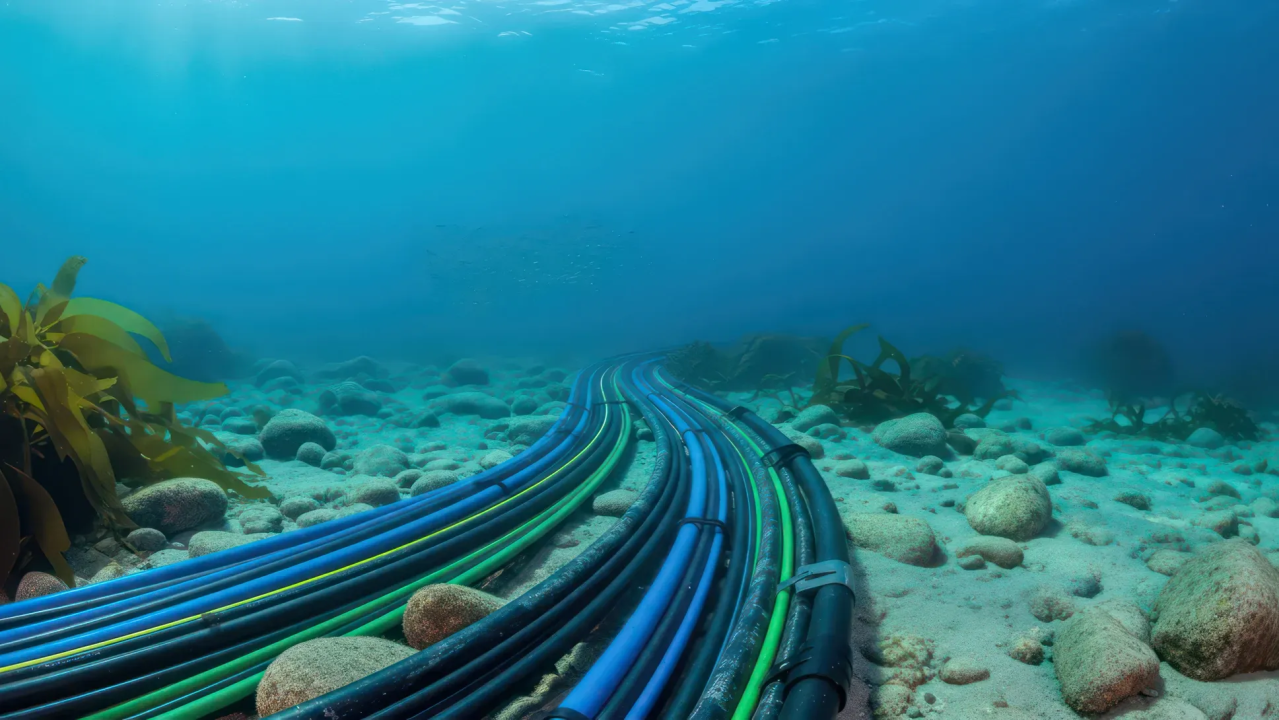

The language used by officials to describe undersea infrastructure has changed markedly. “The seabed is a battlefield,” Australia’s defence minister told a room full of admirals and generals in Singapore at the end of May, citing several subsea cables that have been cut in the Baltic Sea and around Taiwan in recent years. He joined sixteen counterparts in announcing plans to protect what was described as the submarine tendrils of the digital world, the nearly 700 communications cables that mostly lie exposed on the floor of the world’s oceans.
Governments and armed forces across Asia have only recently woken up to the strategic weight of this infrastructure. Definitive evidence of sabotage behind the recent cable cuts remains absent, but the underlying vulnerability of these arteries of commerce is real. And the private firms that build and operate nearly all the world’s subsea cables are not waiting for governments to secure them. They are already rerouting around Asia’s most contested waters on their own.
A New Geography Designed to Avoid Trouble
For decades, fibre-optic cables connecting Asia and Australia to Europe tended to hug the coastlines of the Asian continent before heading up the Red Sea. That pattern is now being overturned. A combination of the AI boom and geopolitics is rerouting cable traffic across the Indian and Pacific oceans, a new geography designed specifically to avoid chokepoints like the Strait of Malacca and contested waters like the South China Sea. Much of this new infrastructure bypasses South-East Asia entirely, running instead from the Middle East and India to Australia and onward through the Pacific Islands to America.
The first cable to follow this new route was laid in 2022 between Oman and Australia, with spurs to the Anglo-American military base at Diego Garcia and the Cocos Islands, a small Australian territory in the Indian Ocean. Last year, Google announced that Christmas Island, another Australian territory in the Indian Ocean, would become a hub for a new cable network linking Australia and the Middle East, running fibre from Oman via the Maldives to Christmas Island before continuing to Australia. Meta’s $10 billion Project Waterworth, a global cable network still under development, looks set to follow a similar course through the Indian Ocean.
Who Pays Has Changed, and So Has the Map
The shift is rooted partly in economics. Subsea cables are expensive, and for most of the last few decades, large national telecoms firms formed consortia to share the cost. One of the first major fibre-optic cables linking Europe and Asia, SEA-ME-WE 3, came online in 1999 at a cost of $1.3 billion and involved 92 consortium partners. Financing and planning a cable among so many firms tended to inflate costs and delay construction, and once a project was funded, the sheer number of partners tended to pull the route close to the Asian continent, where most of the customers were located.
The AI boom has scrambled that economics entirely. Over the past decade, internet giants have begun financing and building cables single-handedly, simplifying fundraising and cutting the lead time for new projects considerably. Google invested in its first cable in 2008 and has since funded at least 34 more, 18 of which it owns without partners. Increasingly, firms like Meta, Google and Microsoft are building cables not to connect population centres but to connect their own data centres directly to one another.
The scale of this build-out is substantial. By one estimate, the next four years will see an average of $4 billion a year in new cable investment, the bulk of it from hyperscalers seeking to win the AI race. While satellite internet services such as Starlink are becoming cheaper, beaming each gigabyte of data into space remains orders of magnitude more expensive than pushing light down a cable, a gap likely to persist for years. As a result, subsea cables still carry 99% of the world’s intercontinental internet traffic.
Navigating Around China and Its Neighbours
As the subsea cable market consolidates vertically among a handful of dominant firms, it is also expanding geographically. Freed from the old necessity of staying close to population centres, ships are laying cables across open ocean more than ever before, with routes deliberately drawn to avoid seabed governed either by China or by governments inclined to extract payment for laying or repairing cables across a chokepoint, such as the Indonesian straits.
This geopolitical risk is most acute in the South China Sea, where China has yet to establish full control of the surface but exercises de facto sovereignty over the seabed. Under international law, states are not meant to interfere with repairs to cables outside their territorial waters. But repairs to any cable within China’s so-called nine-dash line, which stretches over a thousand kilometres from its coast and which Beijing claims as the extent of its waters, require approval from officials in Beijing.
Cables transiting through chokepoints like the Strait of Malacca face comparable risks, according to Samuel Bashfield, who studies subsea cables at La Trobe University in Australia. Constantly shifting rules set by littoral states such as Malaysia and Indonesia, including requirements to use local ships, are designed to extract value from cable operations and can prove costly and disruptive. Recent comments from Indonesia’s cash-strapped president and finance minister about monetising the country’s position astride some of the world’s great sea lanes suggest more aggressive measures could be on the horizon.
To avoid these risks, internet traffic is increasingly routed around them altogether. Google and Meta’s new networks instead run from the Middle East through Australia and onward to Japan and South Korea or America. In the Pacific, cables increasingly use Guam as a hub to connect American allies across Asia. These new routes form part of an increasingly bifurcated internet infrastructure beneath the waves. No new cable directly linking America and China has been approved since Barack Obama was in office.
Follow for daily updates on cybercrime, corporate fraud, DFIR, hacking, investigations, and digital forensics
