
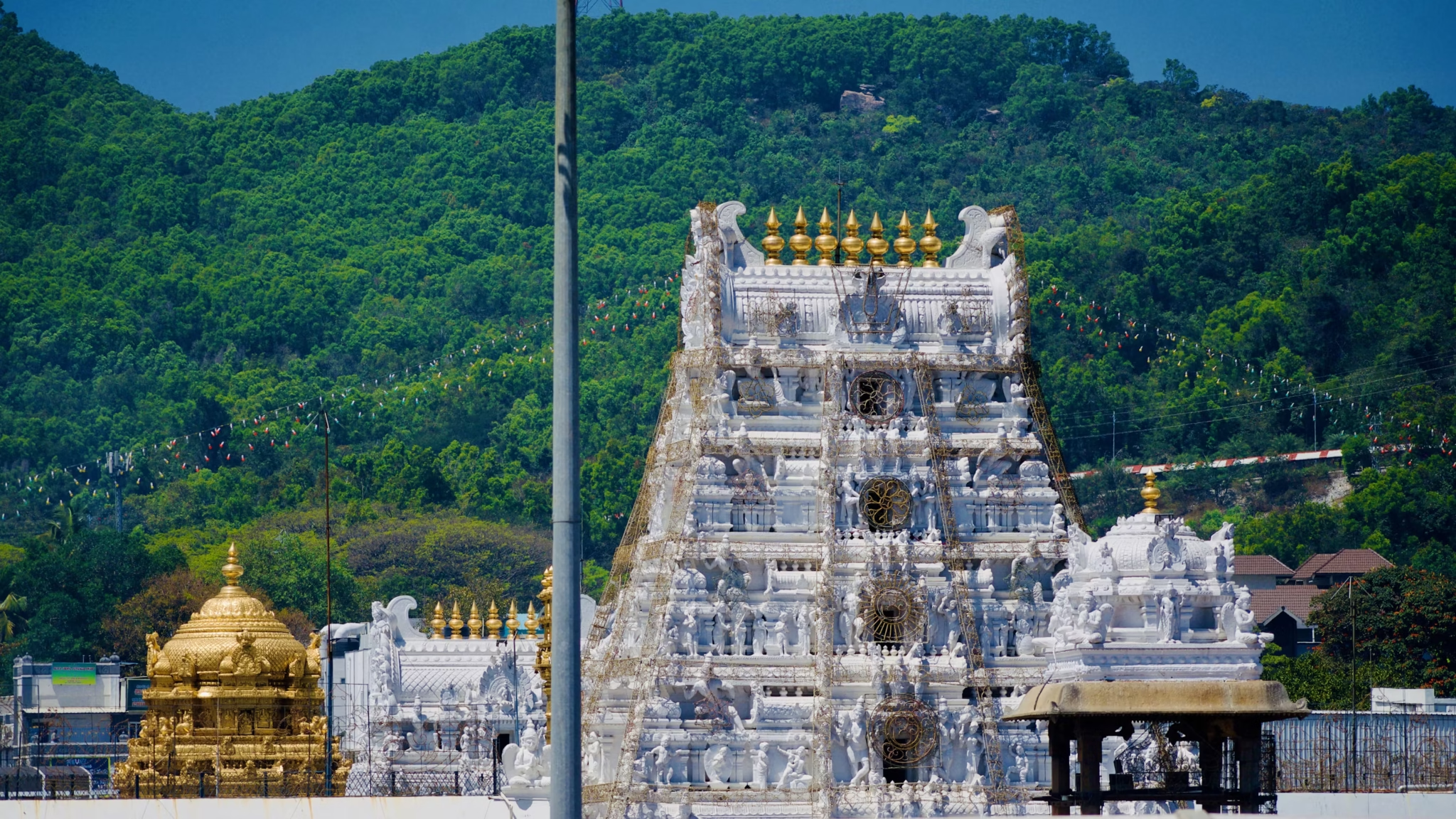

The Srisailam Temple administration is preparing to introduce an artificial intelligence-based darshan management system alongside a world-class queue-lines complex, with the explicit aim of ensuring devotees receive darshan of Lord Mallikarjuna Swamy and Goddess Bhramaramba Devi within 45 minutes. The centrepiece of the project is a state-of-the-art queue complex modelled directly on the Tirumala Tirupati Devasthanams system, a precedent temple officials believe will revolutionise crowd management and enhance the overall pilgrimage experience.
The facility, as outlined by temple authorities, will include modern amenities, streamlined entry and exit points, advanced surveillance, waiting halls, and AI-enabled monitoring to regulate the movement of pilgrims. Temple Trust Board Chairman P Ramesh Naidu said a preliminary survey for the complex has already been completed, with the project estimated to cost Rs 145 crore. The administration aims to finish the tender process and hold the groundbreaking ceremony by August, with the project expected to be completed within 18 months, after which the AI-based darshan system will be implemented.
The Scale of the Problem the System Must Solve
The urgency behind the project becomes clear when set against current conditions at the shrine. Devotees currently spend two to three hours in queues at Srisailam. The temple accommodates roughly 6,000 devotees per hour on normal days and nearly 8,600 during festivals. Under the new system, officials expect to maintain a steady flow of 7,000 devotees per hour while substantially reducing waiting time.
Naidu also announced changes to Sparsha Darshan on high-rush days such as Saturdays, Sundays, and Mondays, aiming to facilitate darshan for at least 20,000 general devotees between 5:30 am and 8:30 am. Temple Executive Officer M Srinivasa Rao framed the underlying philosophy succinctly, stating that no devotee should stand still in queue lines and that pilgrim movement should remain continuous while still ensuring a satisfying darshan experience. The administration has also proposed Pilgrim Amenities Complexes at Dornala and Hatakeswaram, extending the upgrade beyond the main temple precinct itself.
Tirumala’s Track Record Offers a Working Template
Srisailam’s decision to model its system on Tirumala is significant because the reference point is not theoretical. Tirumala Tirupati Devasthanams has already deployed an AI-driven Integrated Command and Control Centre equipped with over 300 CCTV cameras and 42 facial-recognition units, delivering real-time three-dimensional visualisation of pilgrim flow that flags congestion instantly, turning zones red when numbers exceed 500 and enabling rapid staff redeployment and queue rerouting.
The results during peak periods have been notable. During the Vaikuntha Ekadasi festivities at Tirumala, the technology kept darshan waits between 1.5 and four hours despite record turnout exceeding 67,000 devotees on a single day, with no stampedes, overcrowding, or disruptions reported. Union Minister Piyush Goyal, after visiting Tirumala’s Integrated Command Centre, described the system as a model example of how technology can be used effectively in religious tourism, noting that it has brought remarkable efficiency in crowd management, queue monitoring, and overall darshan scheduling.
TTD’s broader ambitions for the technology extend further still. The temple administration has set a goal of reducing waiting times that have historically stretched to twenty or thirty hours during peak periods down to just two to three hours, through a multi-layered AI architecture that aggregates data from surveillance cameras, RFID trackers and ticketing systems to predict surges and recommend optimal scheduling in real time.
What This Signals for Temple Management in India
The Srisailam project reflects a wider pattern emerging across major Indian pilgrimage sites, where AI-driven crowd management is increasingly being treated not as an experimental add-on but as essential public safety infrastructure. With millions of devotees converging on a small number of temple towns each year, often during compressed festival windows, the consequences of poor crowd management can be severe, ranging from prolonged devotee discomfort to genuine stampede risk.
By explicitly adopting Tirumala’s template rather than building a system from scratch, Srisailam’s administration is opting for a tested approach over an experimental one, a choice likely to shorten both the development timeline and the margin for error. Whether the system can replicate Tirumala’s results at Srisailam’s own scale will become clear once the queue complex is operational, but the underlying direction is now unmistakable: India’s most visited religious sites are increasingly being run with the same data-driven discipline once reserved for airports and metro systems.
Follow for daily updates on cybercrime, corporate fraud, DFIR, hacking, investigations, and digital forensics
