
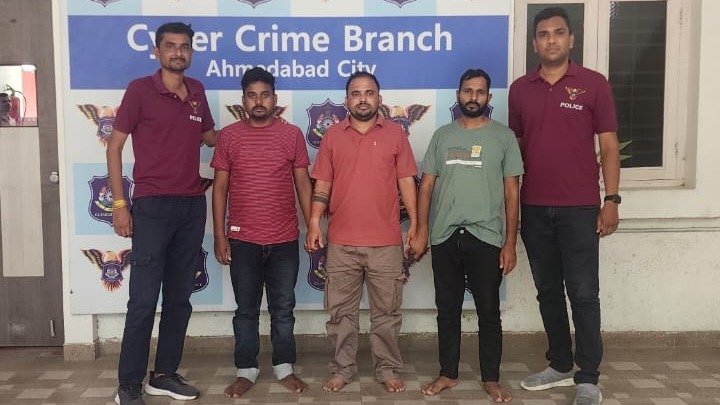

For years, the rugged terrains of Jamtara in Jharkhand have operated as the undisputed capital of Indian phishing operations. But as the country’s digital banking infrastructure has fortified its defenses, the syndicates operating out of these remote villages have quietly evolved, trading crude social engineering tricks for sophisticated, silent malware deployments.
A major breakthrough against this modern criminal enterprise came to a dramatic climax this week. In an operation that felt more like a cinematic thriller than a standard digital investigation, the Ahmedabad Cyber Crime Cell tracked and intercepted a speeding transit vehicle to arrest Poornanad Tiwari, the mastermind of a multi-state Android Package (APK) file fraud ring, directly from a moving train.
The high-pressure capture marks a critical structural victory for local enforcement agencies struggling to contain a massive surge in automated mobile banking thefts across western India. It also highlights a fundamental shift in how local cybercriminals weaponize technology. Investigators note that Tiwari’s gang had moved entirely away from traditional phone scams—where operators clumsily call victims pretending to update bank Know Your Customer (KYC) details—and transitioned instead into malicious software deployment.
The mechanical flow of Tiwari’s APK fraud campaign relied heavily on exploiting daily human trust and urgency. Victims typically received text alerts or WhatsApp messages mimicking official updates from utility providers, state transport bodies (RTOs), or central courier agencies. The message instructed the user to download a small utility file—an unverified APK—to resolve a fictional billing or delivery issue.
Once installed on a victim’s smartphone, the application remained entirely hidden from view, silently operating in the background. The malware immediately harvested broad system permissions, giving Tiwari’s remote operators absolute control over the device’s messaging system. When the victim attempted a routine financial transaction, the backend operators instantly intercepted banking One-Time Passwords (OTPs), allowing the syndicate to siphon out life savings before the user realized their security had been compromised.
“This is a highly tactical evolution of the traditional Jamtara playbook,” an official from the Ahmedabad Cyber Crime Cell explained during an intelligence briefing. He stressed that by using malicious APKs, syndicates no longer need to manipulate the victim during a live phone conversation; the software autonomously handles the theft.
The geographic footprint of the gang reflects the deeply decentralized nature of contemporary Indian cybercrime. While Tiwari orchestrated the digital operations and server payloads out of Jharkhand, the financial damage spanned across multiple states, with Gujarat emerging as a high-density target area over the last quarter.
Tracking down Tiwari required investigators to reverse-engineer the malware’s command-and-control infrastructure. Once a precise physical identity was established, the Ahmedabad team realized their target was actively fleeing across state borders via the regional rail network. Utilizing real-time cellular tower triangulation and local railway police coordinates, the tactical team successfully boarded the train to execute the arrest.
For Indian smartphone users, this arrest serves as a sobering reminder of the changing threat perimeter. As mobile banking becomes the default economic standard across tier-1 and tier-2 cities, the responsibility of defense is shifting onto the consumer. Security cells are issuing nationwide warnings urging citizens to never side-load unverified software applications outside of official platforms like the Google Play Store, as a single unauthorized click can completely hand over personal financial sovereignty to a remote criminal terminal.
Follow for daily updates on cybercrime, corporate fraud, DFIR, hacking, investigations, and digital forensics
