

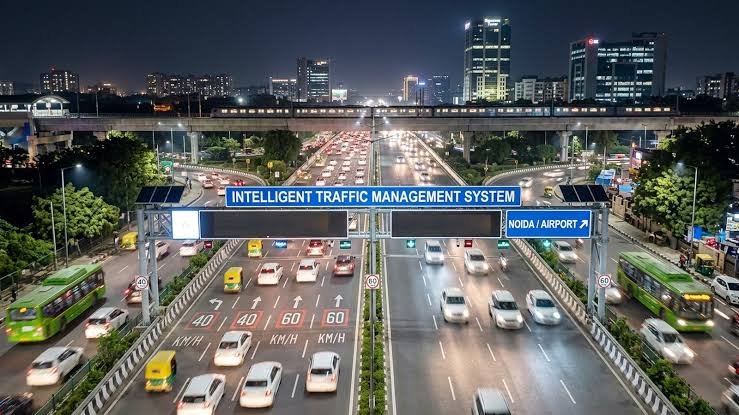

New Delhi: The Union Cabinet has approved a ₹1,789.52 crore artificial intelligence-enabled traffic management system for Delhi, introducing automated traffic enforcement, intelligent signals and real-time vehicle monitoring across 42 major traffic corridors.
The Cabinet Committee on Economic Affairs approved the project on September 30, 2026. It will be implemented by Delhi Police in three phases over 24 months, followed by five years of operation and maintenance.
The system will cover 1,092 adaptive traffic signal locations and 1,029 traffic enforcement locations. It is intended to improve traffic movement, detect violations automatically and give ambulances priority at congested intersections.
The announcement formed part of three Cabinet decisions, which also included a ₹1.86 lakh crore renewable energy infrastructure programme and increased minimum support prices for six Rabi crops.
FCRF Launches CP-FRM to Build India’s Next Generation of Fraud Risk Professionals
AI-Based Traffic Signals to Replace Fixed Timing Systems
Delhi’s existing traffic management relies heavily on fixed signal timings and manual intervention. The government says the system has become increasingly difficult to manage as the number of vehicles continues to grow.
According to official figures, Delhi has approximately 71 lakh active registered vehicles. Road infrastructure has not expanded at the same pace as vehicle registrations.
The newly approved Intelligent Traffic Management System (ITMS) will use artificial intelligence and real-time information to adjust traffic signals according to actual road conditions.
Unlike conventional signals that operate on predetermined timings, adaptive signals can respond to changing traffic volumes.
For example, if one road experiences heavy congestion while another has relatively little traffic, the system can adjust signal timings to manage vehicle movement more efficiently.
The technology will also coordinate traffic signals along designated corridors to reduce unnecessary stoppages.
Union Minister Ashwini Vaishnaw said the new system would introduce greater intelligence into Delhi’s existing traffic management infrastructure.
However, the government has not released estimates showing precisely how much the project will reduce average travel times or congestion.
AI Cameras to Detect Traffic Violations and Identify Suspect Vehicles
Beyond managing traffic signals, the project will introduce technology-based monitoring and automated enforcement.
The government plans to establish 1,029 enforcement locations equipped with systems capable of identifying several types of traffic violations.
These include speeding, jumping red lights, crossing stop lines, driving in the wrong direction, illegal parking and driving without helmets or seat belts.
The system will also monitor the use of mobile phones while driving.
Artificial intelligence-based video analysis will help authorities identify vehicles associated with repeated violations, hit-and-run incidents and police watchlists.
Instead of relying entirely on traffic personnel stationed at individual intersections, the system will allow information from different locations to be processed through a common platform.
Traffic Command and Control Centres will integrate monitoring, enforcement and the distribution of traffic information.
The project will also include dedicated data centre and disaster recovery infrastructure to support its operations.
However, the government has not provided detailed public information about video retention periods, access restrictions or the safeguards that will govern the handling of information collected through the proposed system.
These aspects will be relevant as Delhi expands the use of automated traffic monitoring.
Ambulances to Receive Priority Through Intelligent Green Corridors
Emergency vehicle movement is another important component of the project.
The system is designed to provide priority movement for ambulances and other emergency vehicles by coordinating traffic signals along designated routes.
For instance, traffic signals could be adjusted to help an ambulance move through congested intersections without repeatedly stopping.
The technology will also support faster identification of traffic congestion, accidents and other road incidents.
Delhi Police will receive real-time information to assist with diversions and emergency responses.
For ordinary commuters, the system will display information about traffic conditions, diversions, parking availability and congestion through electronic message boards and digital platforms.
The government has also proposed sharing relevant information with navigation service providers.
This could allow commuters to receive more timely information about road conditions while planning their journeys.
The extent of these benefits will depend on how effectively the system is deployed and integrated with existing infrastructure.
Delhi Police to Implement Project With C-DAC Support
Delhi Police will implement the project through a Master System Integrator selected through competitive bidding.
The Centre for Development of Advanced Computing (C-DAC) will provide technical assistance as the project’s management consultant.
Its responsibilities will include technical scrutiny, monitoring, validation and acceptance during implementation.
The project will be introduced across 42 identified corridors in three phases.
Each subsequent phase will proceed following an evaluation of the previous phase against specified performance and acceptance requirements.
The government expects implementation to take 24 months, followed by a five-year maintenance period.
The September 30 approval authorises the project. It does not mean the proposed AI monitoring infrastructure is already operational.
Cabinet Also Clears ₹1.86 Lakh Crore Renewable Energy Programme
Alongside the Delhi traffic project, the Cabinet approved Green Energy Corridor Phase-III, with a total estimated outlay of ₹1,86,405 crore.
The programme will strengthen electricity transmission infrastructure to support the integration of up to 135 gigawatts of renewable energy.
It also includes ₹50,000 crore for battery storage systems with a combined capacity of 50 gigawatt-hours.
Separately, the Cabinet approved higher minimum support prices for six Rabi crops for the 2027–28 marketing season.
The revised MSP for wheat has been fixed at ₹2,610 per quintal, while safflower received the largest absolute increase of ₹675 per quintal.
Together, the three decisions cover agricultural pricing, renewable energy infrastructure and technology-based urban traffic management.
What this means for you
Delhi commuters could eventually benefit from signals that respond to actual traffic conditions, quicker emergency vehicle movement and real-time congestion alerts. Drivers should also expect greater automated enforcement as the system is deployed, although the government has not yet announced when individual corridors will become operational.
Follow for daily updates on cybercrime, corporate fraud, DFIR, hacking, investigations, and digital forensics
