
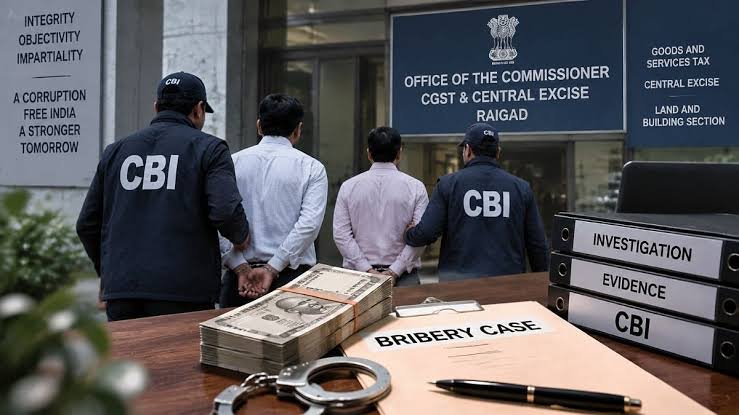

The Central Bureau of Investigation has arrested a CGST superintendent and a consultant after an alleged ₹1 crore bribe demand linked to the redevelopment of government-owned flats in New Panvel, Maharashtra.
The accused have been identified as Pankaj Kumar alias Pankaj Rajput, Superintendent in the Land and Building Section of the CGST and Central Excise Raigad Commissionerate, and consultant Prasad Kumar Swami. The CBI registered the case on September 9 following a complaint from the project head of a private real-estate company.
Proposal for Conducting Cyber Crisis Drill, Tabletop Exercise (TTEx) & CCMP Readiness Exercise
₹1 crore allegedly sought for NOC and handover of flats
The company was redeveloping two buildings in Sector 17 of New Panvel that included 24 flats belonging to the CGST and Central Excise Raigad Commissionerate.
According to the complaint, Kumar allegedly demanded ₹1 crore for issuing a no-objection certificate and facilitating the handover of those flats for redevelopment.
The alleged demand was not meant to be paid in one instalment.
During verification of the complaint, CBI officials said Kumar allegedly sought ₹10 lakh in cash immediately, another ₹20 lakh as the down payment for a flat he was purchasing, and ₹70 lakh at a later stage.
The agency said the ₹70 lakh was allegedly described as money meant for other officers of the Directorate General of Human Resource Development, CGST, in New Delhi.
That allegation is now part of the investigation. There is no finding yet establishing wrongdoing by any unnamed DG HRD officer.
CBI trap focused on first ₹10 lakh payment
The CBI laid a trap on September 10 after Kumar allegedly instructed the complainant to hand over the initial ₹10 lakh to consultant Prasad Kumar Swami.
Swami was allegedly present to receive the money when the operation was carried out. Both men were arrested the same day.
They were produced before the competent court on September 11 and remanded to two days of CBI custody.
The distinction between the alleged ₹1 crore demand and the trap amount is important.
The investigation concerns an alleged demand totalling ₹1 crore, while the transaction at the centre of the trap involved ₹10 lakh.
Why an NOC can become a corruption pressure point
A no-objection certificate may sound like routine paperwork, but in redevelopment projects it can become essential before property can be handed over or work can proceed.
Where a government department owns flats or other property inside a redevelopment project, the developer may need formal departmental clearance before taking possession or beginning certain stages of construction.
That gives the official responsible for processing or issuing the clearance substantial administrative influence.
The allegation in this case is that such authority was used to seek money in exchange for a clearance that should have been decided through the official process.
This is exactly why corruption investigations often focus on discretionary approvals, licences, certificates and permissions.
Delays in these processes can impose large financial costs on businesses, making them vulnerable to demands for illegal payments.
Flat down payment allegedly formed part of the bribe structure
One unusual feature of the case is the alleged ₹20 lakh component.
The CBI says Kumar allegedly wanted that amount paid towards the down payment of a flat he was purchasing.
If proved, such an arrangement would show how a bribe need not always be handed over as cash directly to a public servant.
An illegal gratification can allegedly be structured as a payment towards a personal asset, payment to a third party, transfer through an intermediary or some other financial benefit.
Investigators will therefore examine payment instructions, property records, communications and the financial relationship between the accused and the consultant.
Role of consultant could become important
Swami’s alleged involvement also raises questions about the use of intermediaries.
Consultants and middlemen may have legitimate roles in helping businesses navigate complex government processes.
But when an intermediary is allegedly used to collect money linked to an official favour, investigators must establish whether the consultant was merely present, knowingly acted as a conduit or played a larger role in arranging the transaction.
The CBI’s decision to arrest both men suggests investigators believe there was sufficient prima facie material to examine their roles together.
The final determination, however, will depend on evidence and court proceedings.
Investigation may expand beyond the two arrested men
The reference to ₹70 lakh allegedly meant for other CGST officers could broaden the case.
For now, that remains an allegation attributed to the accused superintendent during the CBI’s verification process.
Investigators are likely to examine call records, chats, financial documents and any communications with officials connected to the redevelopment approval.
They may also look at whether similar demands were made in other cases handled by the same office.
No other officer has so far been reported as arrested in this case.
That distinction matters because naming an entire department or suggesting a wider conspiracy would go beyond the available evidence.
The present case is against the arrested superintendent and consultant, with any wider nexus still under investigation.
What this means for you: Businesses facing an illegal demand from a public official should preserve messages, payment instructions and related documents rather than negotiating privately. Such evidence can become crucial if an anti-corruption agency verifies the complaint and conducts a trap.
The420 Insight: The alleged ₹1 crore demand shows how corruption can be embedded inside an otherwise ordinary administrative step. A single NOC can become a powerful pressure point when a project cannot move forward without it, making transparency around approvals as important as the anti-bribery law itself.
Follow for daily updates on cybercrime, corporate fraud, DFIR, hacking, investigations, and digital forensics
