
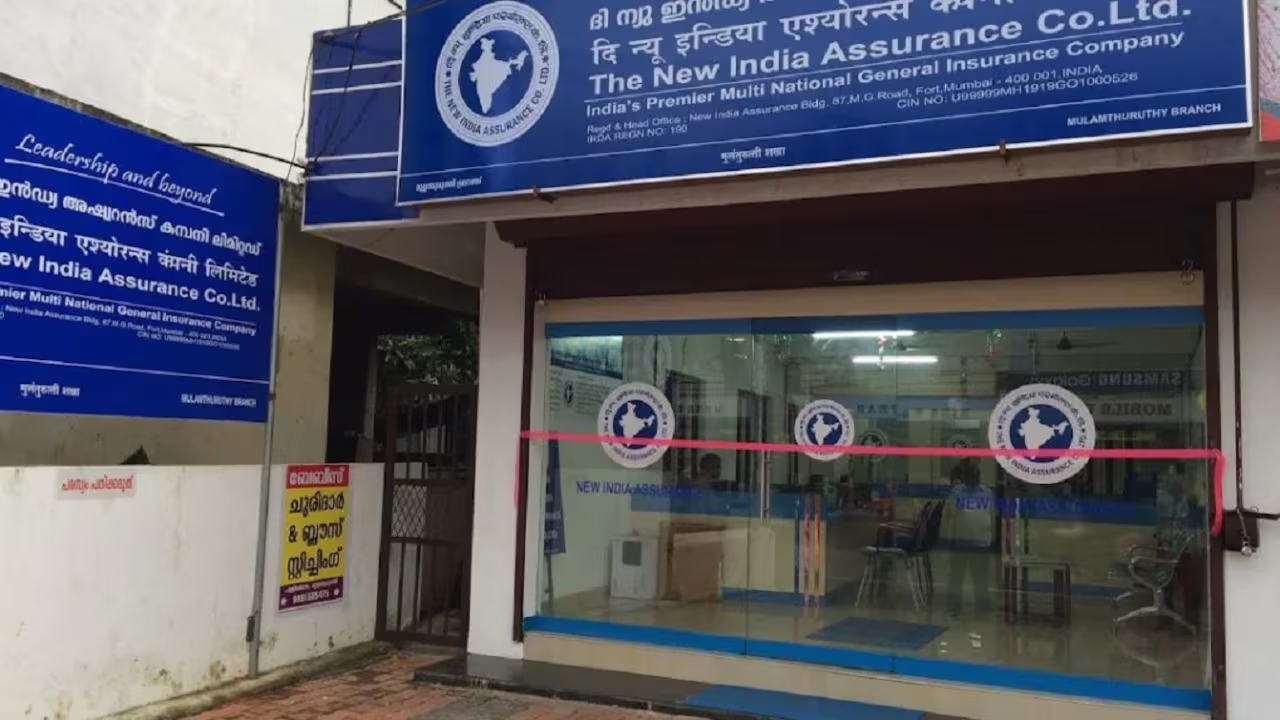

A Mumbai consumer commission has ordered New India Assurance Company to pay more than ₹8.06 crore to Victorinox India after holding that the insurer unfairly rejected a fire insurance claim on technical grounds.
The dispute stretches back more than seven years to a major fire at Victorinox India’s customs bonded warehouse in February 2019.
The District Consumer Disputes Redressal Commission, South Mumbai, held in its September 2 order that the insurer’s rejection could not be sustained when its own surveyor had already assessed the company’s loss at ₹8,06,49,573.
The insurer has also been directed to pay 9% interest from the date the consumer complaint was filed, along with ₹50,000 for mental distress and another ₹50,000 towards litigation expenses.
Fire destroyed goods at bonded warehouse
Victorinox India Pvt Ltd is the Indian subsidiary of Switzerland-based Victorinox AG, known for products including knives, watches, travel gear and cutlery.
The Indian company had obtained a Standard Fire and Special Perils Policy from New India Assurance.
On February 16, 2019, a fire broke out at its customs bonded warehouse.
A customs bonded warehouse is a regulated facility where imported goods can be stored before customs duty and other formalities are completed.
According to the complaint, employees initially attempted to control the blaze before assistance was sought from the Jawaharlal Nehru Port Trust Fire Services.
Despite those efforts, the fire caused extensive damage to goods stored inside the warehouse.
New India Assurance subsequently appointed a surveyor to inspect the site and calculate the loss.
The surveyor assessed the net damage at ₹8,06,49,573.
That assessment eventually became one of the most important facts in the consumer commission’s decision.
Insurer rejected claim nearly two years later
New India Assurance repudiated the claim in January 2021.
The rejection was linked to alleged non-compliance with policy requirements concerning certain internal agreements and invoices.
Victorinox India challenged that reasoning.
The company maintained that it had repeatedly supplied documents sought during the claims process and participated in virtual meetings to address queries raised by the surveyor.
The consumer commission examined email correspondence between the parties and found that Victorinox had provided documents and cooperated with the investigation.
It also noted that the insurer-appointed surveyor had already inspected the loss and arrived at a final figure.
The panel therefore questioned why a claim whose underlying fire loss had already been assessed was later rejected entirely on procedural grounds.
Commission calls rejection legally unsustainable
The commission held that procedural non-compliance alone could not justify repudiating the entire claim in the circumstances before it.
It found that there was no substantive dispute over the occurrence of the fire or the amount assessed by the insurer’s surveyor.
The commission concluded that the insurer had adopted an unfair trade practice and was deficient in providing service to Victorinox India.
The ruling does not mean that policyholders can ignore documentation requirements.
Insurance companies are entitled to seek documents necessary to establish the cause and extent of a loss.
The narrower finding in this case was that the procedural objections raised by New India Assurance did not justify wiping out an otherwise assessed claim after the company had substantially cooperated with the survey process.
₹8.06 crore is only the principal amount
The financial liability could ultimately be substantially higher than the headline ₹8.06 crore figure.
The consumer commission ordered New India Assurance to pay ₹8,06,49,573 with interest at 9% per annum from the date the complaint was filed.
That means interest has been accumulating during the period in which the case remained pending.
The commission separately awarded ₹50,000 for mental distress and ₹50,000 towards litigation costs.
New India Assurance has reportedly been given 45 days to comply with the order.
The eventual amount payable will therefore depend on the applicable interest period and whether the insurer pursues further legal remedies against the order.
Why an insurer’s surveyor matters in a claim dispute
After a major insured loss such as a warehouse fire, insurers generally appoint surveyors to inspect the damage and quantify how much may be payable under the policy.
The surveyor examines physical damage, inventory records, invoices and other evidence before calculating the estimated loss.
A survey report does not automatically guarantee that an insurer must pay every rupee assessed.
Policy exclusions, fraud, inadequate disclosure or other contractual issues may still affect liability.
But once the insurer’s own surveyor has investigated the incident and established the value of the loss, rejecting the entire claim requires a legally sustainable reason.
In the Victorinox dispute, the consumer commission found that the insurer’s reliance on procedural deficiencies did not provide that justification.
Seven-year dispute shows why claim paperwork matters
The case also demonstrates how long a commercial insurance dispute can continue.
The fire happened in February 2019.
The insurer rejected the claim in January 2021.
The consumer commission delivered its order in September 2026.
For a business, that delay can be significant.
A large insurance claim may represent working capital needed to replace inventory, rebuild infrastructure or continue operations after a disaster.
Businesses therefore need to preserve invoices, stock records, internal agreements, photographs, correspondence with insurers and every document submitted during the survey process.
The same records can later become critical evidence if a claim is rejected.
The ruling is also a reminder for insurers that technical objections must be weighed against the substance of a claim.
Where the loss itself has been investigated and quantified, a procedural defect cannot automatically become a reason to reject everything.
What this means for you
If an insurance claim is rejected, do not assume the insurer’s decision is necessarily final. Ask for the rejection reasons in writing, preserve every document submitted during the claim and compare the insurer’s objections with the surveyor’s findings and policy conditions.
The420 Insight
The key issue was not whether Victorinox suffered a fire loss. Even the insurer’s own surveyor had quantified it at ₹8.06 crore. The dispute was over whether procedural paperwork could erase an otherwise established loss, and the consumer commission decided that it could not.
Follow for daily updates on cybercrime, corporate fraud, DFIR, hacking, investigations, and digital forensics
