
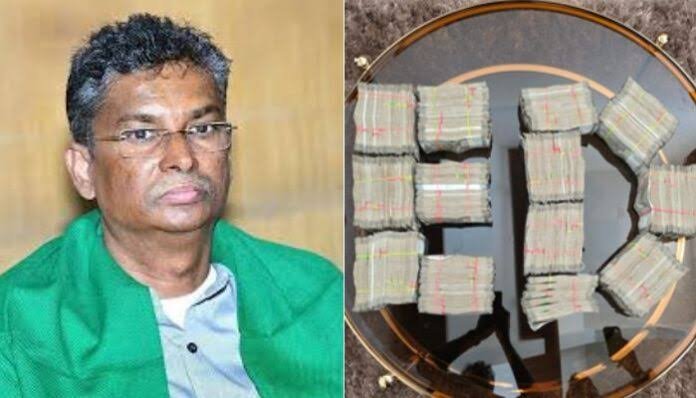

The Enforcement Directorate has searched 21 premises linked to Karnataka Public Works Department Minister Satish Jarkiholi, his family and associates in a FEMA investigation examining alleged undisclosed overseas investments and cross-border financial transactions.
The searches were conducted on September 9 and 10 across Bengaluru, Belagavi, Gokak and Kolkata by the ED’s Bengaluru Zonal Office. The agency said it seized ₹3.3 crore in Indian currency and foreign currency, including US dollars and euros, worth around ₹15 lakh.
The action was conducted under the Foreign Exchange Management Act, or FEMA, rather than the Prevention of Money Laundering Act.
ED examines investments in African mining companies
According to the agency, documents recovered during the searches indicate that members of the Jarkiholi family had acquired stakes in companies with mining interests in Africa.
The ED alleged that Jarkiholi’s daughter and Chikkodi MP Priyanka Jarkiholi, his son Rahul Jarkiholi and his sister Mahadevi Manjunath held shares in companies including Eldorado Mining Resources in Congo and Nava Aurum Mining Ltd in Zambia.
The agency further claimed that Satish Jarkiholi had acquired a nearly 40% stake in Magnitude Star SARL, a Congo-based company involved in gold mining.
Documents relating to other overseas entities holding mining interests in Africa were also reportedly seized during the searches.
Owning shares in a foreign company is not by itself illegal.
The investigation is focused on whether the investments were properly disclosed, whether the required foreign-exchange rules were followed and how the money used for those investments moved out of India.
What does FEMA regulate?
FEMA governs foreign-exchange transactions involving Indian residents, including investments abroad, acquisition of foreign assets and movement of money across borders.
Indian residents can legally invest in overseas companies subject to RBI rules, prescribed limits, reporting requirements and permitted routes.
The problem arises if investments are funded through unauthorised channels, are not properly reported or violate the conditions governing overseas investment.
Unlike many PMLA investigations, a FEMA proceeding does not automatically mean that investigators are alleging money laundering.
The immediate question is whether foreign-exchange regulations were breached.
That distinction is important because the searches have also produced allegations relating to PWD contracts, but those claims remain part of an ongoing investigation.
ED alleges cash was routed abroad through unauthorised channels
The ED says material recovered during the searches suggests that substantial cash investments and expenses were made in a Congo-based entity through unauthorised channels.
Investigators are now examining how the funds were transferred and whether the investments complied with Indian foreign-exchange rules.
The agency has also seized financial records and digital devices that it says may shed light on the source and movement of the money.
The recovery of foreign currency does not by itself prove a FEMA violation.
Investigators will have to establish where the currency came from, who owned it and whether possession or transfer breached applicable rules.
PWD contract bribery allegation broadens the investigation
The searches have also opened a second and potentially more serious line of inquiry involving public works contracts.
The ED has alleged that Bharat Vanijya Eastern Private Limited, or BVEPL, made a substantial bribe payment in connection with obtaining a PWD tender.
The agency claims that part of the alleged proceeds was subsequently used for purchasing or funding overseas assets.
Offices and residences connected with BVEPL and its owners were also searched.
The ED further said it recovered documents and digital material relating to alleged collections from contractors and transactions involving entities associated with Jarkiholi’s brother-in-law Y D Manjunath.
These remain allegations made by the investigating agency.
No court has yet established that a bribe was paid, that Jarkiholi received such money or that foreign assets were acquired with illegal proceeds.
Family members and close associates also covered in searches
The search operation extended beyond the minister’s own premises.
Locations linked to Priyanka Jarkiholi, Rahul Jarkiholi and Y D Manjunath were covered, along with properties associated with several aides and associates.
These included Jarkiholi’s Officer on Special Duty and personal assistant Malagouda Patil, as well as Raju Daragshetti, Vittal Parasannavar and Dr Girish Sonwalkar.
Searching a person’s premises does not mean that the person has been charged or found guilty of an offence.
The purpose of such searches is generally to collect documents, digital material, financial records and other evidence relevant to the investigation.
Jarkiholi says he will cooperate with ED
Jarkiholi has said the ED investigation is primarily connected with foreign investments and that he will provide the documents sought by the agency.
He has acknowledged that minor compliance errors may have occurred but has rejected suggestions of serious wrongdoing. He has also said he would seek the return of seized cash by producing documents establishing its ownership.
Karnataka Congress leaders have also criticised the searches, with senior party figures describing the action as politically motivated.
That political response does not determine the legal merits of the case.
The investigation will ultimately depend on documentary evidence showing how the foreign investments were funded, whether disclosures were made and whether any public-contract money was improperly diverted.
Overseas assets could become the key financial trail
The most important part of the ED investigation may now be the source of funds used for the African investments.
If the investments were made through authorised banking routes and properly reported under FEMA, the overseas shareholdings themselves would not establish wrongdoing.
If investigators prove that cash was moved through unauthorised channels or that proceeds from illegal payments were used to acquire foreign assets, the case could become significantly more serious.
The ED is now expected to examine bank statements, overseas-company records, shareholding documents, communications and the financial links between the individuals and entities covered in the searches.
Further notices or action will depend on what emerges from that analysis.
What this means for you
Owning or investing in a foreign company is legal for Indian residents when RBI and FEMA requirements are followed. The key issue in this case is not simply the existence of African investments, but whether the source, route and disclosure of those funds complied with Indian law.
The420 Insight
The foreign mining investments are only one layer of this case. The more consequential allegation is the ED’s attempt to connect overseas assets with payments allegedly arising from PWD contracts. If that financial trail is established, the investigation could move beyond a technical FEMA dispute into a much broader corruption inquiry.
Follow for daily updates on cybercrime, corporate fraud, DFIR, hacking, investigations, and digital forensics
