

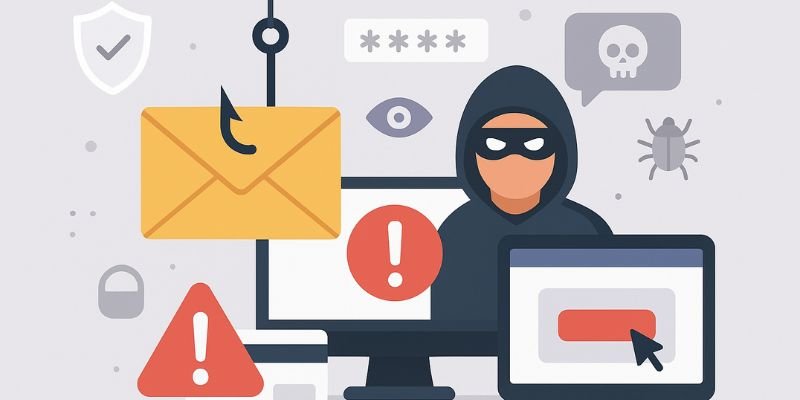

Cybercriminals are rapidly modernizing how they construct, host, and deploy phishing pages to target corporate environments and everyday internet users. Rather than manually coding fake login forms, threat actors now leverage automated frameworks, cloud services, and artificial intelligence to assemble high-conviction replicas in seconds.
By shifting toward modular Phishing-as-a-Service kits, attackers can launch scalable credential-harvesting operations with minimal technical expertise. This industrialization of cybercrime ensures that malicious landing pages are more evasive, visually flawless, and difficult for legacy filters to block.
Algoritha Security Launches ‘Make in India’ Cyber Lab for Educational Institutions
Modern Phishing Architecture
Phishing-as-a-Service (PaaS) represents subscription-based platforms where developers lease pre-built phishing templates, infrastructure, and automated bypass tools to low-skilled cybercriminals. Subscribers pay monthly fees to access centralized dashboards that manage victims, collect credentials, and defeat multi-factor authentication.
Adversary-in-the-Middle (AiTM) attacks utilize proxy frameworks to sit silently between a target user and a legitimate authentication server. By intercepting live web traffic in real time, these proxies capture session cookies and one-time passwords, rendering standard multi-factor authentication ineffective.
Cloud Infrastructure Hijacking involves hosting malicious phishing templates on legitimate cloud hosting solutions like Vercel, Firebase, or Cloudflare Workers. Because these domain endpoints carry high reputation scores, security filters often trust them, allowing fraudulent landing pages to bypass web scanners.
The Industrialization of Automated Phishing Kits
The barrier to entry for launching convincing phishing campaigns has completely collapsed due to the proliferation of commercial PaaS platforms. Modern kits come pre-packaged with adaptive templates that automatically mirror the branding, graphics, and localized language of targeted enterprises.
These kits also include built-in anti-analysis scripts designed to detect automated sandbox environments and security crawlers. When a security scanner attempts to audit the link, the page displays a benign decoy, while legitimate human victims are routed straight to the fake portal.
Furthermore, real-time analytics dashboards allow attackers to track open rates, victim geography, and captured credentials in one unified interface. This operational efficiency enables small cybercriminal groups to launch global campaigns that previously required advanced state-sponsored resources.
Exploiting Generative AI and Legitimate Cloud Services
Generative artificial intelligence tools have dramatically accelerated the speed and accuracy with which hackers generate malicious code and landing page templates. Attackers use custom AI models to translate phish kits into dozens of languages, removing spelling errors and awkward phrasing that previously tipped off vigilant users.
Beyond text generation, AI scripts assist threat actors in dynamically writing obfuscated JavaScript that hides malicious forms from browser inspection tools. This code obfuscation prevents security software from recognizing static signatures, allowing fake login portals to remain online significantly longer.
Threat actors also exploit trusted cloud infrastructure, hosting their pages on reputable software-as-a-service platforms. By abusing free tier offerings on reputable hosting providers, attackers generate valid SSL certificates and trusted subdomains that trick both web browsers and users into perceiving the site as safe.
Defensive Strategies Against Evasive Web Attacks
Neutralizing modern phishing infrastructure requires security teams to transition away from traditional static domain blocklists and URL filtering. Organizations must implement fast, behavioral inspection tools capable of detecting AiTM proxy setups and dynamic page obfuscation in real time.
Enforcing hardware-backed or FIDO2-compliant multi-factor authentication provides robust protection against credential interceptors. Because cryptographic keys are bound to specific domain URLs, hardware tokens will refuse to authenticate on proxy pages built by attackers.
Finally, continuous user awareness training must evolve beyond teaching employees to check for SSL padlocks or obvious typos. Organizations should train staff to scrutinize unexpected login requests, verify web domains carefully, and report suspicious redirects immediately.
What this means for you: Always verify website domain URLs before logging in, use hardware-backed MFA, and never trust unexpected sign-in prompts.
Follow for daily updates on cybercrime, corporate fraud, DFIR, hacking, investigations, and digital forensics
