

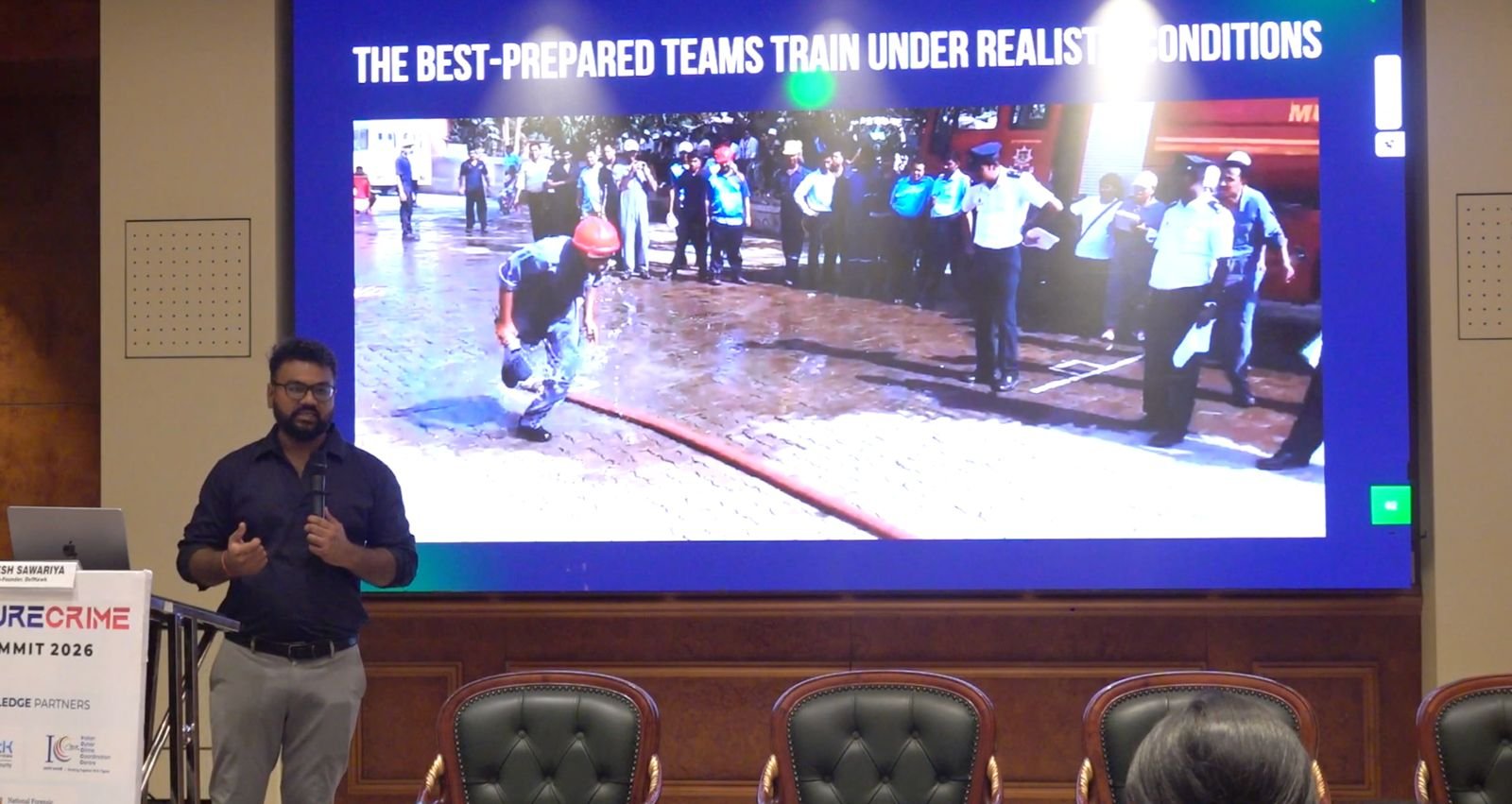
At the FutureCrime Summit 2026, a workshop titled “Cyber Range for Cyber Commandos: Live Attack-and-Defence Simulation” focused on how realistic cyber ranges can be used to train security professionals in responding to live attack scenarios and defending critical digital environments under pressure.
The workshop was led by Gitesh Sawariya, Co-Founder, DefHawk, and centred on simulation-based cyber training. Rather than relying only on classroom instruction or theoretical exercises, cyber ranges are designed to recreate realistic attack conditions in controlled environments, allowing participants to practise detection, defence and response without placing operational systems at risk.
Cyber Ranges Bring Training Closer To Real Attacks
One of the central ideas behind the workshop was the importance of experiential learning in cybersecurity.
Cyberattacks often unfold rapidly, forcing defenders to analyse suspicious activity, understand an adversary’s methods and take corrective action while an incident is still developing. Traditional training can explain concepts and procedures, but live simulation allows participants to experience the pressure and complexity of an attack more directly.
A cyber range can provide a controlled environment in which attackers and defenders operate simultaneously. Participants may be required to identify vulnerabilities, detect malicious activity, contain compromised systems and restore services while responding to changing conditions. The workshop therefore positioned attack-and-defence simulation as a practical way of building confidence and operational readiness.
Live Simulation Tests More Than Technical Knowledge
Cyber defence requires more than knowing how individual security tools work. During an actual incident, teams must also communicate, prioritise threats and make decisions with incomplete information. A live attack-and-defence environment can test these broader capabilities by placing participants in situations where several problems may emerge at once.
For cyber commandos and specialised security teams, this kind of training can be especially valuable because it mirrors the dynamic nature of real cyber incidents. Attackers may change tactics, move between systems or attempt to exploit several weaknesses in succession.
The workshop led by Gitesh Sawariya, Co-Founder, DefHawk, highlighted how simulation platforms can help security teams practise these situations repeatedly and refine their response strategies.
Readiness Depends On Practice
The broader theme of the workshop was cyber readiness.
Organisations may invest heavily in cybersecurity tools, monitoring platforms and defensive technologies, but their effectiveness ultimately depends on whether teams know how to use them when a serious incident occurs. Simulation-based training provides an opportunity to expose weaknesses before they are tested by a real attacker. It can reveal gaps in procedures, communication, technical skills and decision-making, giving organisations an opportunity to improve before facing an actual crisis.
This also makes cyber ranges useful for measuring preparedness over time. Repeated exercises can help teams compare performance, identify recurring weaknesses and build more effective response habits.
From Cyber Knowledge To Operational Capability
The “Cyber Range for Cyber Commandos: Live Attack-and-Defence Simulation” workshop underscored a wider shift in cybersecurity training from knowledge-based learning toward operational capability.
As cyber threats become more sophisticated, defenders increasingly need environments where they can practise under realistic conditions rather than encountering complex attack scenarios for the first time during a genuine incident. The workshop demonstrated why cyber ranges are becoming an important part of modern security preparation. By combining live attack scenarios, defensive decision-making and structured simulation, they offer a way to transform technical knowledge into practical readiness. For cyber commandos and security teams, that difference can be critical. In a real incident, preparedness is not measured by what defenders know in theory, but by how effectively they can respond when systems are under active attack.
