

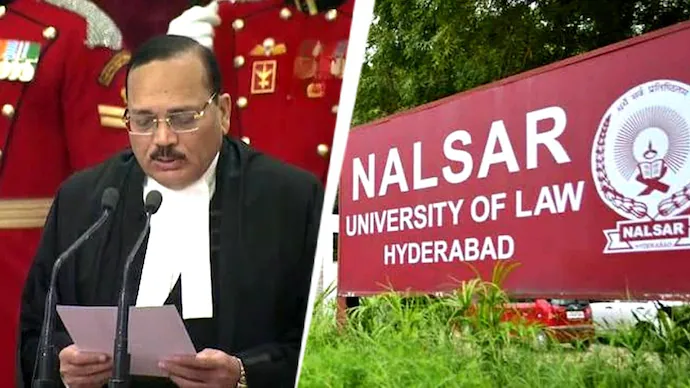

A major institutional standoff has emerged at the National Academy of Legal Studies and Research (NALSAR) University of Law in Hyderabad, where over 450 students across multiple cohorts have urged the administration to reconsider inviting Chief Justice of India Surya Kant as the chief guest for the upcoming 2026 convocation. The unprecedented internal pushback, initiated by seventy members of the outgoing graduating batch, challenges a long-standing tradition wherein the sitting head of the Indian judiciary delivers the ceremonial address at premier national law universities.
In formal representations submitted to the Vice-Chancellor, Registrar, and senior faculty members, the graduating students argued that extending an official invitation conflicts with the core constitutional ethos championed by the institution. The representations rapidly gained momentum across campus, drawing formal endorsement from junior cohorts spanning the classes of 2027 through 2031. Together, the signatories represent nearly a third of the university’s total student body of 1,400, converting a localized graduating class concern into a broader institutional movement.
Constitutional Ethos versus Institutional Tradition
At the heart of the controversy lies a fundamental friction between established administrative protocols and the socio-political expectations of young legal scholars. Historically, hosting the Chief Justice of India at university convocations has served as a hallmark of legal authority and academic prestige for national law schools. However, the student body contends that ceremonial honors should reflect a visible alignment with constitutional rights, access to justice, and reasoned engagement with citizen grievances.
In their initial representation, the graduating students noted that receiving degrees from a dignitary whose public posture appears dismissive of alleged police excesses creates an uncomfortable contradiction with their academic training. Subsequent letters from junior cohorts echoed these sentiments, asserting that the choice of chief guest carries symbolic weight that extends far beyond a single graduating class. The student representations emphasize that NALSAR’s pedagogical commitment to human rights and civil liberties must directly inform its administrative decisions.
The university administration has maintained a cautious silence on the matter, refraining from issuing public statements or confirming official schedules. Sources within the faculty indicate that the administration has neither finalized the date for the convocation nor issued a formal invitation to the Chief Justice. Internal discussions suggest that university authorities may consider adjusting the ceremony format to navigate potential institutional embarrassment while balancing administrative protocols with student sentiment.
Oral Remarks and the Spark of Campus Discontent
The immediate catalyst for the student objection stems from recent judicial proceedings before a Supreme Court bench led by Chief Justice Surya Kant. During a hearing regarding a plea concerning alleged police excesses during a student demonstration in New Delhi, the bench declined to urgently list the matter or examine submitted videographic evidence. Oral observations made during the hearing, where the bench advised counsel not to waste judicial time, triggered sharp reactions across legal academic circles.
Students also highlighted earlier controversial remarks attributed to the judiciary regarding student activism and public protests. The accumulation of these oral observations generated widespread discussion across law school corridors, culminating in the coordinated representations at NALSAR. The law students argued that judicial reluctance to examine prima facie evidence of state overreach weakens public faith in constitutional remedies and judicial oversight.
Legal scholars observe that while oral observations made during court hearings do not constitute binding judicial precedent, they frequently shape public perceptions of judicial temperament. In premier legal institutions, where students spend years analyzing judicial decisions through the lens of constitutional morality, such remarks carry significant weight and provoke rigorous analytical scrutiny.
Broader Context of Student Dissent and Ceremonial Norms
The unfolding situation at NALSAR reflects a wider trend of heightened student awareness surrounding high-profile academic events across Indian higher education institutions. Convocations at premier national centers, including the Indian Institutes of Technology and national law universities, have increasingly become platforms for broader discussions regarding executive authority, judicial accountability, and academic freedom.
Earlier this month, Prime Minister Narendra Modi addressed the 57th convocation ceremony at IIT Delhi, encouraging fresh graduates to maintain a spirit of relentless inquiry and question established norms while working toward constructive solutions. The intersection of state leadership, judicial figures, and student bodies highlights the evolving dynamics governing academic ceremonies across the country.
As the NALSAR administration deliberates its next steps, the legal fraternity awaits a resolution that balances institutional decorum with student sentiment. The ongoing debate underscores the evolving relationship between the judiciary and the next generation of legal professionals trained to uphold constitutional principles.
Follow for daily updates on cybercrime, corporate fraud, DFIR, hacking, investigations, and digital forensics
