


Every investigator has a case that never leaves them.
Not because it was the biggest.
Not because it made headlines.
But because it changed the way they looked at crime.
Ask any police officer who has spent years in investigation, and they will tell you the same thing.
Some cases become memories.
Some become lessons.
Most disappear into dusty files.
But what if those files could educate millions?
What if the FIRs, seizure memos, forensic reports and digital evidence that investigators work with every day could become stories that not only entertain people—but also prevent future crimes?
That is precisely what makes the journey of cyber crime investigator Amit Dubey worth examining.
Because this is not the story of a writer who researched policing.
It is the story of an investigator who never stopped being one—even after entering the entertainment industry.
Every Police Officer Has Stories. Few Ever Tell Them.
Walk into any cyber police station in India.
You will hear stories stranger than fiction.
A businessman who transferred his life’s savings because a caller sounded exactly like his son.
A fake embassy operation.
A digital arrest scam.
A romance fraud that unfolded over months.
A ransomware attack routed across continents.
Ask investigators where these stories came from.
They usually smile.
“We can’t tell you.”
Confidentiality is part of the profession.
Yet, after years of working alongside Indian law enforcement agencies on more than 1,300 cyber crime investigations, Amit Dubey realised something important.
If investigators never share what they learn, criminals will continue repeating the same tricks on new victims.
The public will always remain one step behind.
That realisation eventually pushed him towards writing.
The Case Diary Became a Bookshelf
Most investigators write case diaries.
Dubey started writing books.
Not because he wanted to become an author.
Because he wanted ordinary citizens to understand what investigators already knew.
The result was nine books, many inspired by real investigations and the behavioural patterns behind cyber-enabled crimes.
Among them, Return of the Trojan Horse and Hidden Files would later become especially significant.
Hidden Files, co-authored with Prof. Triveni Singh, former IPS officer and one of India’s most respected names in cyber policing and cyber crime investigation, drew heavily from real investigative experiences accumulated over years of policing and cyber investigations. The collaboration brought together two professionals who had spent their careers dealing with digital crime from the frontlines, offering readers an unusually authentic window into the world of cyber investigations.
Readers quickly discovered something unexpected.
Cyber crime wasn’t really about computers.
It was about human behaviour.
Fear.
Greed.
Trust.
Urgency.
Loneliness.
Exactly the same behavioural patterns investigators witness every day.
Then Came The Phone Call Every Writer Dreams About
As the books found readers across the country, filmmakers began noticing something unique.
These were not conventional crime novels.
They were stories rooted in authentic investigations.
Several of those investigative narratives eventually became the creative foundation for Hack Crimes Online, produced by Neeraj Pandey for Amazon Prime Video. The series drew inspiration primarily from Dubey’s books Return of the Trojan Horse and Hidden Files, bringing real-world cyber investigations to mainstream entertainment.
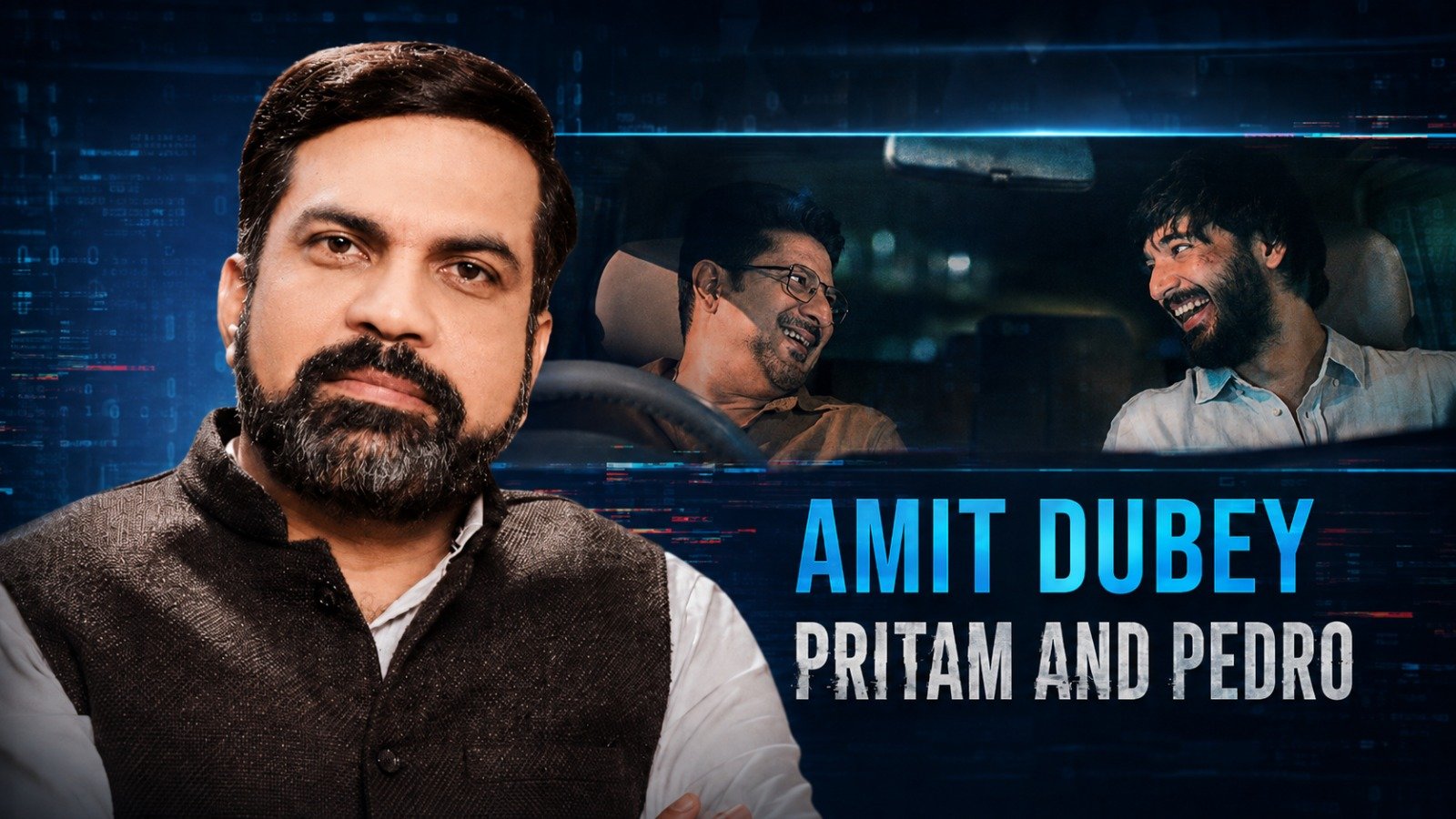
Dubey later contributed creatively to Special Ops 2, and most recently collaborated with Rajkumar Hirani on Pritam Pedro for JioHotstar.
For the entertainment industry, these became successful streaming projects.
For investigators, they represented something much larger.
Perhaps for the first time, cyber policing itself had become compelling mainstream storytelling.
Six Years. Sixteen Drafts.
Police investigations rarely move in straight lines.
Apparently, screenwriting doesn’t either.
Dubey says Pritam Pedro spent nearly six years under development.
The screenplay was rewritten 16 times.
Imagine rewriting an entire charge sheet sixteen times.
That comparison probably comes closest to explaining the creative process.
Every rewrite removed assumptions.
Strengthened motivation.
Improved authenticity.
Added emotional depth.
Investigators call it reconstruction.
Screenwriters call it rewriting.
The discipline feels surprisingly similar.
Neeraj Pandey Investigates. Rajkumar Hirani Humanises.
Ask Dubey about working with both filmmakers and he doesn’t compare them.
He distinguishes them.
Neeraj Pandey, he says, thinks like an investigator.
Precision.
Suspense.
Evidence.
Escalation.
Every clue matters.
Every reveal changes the direction of the investigation.
Rajkumar Hirani approaches the same material differently.
He asks another question.
“Why should the audience care?”
Technology becomes secondary.
People become primary.
According to Dubey, Hirani has an extraordinary ability to discover humour, hope and humanity inside difficult situations without diluting their seriousness.
That, he believes, is what makes Pritam Pedro a different kind of cyber story.
There Is A Lesson Here For Every Investigator
Police officers often underestimate the stories they live through.
Because they become routine.
But routine to investigators is extraordinary for ordinary citizens.
The cyber fraud your team solves this week may prevent thousands of future victims if its lessons are communicated effectively.
The digital trail you reconstructed.
The interrogation strategy that worked.
The forensic breakthrough.
The behavioural clue that exposed the accused.
Each contains public value.
Perhaps investigators need to document more.
Write more.
Teach more.
Share more.
Because public awareness remains the first line of cyber defence.
Beyond Books. Beyond OTT.
Even after writing books and contributing to streaming platforms, Dubey continues doing what he has always done.
Training.
According to him, more than 900,000 police personnel, investigators, judicial officers and government officials have attended programmes he has conducted across India.
Technology changes every few months.
Criminals evolve even faster.
Learning, therefore, can never stop.
That philosophy explains why he continues to spend as much time inside police training academies as he does inside writers’ rooms.
One Question Every Investigator Should Ask
How many extraordinary investigations are quietly lying inside police case files across India?
How many officers have solved remarkable crimes that the public will never hear about?
How many investigative innovations disappear when an officer retires?
Perhaps far too many.
That is why Amit Dubey’s journey matters beyond books or web series.
It raises a larger question for Indian policing.
Should investigations end with convictions?
Or should they also become knowledge?
Because every solved case contains intelligence.
Every intelligence contains a lesson.
Every lesson shared with society creates fewer victims tomorrow.
And perhaps the next landmark cyber thriller is not waiting to be imagined.
It is already sitting inside an investigator’s case diary, waiting for someone to tell its story.
Follow for daily updates on cybercrime, corporate fraud, DFIR, hacking, investigations, and digital forensics
