

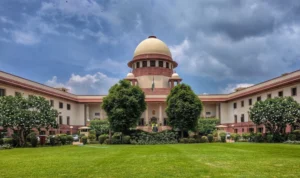
The Supreme Court of India has issued a significant interim order prohibiting the unauthorized uploading, posting, or sharing of video clips of judicial proceedings on social media and other digital platforms without prior permission from the Supreme Court or the concerned High Court. The Court observed that edited and out-of-context clips of live-streamed hearings have increasingly been circulated online, posing a risk to the image of the judiciary and the fairness of the judicial process.
During the hearing, the Supreme Court remarked that judicial proceedings cannot be treated as entertainment content. It emphasized that the purpose of live-streaming court proceedings is to promote transparency in the administration of justice, not to enable selective editing, sensationalisation, or the creation of misleading content for wider circulation on digital platforms. The Court observed that the judiciary is “not an entertainment platform” and that judicial proceedings should not be presented outside their proper context.
The interim order was passed while hearing a public interest litigation filed by a journalist seeking guidelines to regulate the editing, sharing, and commercial exploitation of videos from court proceedings. The petition argued that selectively edited clips uploaded without context could create misconceptions about judicial proceedings and undermine public confidence in the justice delivery system.
According to the petition, portions of lengthy hearings are often extracted and circulated independently on social media, presenting judicial observations without the surrounding legal arguments or factual background. Such selective dissemination, it argued, has the potential to distort the meaning of courtroom exchanges and create a misleading public narrative. The Supreme Court acknowledged these concerns and observed that fragmented presentation of judicial proceedings could misinform the public.
At the same time, the Court clarified that its interim order does not restrict the work of journalists or media organisations engaged in fair, accurate, and responsible reporting of court proceedings. News media will continue to report judicial developments in accordance with existing legal and ethical standards. The restriction applies specifically to the unauthorized use, editing, and online dissemination of courtroom video recordings.
Legal experts say the order represents an important step toward preserving the dignity of the judiciary while addressing the challenges created by the rapid spread of digital content. They note that judicial hearings often involve lengthy legal arguments and contextual discussions, and isolated video excerpts may fail to reflect the complete proceedings, potentially leading to public misunderstanding.
The Supreme Court also indicated that broader guidelines governing the use of live-streamed courtroom recordings may be considered in the future. The Court is expected to examine suggestions from stakeholders before developing a comprehensive regulatory framework that balances judicial transparency with the need to protect the integrity and dignity of court proceedings.
Until further orders, the interim direction will remain in force, and no video clip of court proceedings may be uploaded, shared, or circulated on social media, video-sharing platforms, or other digital channels without the prior permission of the Supreme Court or the concerned High Court. The matter will be taken up again for further consideration on the issue of permanent guidelines governing the use of judicial video recordings.
