
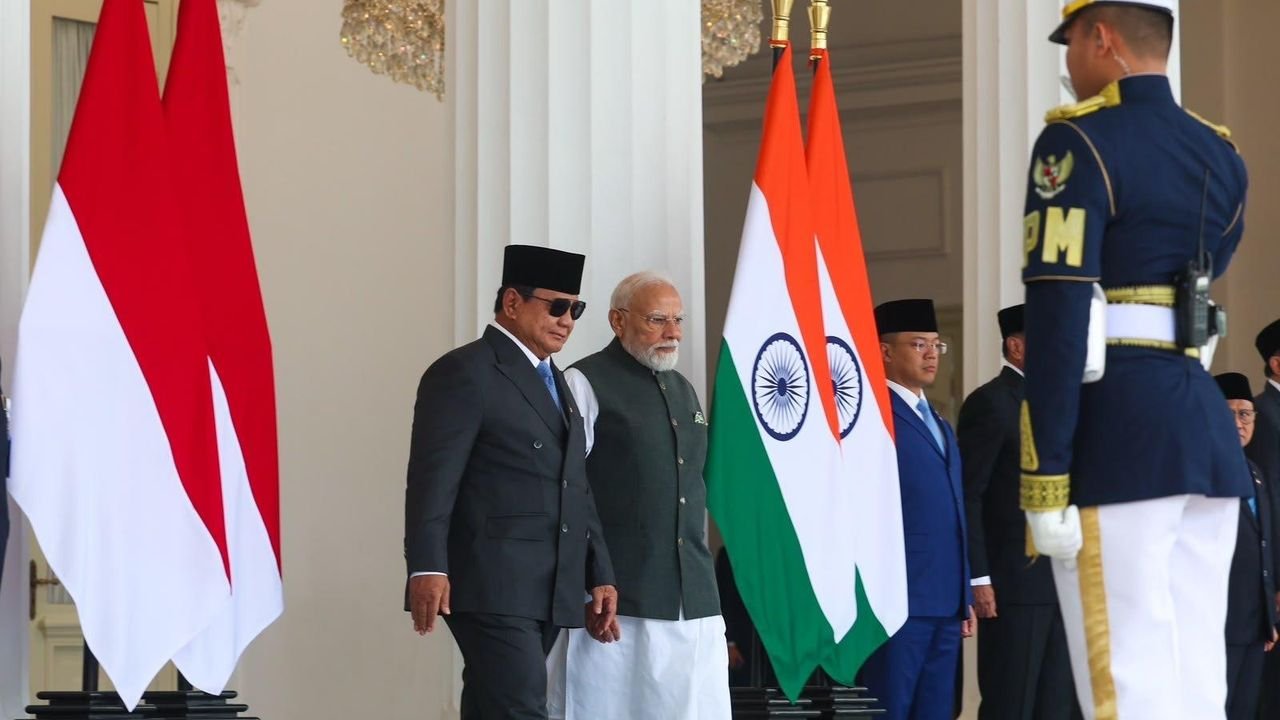

India and Indonesia have formalized a sweeping defense partnership during Prime Minister Narendra Modi’s state visit to Jakarta, signing landmark export contracts for BrahMos supersonic cruise missiles and Astra air-to-air missile systems. The strategic agreements, finalized during high-level bilateral talks with Indonesian President Prabowo Subianto, represent a major milestone in India’s defense export ambitions and solidify its role as a key security provider in the Indo-Pacific. The multi-million dollar transactions officially position Jakarta as the third major Southeast Asian customer for the BrahMos platform, following earlier procurement deals established with the Philippines and Vietnam. The dual missile deals emphasize an operational shift from standard diplomatic exchanges toward deep industrial and technological collaboration between Asia’s two largest maritime democracies.
Technical integration and tactical capabilities
The centerpiece of the defense agreements involves the procurement of an additional battery of the land-based BrahMos supersonic cruise missile system, along with an overarching framework for the supply of Astra Mk-1 beyond-visual-range air-to-air missiles. Developed through a joint venture between India’s Defence Research and Development Organisation and Russia’s NPO Mashinostroyenia, the BrahMos travels at speeds up to Mach 2.8 and possesses an operational range exceeding 290 kilometers.
This cruise missile system provides the Indonesian military with robust coastal defense capabilities, reinforcing an anti-access and area-denial strategy across its critical archipelagic sea lanes and international chokepoints.
Concurrently, the integration of the indigenous Astra Mk-1 missile system marks India’s entry into the sophisticated air-to-air precision export market. Under the agreed arrangement, Bharat Dynamics Limited will oversee the technical integration of the Astra weapon system with the Indonesian Air Force’s existing fleet of Russian-built Su-30 fighter aircraft. The Astra Mk-1 utilizes a solid rocket motor to engage aerial targets at distances ranging from 80 to 110 kilometers and is already fully operational within the Indian Air Force. Defense analysts note that international confidence in both the BrahMos and Astra platforms has escalated significantly following their successful deployment and proven accuracy during recent operational exercises conducted by the Indian Armed Forces, including the high-profile tactical maneuvers under Operation Sindoor. Combined, these defense export packages are estimated by commerce officials to be worth more than 600 million dollars.
Strategic infrastructure and supply chain diversification
Beyond direct military hardware sales, the bilateral summits yielded extensive agreements designed to secure regional logistics and industrial supply chains. A primary highlight of the infrastructure roadmap is the joint commitment to develop Sabang Port, Indonesia’s northernmost deep-sea installation situated at the entry point of the highly congested Strait of Malacca. Sabang Port sits approximately 160 kilometers from India’s Great Nicobar Island, where Centre is advancing a massive economic and strategic hub project. The collaborative development of this port allows both nations to coordinate maritime safety, share electronic tracking data, and enhance oversight of vital commercial shipping lanes connecting the Indian and Pacific Oceans.
Economic security provisions were further strengthened by a series of agreements covering critical minerals, rare-earth magnet manufacturing, and the steel supply chain. Indonesia, a dominant global producer of nickel and vital industrial raw materials, will partner with Indian engineering firms to establish resilient domestic processing facilities. This materials alliance aims to shield both economies from unilateral export blocks and erratic price fluctuations in the global market while supporting India’s expanding domestic high-tech manufacturing base. In total, the state visit resulted in fourteen distinct agreements spanning public health, educational exchanges, outer space research, and telecom security, underscoring a comprehensive upgrade of the bilateral relationship.
Geopolitical alignment and maritime overwatch
The diplomatic convergence between New Delhi and Jakarta occurs against a backdrop of increasing regional friction and military posturing within the South China Sea. While avoiding direct references to external powers, Prime Minister Modi and President Prabowo issued a joint statement reaffirming their commitment to a free, open, and inclusive Indo-Pacific. The two leaders emphasized strict adherence to international law, including the 1982 United Nations Convention on the Law of the Sea, while advocating for the complete freedom of navigation and overflight across regional waters. To cement daily operational coordination, Indonesia has agreed to deploy a permanent Liaison Officer at India’s Integrated Fusion Centre for the Indian Ocean Region, enabling real-time information sharing regarding maritime threats.
The high-stakes visit concluded with a significant diplomatic gesture, as President Prabowo conferred the Bintang Adipurna, the highest civilian honor of the Republic of Indonesia, upon the Indian Prime Minister. Reflecting on the outcomes of the summit, leaders from both nations stated that the growing trust and industrial synergy have placed the bilateral relationship at the threshold of a new golden era. The comprehensive defense and economic framework established in Jakarta sets a definitive blueprint for secondary middle powers seeking to balance regional stability through independent public-private partnerships.
Follow for daily updates on cybercrime, corporate fraud, DFIR, hacking, investigations, and digital forensics
