
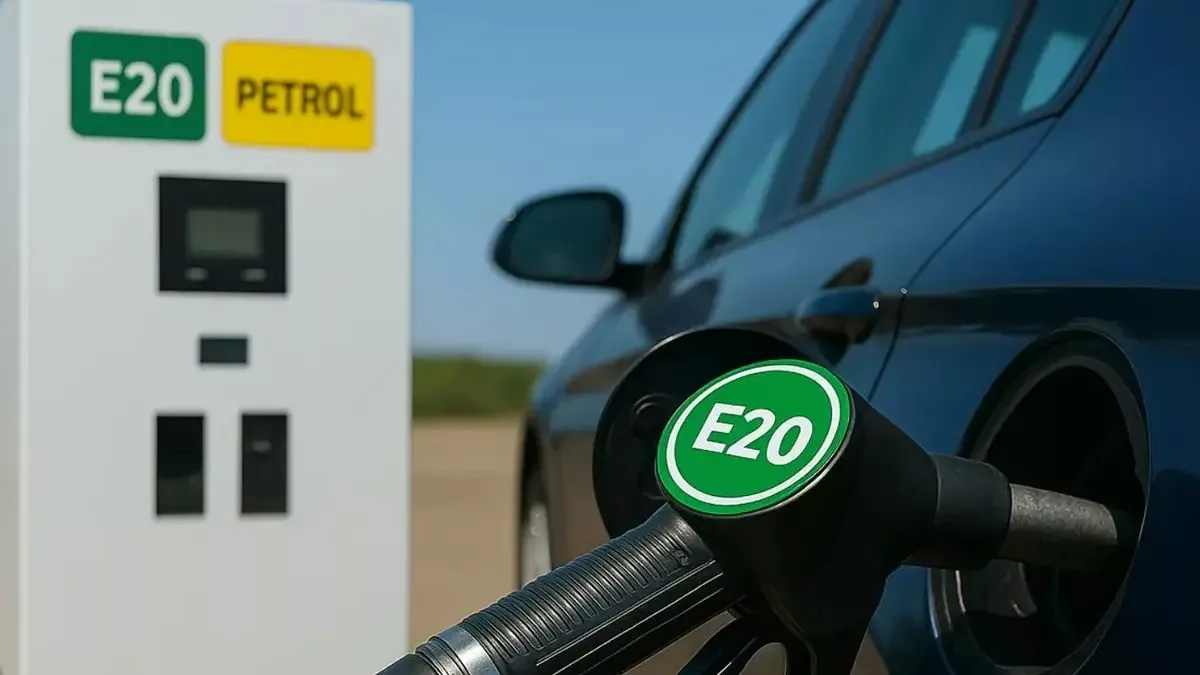

The Centre rejected media reports claiming that Bhutan had turned down an Indian proposal to import E20 petrol, clarifying that no such offer was ever made by Indian Oil Marketing Companies and that there is no proposal to export the fuel to the neighbouring country. “Claims that Bhutan declined an offer to import E20 petrol from India are incorrect,” the Ministry of Petroleum and Natural Gas said in its statement, adding plainly that no such offer has been made by the OMCs, and there is no proposal for export of E20 petrol to Bhutan.
The clarification came after media reports, citing Bhutanese officials, claimed the country had specifically requested Indian OMCs to continue supplying conventional petrol instead of E20, pointing to technical and infrastructure-related challenges. According to those reports, Bhutan’s concerns centred on the hygroscopic nature of ethanol, its tendency to absorb moisture more readily than conventional petrol, with officials reportedly worried that ageing underground fuel storage tanks in the country’s mountainous terrain could be vulnerable to water seepage, raising the risk of phase separation that could degrade fuel quality and potentially damage vehicle engines.
A Technical Concern That Would Not Be Unprecedented
Whatever the accuracy of the specific claim about Bhutan, the underlying technical concern cited in the disputed reports is not without basis in how ethanol-blended fuel behaves in storage. Ethanol’s affinity for water is a well-documented property of the fuel, and it is precisely this characteristic that has driven much of India’s own domestic debate over E20’s rollout, particularly among owners of older vehicles and fuel retailers managing ageing storage infrastructure.
That domestic debate has been especially heated in recent days. India’s government has spent much of this week trying to contain a growing public backlash against the E20 mandate at home, a controversy that intensified sharply after Attorney General R. Venkataramani was recorded telling a court hearing that E20 was an “experiment” whose results would only emerge next year, a remark that went viral despite the government’s insistence it had been taken out of context. Petroleum Minister Hardeep Singh Puri had separately acknowledged this week that mileage “may drop a little” under E20, even as he defended the policy by comparing ethanol’s performance characteristics to its use in motor racing.
Why the Timing of This Denial Matters
Set against that backdrop, reports suggesting a neighbouring country had rejected Indian E20 petrol on structural and infrastructure grounds risked reinforcing precisely the narrative the government has spent the past week trying to push back against domestically: that E20’s technical drawbacks are significant enough for outside parties to actively resist adopting the fuel. This is likely why the Centre moved quickly and unambiguously to characterise the entire premise of the story as false, rather than engaging with the underlying technical claims about ethanol’s storage behaviour at all.
India’s E20 programme, which blends 20 per cent ethanol with petrol, remains a centrepiece of the government’s strategy to reduce dependence on crude oil imports, lower vehicular emissions, and build domestic biofuel production capacity. The programme achieved its blending target five years ahead of the original 2030 deadline, a genuine policy accomplishment that the government has repeatedly highlighted even as it now fields criticism over how the transition was managed for consumers.
A Pattern of Pushback on Two Fronts at Once
Taken together with this week’s domestic controversy, the Bhutan denial illustrates a government managing E20-related messaging on two simultaneous fronts, one addressing Indian motorists frustrated by perceived mileage loss and a lack of fuel choice at the pump, and another now addressing international reporting that could suggest the policy faces resistance beyond India’s own borders. Whether the original reports about Bhutan’s position were based on a genuine internal discussion within Bhutanese fuel supply circles, a miscommunication, or an unrelated technical assessment mischaracterised as a formal rejection remains unclear, since the Ministry’s statement addressed only the existence of a formal export proposal, and did not directly comment on whether informal discussions or technical assessments regarding ethanol-blended fuel had taken place between the two countries at any level.
For now, the Centre’s position is unambiguous on the narrow factual question: no export offer was made, and therefore no rejection could have occurred. Whether that clarification fully closes the story, or whether further detail emerges about what, if any, informal conversations took place between Indian and Bhutanese fuel officials, will likely determine how much traction this particular episode retains alongside the broader E20 debate still playing out domestically
Follow for daily updates on cybercrime, corporate fraud, DFIR, hacking, investigations, and digital forensics
