
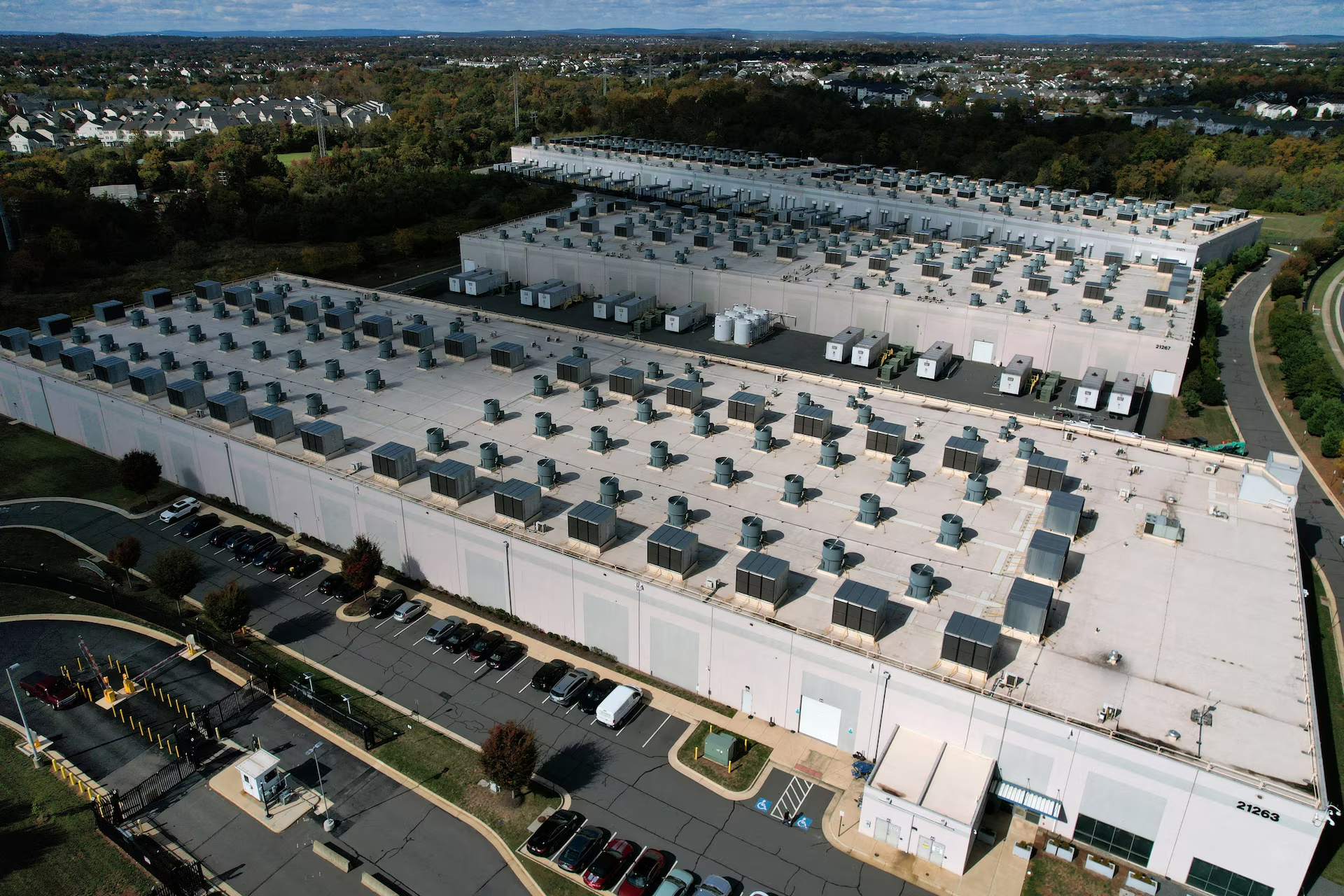

The global race to construct the computing infrastructure for artificial intelligence is running headlong into an existential ecological barrier. As massive server farms expand globally to power next-generation machine learning, record-breaking heatwaves and severe weather are pushing these high-density facilities to their absolute operational limits. Data centres, which naturally generate enormous internal heat, are increasingly struggling to maintain optimal temperatures against the backdrop of a warming planet. This collision between technological ambition and climate reality is transforming digital infrastructure planning from a pure engineering challenge into a high-stakes risk assessment.
The Insurance Shock and Outdated Models
The financial and insurance sectors are already sounding the alarm over the escalating physical vulnerabilities of these multi-crore digital assets. Severe weather events have rapidly risen to become the primary driver of financial losses in global infrastructure construction portfolios. Insurers warn that the technology industry’s historical reliance on past weather patterns is masking the true scale of modern environmental risks.
Patrick McBride, Zurich’s Head of International Construction, recently observed that “severe weather is no longer something that can be treated as a background exposure.” McBride noted that as data centres migrate to cheaper, rural areas where historical extreme weather records are scarce, developers face unprecedented vulnerabilities. “Now we have $3 billion worth of assets with over a mile worth of exposure to these events,” McBride warned, highlighting the massive capital now sitting directly in harm’s way.
This sentiment is echoed by climate risk analytics firms, which argue that traditional financial underwriting models are fundamentally broken. Matthew Eby, the founder and chief executive officer of First Street, stated that “most underwriting for real assets still uses historical data, but the climate is no longer behaving the way the historical record would predict.” Eby cautioned that as heat, drought, and water stress intensify across the globe, outdated risk models fail to offer a complete view of structural asset vulnerabilities.
The Vulnerability of the Indian Grid
The broader economic fallout from climate-induced data centre failures extends far beyond localized technical glitches. When a server farm falters under extreme thermal stress, the consequences rapidly cascade through the surrounding public utility networks and regional economies. In emerging digital powerhouses like India, the localized pressure on resources is creating acute friction between technological development and community survival.
Jeremy Porter, chief economist at First Street, noted that “where you build a data center determines a large share of what it will cost to run for the next 20 or 30 years.” Porter emphasized that critical operational variables like cooling, water access, and power reliability are deeply dependent on location, even though corporate valuations routinely treat climate as a secondary concern. Furthermore, Porter warned that “a climate hit to a local data center can radiate outward as a service disruption, on top of competing with that same community for power and water in regions already under stress.”
For India, which is currently positioning itself as a premier global hub for cloud computing and artificial intelligence, this warning carries profound implications. A recent global vulnerability assessment ranked India eleventh worldwide in terms of physical climate risks facing planned digital infrastructure. Major technology clusters across states like Tamil Nadu, Telangana, and Karnataka are now flagged among the world’s most vulnerable sub-national zones for projected heat-related operational disruptions.
Engineering the Future on Fractured Ground
As the Union Government and private enterprises pour lakhs of crores into digital infrastructure, the operational lifespan of these facilities demands an immediate pivot toward climate-proof engineering. Because a typical hyperscale data centre is designed to operate for up to three decades, site selections made today will dictate corporate viability well into the middle of the century.
Dr Karl Mallon, Founder and Head of Science and Technology at the climate risk consultancy XDI, bluntly stated that “we are not adequately preparing for climate change.” Mallon stressed that despite a massive influx of global capital into artificial intelligence hardware, developers are failing to align structural investments with changing atmospheric realities. “The question is no longer simply where the next generation of digital infrastructure gets built, but whether those assets can remain operational, insurable and economically resilient over their intended life,” Mallon added.
To mitigate these systemic threats, data centre operators are racing to pioneer new cooling architectures, including closed-loop liquid immersion systems that reduce dependence on public water supplies. However, technical adaptation inside the facility cannot safeguard against the failure of the broader public infrastructure feeding it. If the state power grids and local access roads buckle under extreme weather, even the most advanced server farm becomes entirely inoperable. Navigating this delicate balance will test the resilience of India’s digital economy as it attempts to build a futuristic tech landscape on increasingly unstable environmental ground.
Follow for daily updates on cybercrime, corporate fraud, DFIR, hacking, investigations, and digital forensics
