
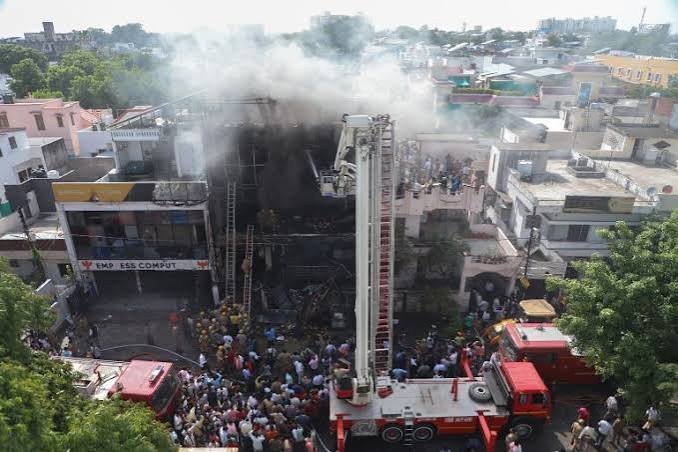
A devastating fire that claimed 15 lives in Lucknow’s Aliganj area has raised serious concerns about fire safety compliance in commercial buildings across urban India. The First Information Report (FIR) registered at the Aliganj police station points to multiple alleged safety violations, including the absolute absence of emergency exits, completely inadequate fire protection measures, and a total lack of smoke ventilation systems. Preliminary findings suggest that the scale of the tragedy could have been significantly reduced had proper safety infrastructure been in place to protect the young occupants trapped inside.
The fire broke out on Monday afternoon around 2:30 PM in a three-storey commercial complex located on Usha Mehta Marg in Sector D of Aliganj. As flames rapidly spread from the lower floors, several occupants became trapped on the upper levels amid thick, toxic smoke and intense heat. Firefighters, along with personnel from the State Disaster Response Force (SDRF), National Disaster Response Force (NDRF), and local police, faced considerable operational challenges while trying to carry out rescue operations within the heavily choked structure.
Registration Begins for FutureCrime Summit 2026, India’s Largest Cybercrime Conference
The Structural Death Trap Pipeline
According to the details outlined in the formal FIR, the commercial building was originally approved exclusively for residential use but was illegally converted for high-density commercial activities. The structural setup operated as a continuous hazard trap pipeline, beginning with a complete lack of an alternative evacuation route. The building featured only a single, narrow entry and exit staircase, with absolutely no secondary fire escapes, external ladders, or designated emergency exit doors available for the occupants.
Following this entry layout, the danger was severely multiplied by a total absence of smoke extraction infrastructure. Because the premises lacked any functional exhaust fans, ventilation shafts, or structural vents, the lone staircase quickly filled with blinding carbon monoxide and advancing flames, cutting off the only path to safety.
The trap concluded with an unsafe electrical installation setup, where heavy air-conditioner outdoor units, overloaded circuit boards, and dense wiring grids were mounted haphazardly inside the main corridors without mandatory insulation or automated circuit-tripping safety gear.
Trapped Amid Multi-Floor Establishments
At the time of the catastrophic incident, the building housed multiple distinct commercial establishments packed with young students and trainees. The basement, ground, and first floors accommodated a pet shop and a veterinary clinic, where the blaze is suspected to have initially erupted. The second floor was utilized as a video gaming zone and a 3D animation center, specifically the “Head Hopper Studio” and a library coaching hub called “Learning Space.” An IT networking office operated from the topmost level. This heavy accumulation of varied businesses and a large volume of unsuspecting young interns significantly increased the overall severity of the disaster.
Rescue teams had to eventually use ladders and scale adjoining structures, drilling two large openings directly through the concrete walls to gain access to the smoke-filled rooms. Emergency medical teams shifted the casualties to the King George’s Medical University (KGMU) Trauma Centre, where doctors confirmed that the majority of the 15 fatalities—mostly young individuals aged between 16 and 27 years—succumbed to severe suffocation and toxic smoke inhalation rather than direct burn injuries.
Administrative Crackdowns and Suspensions
Law enforcement authorities have arrested four individuals in connection with the tragic case, including the building’s joint owner Virendra Prasad Shukla, pet shop operator Ram Krishna Upadhyay, animation center operator Tushar Krishna Jaiswal, and associate Suresh Kumar Sahu. The accused face severe charges under the Bharatiya Nyaya Sanhita (BNS), including Section 105 for culpable homicide not amounting to murder, Section 110 for attempt to commit culpable homicide, and Section 125 for rash or negligent acts endangering human life, alongside strict provisions of the Uttar Pradesh Fire and Emergency Services Act.
Zero Tolerance Matrix: Following directives from Chief Minister Yogi Adityanath, who cut short an official out-of-district visit to inspect the site personally, the state administration has immediately suspended four senior regional officials—including an LDA Executive Engineer, an Assistant Engineer, a Junior Engineer, and a Fire Station Safety Officer—for gross regulatory oversight.
The Uttar Pradesh government has constituted a high-level, two-member Special Investigation Team (SIT) to conduct a comprehensive inquiry into the administrative and structural lapses, with a strict mandate to submit its report within seven days. Concurrently, the Lucknow Development Authority (LDA) has issued an immediate demolition notice for the entire damaged complex. Public safety experts stress that this tragedy underscores an urgent nationwide need to move away from superficial safety checkmarks and implement real-time AI thermal monitoring, mandated dual-exit building designs, and independent third-party audits to secure commercial coaching hubs.
