

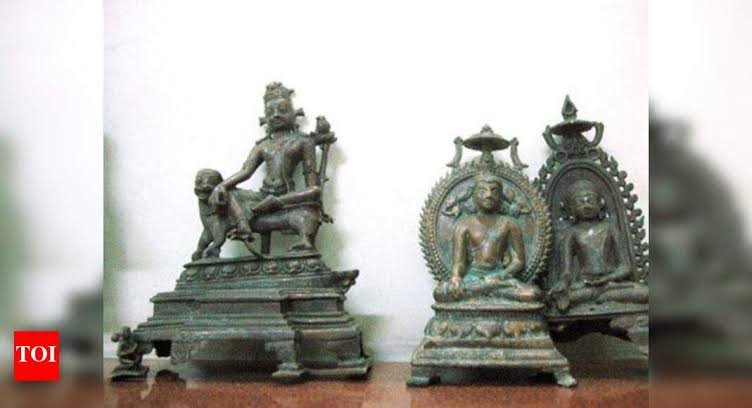
More than 420 ancient artefacts stolen from monuments and archaeological sites protected by the Archaeological Survey of India remain untraced, according to official records spanning more than six decades. At least 488 sculptures, idols and other historical objects were reported stolen across the country between 1961 and 2024.
Three States Account for Most Recorded Thefts
The records cover thefts from ASI-protected premises across 19 states and three Union Territories. Madhya Pradesh, Rajasthan and Uttar Pradesh recorded the highest numbers, together accounting for 319 stolen artefacts, or nearly 65 per cent of the national total.
FCRF’s Flagship Cyber Law Certification Returns With a New Four-Week Cohort
The objects disappeared from temple complexes, forts, museums and sculpture storage facilities. Many of the cases are several decades old and remain unresolved.
The earliest recorded incident dates to 1961, when 15 Buddha and Bodhisattva sculptures were stolen from the Nalanda Museum in Bihar. None of those objects has been recovered.
Other significant missing artefacts include a 10th-century lotus ceiling element from the Sri Mallikarjuna Temple in Andhra Pradesh, a stone Nandi sculpture from the Ramalingeswara Temple Complex in Avani, Karnataka, and a Vishnu idol from the Vriddha Kaleshwar Temple in Khandwa, Madhya Pradesh.
A Mughal-era dagger with an ivory handle stolen from the Indian War Memorial in Delhi also remains among the objects listed as missing.
Missing Records Complicate Recovery Efforts
Photographs and detailed documentation of several stolen objects are unavailable in official records, making their identification and recovery more difficult.
Heritage specialists regard inadequate documentation as a major obstacle, particularly when stolen antiquities enter international markets or are removed from their places of origin.
Experts have recommended comprehensive digital documentation of protected artefacts through high-resolution photography, three-dimensional scanning and a centralised national database. Such records could help Indian and international agencies identify, track and repatriate stolen objects.
Demand for rare sculptures and antiquities in international markets is also believed to encourage organised smuggling. Once an object is removed from a site without a complete visual or archival record, tracing its movement becomes substantially harder.
Thousands of Protected Sites Pose Security Challenge
The ASI is responsible for maintaining and protecting 3,697 monuments and archaeological sites across India. Many are spread over large areas or located in remote regions, creating difficulties in maintaining continuous surveillance.
Limited security resources and manpower constraints have further complicated protection efforts. Although security measures have improved in recent years, safeguarding thousands of sites remains a significant challenge.
The continuing disappearance of these objects has raised concerns about India’s heritage protection system. Beyond their monetary value, the missing sculptures, idols and antiquities represent historical, religious and artistic links that cannot be replaced.
Recovering the stolen artefacts and strengthening their documentation and security remain central to protecting India’s cultural heritage.
Follow for daily updates on cybercrime, corporate fraud, DFIR, hacking, investigations, and digital forensics
