
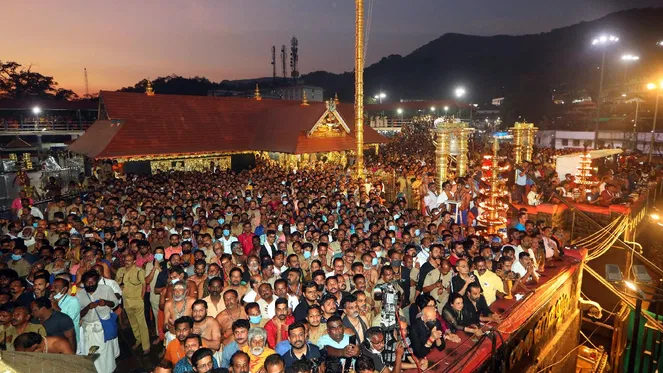

Managing the massive influx of devotees at the historic Sabarimala hill shrine in Kerala has long been a daunting administrative task. With nearly 80,000 to one lakh pilgrims arriving daily during the intense 60-day Mandala-Makaravilakku season, the sheer density of human movement across rugged terrain creates significant safety vulnerabilities. Historically, crowd regulation has relied on physical bottlenecks and manual police checkpoints, leaving officials reacting to congestion only after it builds up.
To mitigate these risks, the Travancore Devaswom Board (TDB) and the Kerala State Police are deploying an artificial intelligence-driven pilgrim management framework. Envisaged under a comprehensive modernization plan approved by the High Court, this initiative intends to replace old manual protocols with predictive, data-driven automated systems.
From Manual Barriers to Predictive Flow
The core objective of the new system is to transition crowd management from a reactive posture to a predictive model. Currently, when bottleneck locations like Sannidhanam or the steep climbing paths become overcrowded, it takes hours for ground personnel to resolve the resulting pressure.
The AI platform will continuously analyze real-time data streams across the primary transit locations, including Nilackal, Pampa, and the main hilltop. By evaluating the entry velocity of pilgrims at base hubs, the software can predict exactly when and where critical density limits will be breached downstream. Instead of allowing crowds to build to dangerous pressure levels, the system can provide operational recommendations directly to command officers, allowing them to dynamically throttle the pilgrim flow at earlier transit hubs where devotees can wait comfortably.
High-Definition Tracking and Biometric Tracing
To feed data into the analytical core, a sophisticated hardware network is being mapped across the entire trekking perimeter. The deployment includes high-resolution optical cameras, specialized infrared sensors for low-light tracking, and aerial drones to monitor open gathering zones.
Beyond density analytics, the camera network introduces advanced facial recognition technology to solve a persistent seasonal issue: tracing lost individuals. During peak hours, hundreds of children and elderly pilgrims frequently become separated from their groups amid the heavy rush. Under the new protocol, photographs of missing persons can be immediately uploaded into the system, matching their faces against the live surveillance grid to locate them within minutes. Additionally, the biometric layer will run automated checks against authorized national security databases to instantly alert field officers to the presence of flagged or anti-social elements.
Lifesaving Interventions and Civic Automation
The application of intelligent vision tools extends well past basic line management; it functions as a critical medical early-warning system. The steep, grueling trek up the hill causes immense physical strain, frequently resulting in severe cardiac emergencies among ascending devotees. The AI engine is trained to identify anomalous behavioral patterns in the crowd—such as an individual suddenly collapsing, showing signs of severe distress, or a localized movement disruption. Once flagged, the platform can immediately pinpoint the precise coordinates and dispatch emergency medical teams, significantly cutting down emergency response times.
Furthermore, the technology-driven overhaul is being tied into the local civic infrastructure. Sensors and vision models will monitor waste accumulation across commercial areas to ensure compliance with a new zero-waste sanitation protocol. The platform will also monitor natural drinking water resources and optimize parking logistics at the massive Nilakkal complex, laying the groundwork for a fully integrated, modern smart-shrine ecosystem.
Follow for daily updates on cybercrime, corporate fraud, DFIR, hacking, investigations, and digital forensics
