


The computational infrastructure driving the global artificial intelligence boom is facing a physical bottleneck: heat. As tech conglomerates deploy dense arrays of specialized processors to train increasingly complex large language models, the traditional methods of keeping servers from overheating are pushing land-based energy grids and freshwater reserves to their breaking points. A single modern AI data center can consume as much electricity as a mid-sized city and require millions of gallons of water daily for evaporative cooling.
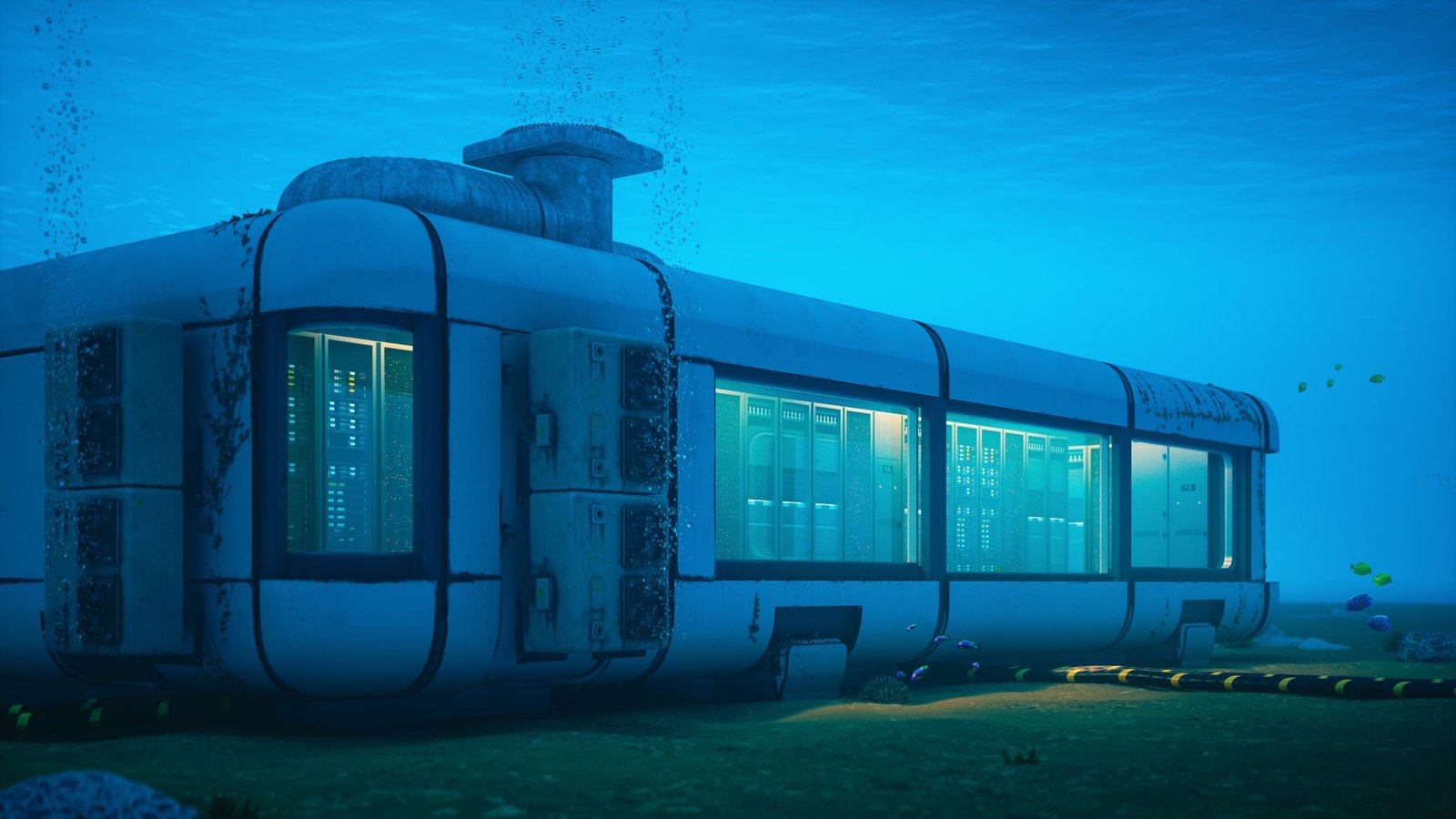
To bypass these terrestrial constraints, engineering teams in China have begun deploying a radical alternative. Off the coast of Hainan Island, massive, airtight steel cylinders packed with high-density server racks are being lowered to the seabed, anchoring the nation’s computational future under thirty meters of ocean. This shift to underwater data centers marks a pragmatic transition in the tech race, treating the deep sea not as a geographical barrier, but as a vast, natural heat sink.
Harnessing the Subsea Heat Sink
The fundamental mechanics of an underwater data center rely on basic thermodynamics. Instead of using energy-intensive industrial air conditioning units and scarce freshwater to cool circulating air, the subsea cylinders use a closed-loop liquid cooling system that transfers internal server heat directly to the surrounding ocean water. Because deep seawater remains constantly cold year-round, the external environment acts as an infinite, passive cooling mechanism.
This simple shift yields dramatic operational efficiencies. Standard data centers operate with a Power Usage Effectiveness (PUE) ratio—a metric where 1.0 represents perfect efficiency, meaning all power goes directly to computing rather than auxiliary cooling. While many modern land-based facilities struggle to drop below a PUE of 1.3, coastal subsea installations have consistently achieved ratios near 1.07.
By eliminating the need for mechanical chillers, these marine developments cut electricity consumption by nearly 30 percent. More importantly for coastal municipal planning, a fully realized underwater cluster can save tens of thousands of tons of freshwater annually, preserving localized water tables that are otherwise heavily depleted by traditional technology hubs.
Relieving the Grid and Land Constraints
The migration to the ocean floor also addresses an acute geopolitical and economic challenge: the extreme scarcity of industrial real estate near major economic engines. China’s primary data consumers and corporate centers are concentrated along its heavily populated eastern and southern coastlines, where land prices are high and regional power grids operate near maximum capacity.
Placing massive computational hubs inland solves the land issue but introduces latency—the physical delay it takes for data to travel thousands of kilometers back to coastal users. By anchoring server clusters just a few miles offshore in coastal waters, operators can maintain ultra-low latency connections to major economic centers while bypassing expensive terrestrial real estate markets.
Furthermore, this maritime strategy allows data infrastructure to hook up directly to the expanding web of offshore clean energy projects. Coastal data nodes are uniquely positioned to tap directly into marine power infrastructure, such as offshore wind farms and coastal nuclear plants. This creates a closed ecosystem where green energy is generated and consumed locally without placing additional strain on the overextended inland electrical grids.
The Engineering of Abyssal Reliability
Operating complex silicon architecture at the bottom of the sea presents intense engineering challenges. The ocean floor is an aggressively hostile environment characterized by immense pressure, highly corrosive saltwater, and the biological reality of biofouling—where barnacles, algae, and marine organisms slowly coat structures, threatening to insulate the steel hulls and block heat transfer.
To survive these conditions without constant human intervention, the subsea vessels are filled with an inert nitrogen atmosphere instead of oxygen. This completely eliminates moisture-induced corrosion and dust accumulation, two of the primary causes of hardware failure in terrestrial facilities.
Because launching a deep-sea salvage operation to replace a faulty graphics card or RAM stick is economically impractical, these underwater pods are built to be entirely autonomous. They rely on advanced robotic internal monitoring and redundant structural designs engineered to operate without physical maintenance for up to a decade. It is a philosophy borrowed directly from aerospace engineering: building a digital capsule that, once deployed, must function flawlessly in an environment as unreachable as deep space.
Follow for daily updates on cybercrime, corporate fraud, DFIR, hacking, investigations, and digital forensics
