

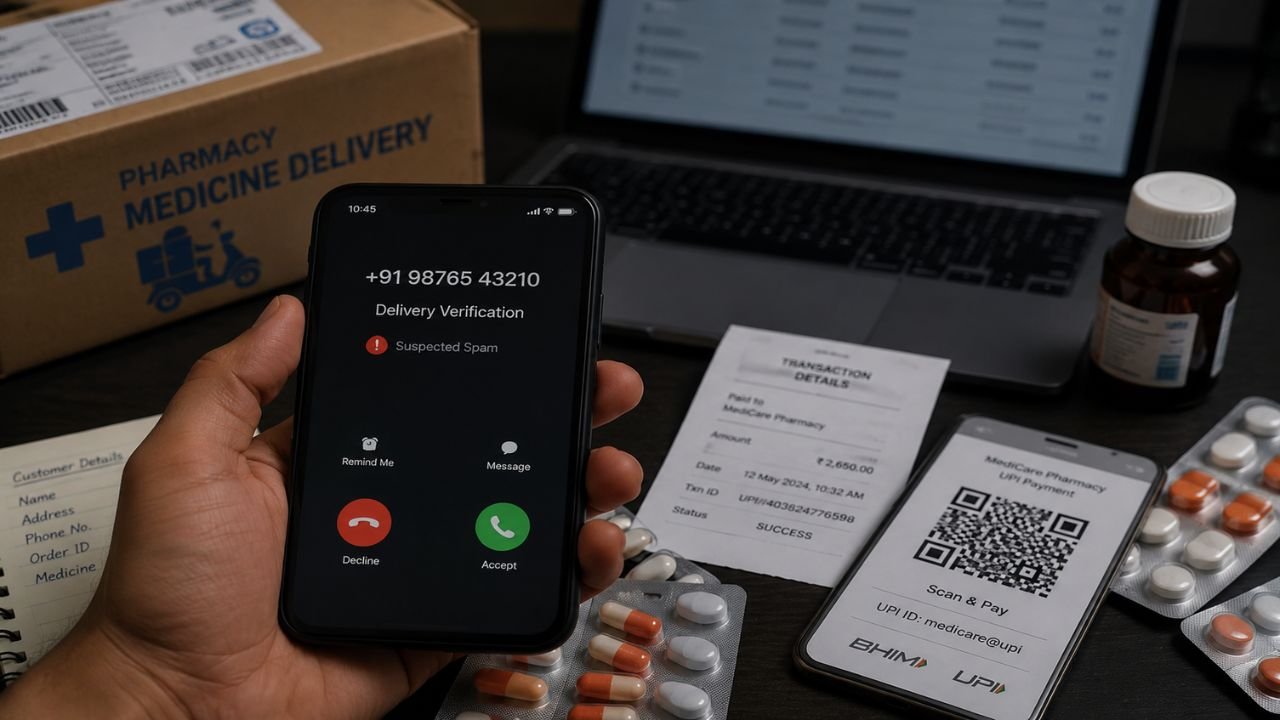

Meerut | Cyber police in Uttar Pradesh’s Meerut have busted an organised cyber fraud network allegedly involved in cheating people in the name of online medicine delivery services. Four accused have been arrested in connection with the case. Investigators claim the gang purchased customer data of people who had previously ordered medicines online and then used fake delivery verification tactics to siphon money from victims. Preliminary findings suggest that at least 37 people across several states were allegedly duped of nearly ₹20 lakh.
According to cyber police officials, the arrested accused have been identified as Sanjay Sarkar, Mohit Sarkar, Subramanyam Yamalvalasa and Harsh Sarkar. Investigators revealed that the accused had earlier worked at an online medicine company located in Sector-62, Noida. During their employment, they allegedly gained access to customer order systems, payment procedures and consumer databases, which were later misused for cyber fraud operations.
FCRF’s Flagship Cyber Law Certification Returns With a New Four-Week Cohort
The case reportedly came to light after multiple complaints were registered from different states on the Indian Cyber Crime Coordination Centre (I4C) portal. Victims alleged that they received calls from individuals posing as representatives of online medicine delivery companies who demanded payment confirmation before dispatching medicines. Following technical surveillance and analysis of digital transaction trails, police tracked the suspects and uncovered the alleged network.
Investigators stated that the gang would contact customers claiming that their medicine order had already been processed and dispatched. Victims were then instructed to scan a barcode, QR code or click on a payment verification link in order to complete delivery formalities. Several victims allegedly transferred money believing the requests to be genuine. Soon after receiving payments, the accused would reportedly block their mobile numbers and disappear.
Police said the accused allegedly purchased customer data from a Delhi-based individual identified as Munna Kumar Shah. During interrogation, investigators learned that batches of around 50 customer profiles were allegedly bought for nearly ₹2,500 each. Using this method, the gang reportedly acquired details of nearly 4,000 customers, many of whom had previously placed online medicine orders. Authorities believe this made it easier for the fraudsters to gain the trust of potential victims.
Sources indicated that the operation was carried out in a highly organised manner. The accused allegedly used Airtel Wi-Fi routers and internet devices connected to mobile phones operating through SIM cards obtained using fake identities. Officials claim the numbers used in the fraud were regularly blocked or discarded after transactions in an attempt to evade digital tracking and law enforcement scrutiny.
During raids, police reportedly recovered ₹20,000 in cash, eight mobile phones, 10 SIM cards, four ATM cards, a Honda Shine motorcycle, internet devices and several other digital gadgets from the accused. Investigators suspect some of the seized items may have been purchased using money obtained through the alleged fraud. Cyber forensic experts are now examining the devices to recover deleted data and trace the broader financial network linked to the operation.
Important cybercrime cases have repeatedly drawn warnings from renowned cyber crime expert and former IPS officer Prof. Triveni Singh, who has cautioned that cyber criminals are increasingly exploiting leaked customer databases, social engineering methods and digital payment systems to target unsuspecting people. According to him, customer data related to e-commerce, online shopping and medicine delivery platforms has become a major tool for organised cyber gangs because it allows them to directly approach potential victims with believable information.
Investigators said the alleged network was active across Haryana, Madhya Pradesh, Delhi, Himachal Pradesh, Rajasthan, Karnataka, Maharashtra, Bihar, Jharkhand and Uttar Pradesh. Police are now examining bank accounts, digital wallets, call records and online transaction histories to identify other individuals who may have been associated with the network.
Cyber police have urged citizens not to trust unsolicited calls related to deliveries, digital payments or banking services. Officials advised people to verify the authenticity of any barcode, QR code or payment link before making transactions. Citizens have also been warned never to share OTPs, banking credentials or financial information with unknown individuals.
The investigation is continuing, and authorities believe further arrests and additional revelations may emerge during digital forensic analysis and interrogation of the accused.
