

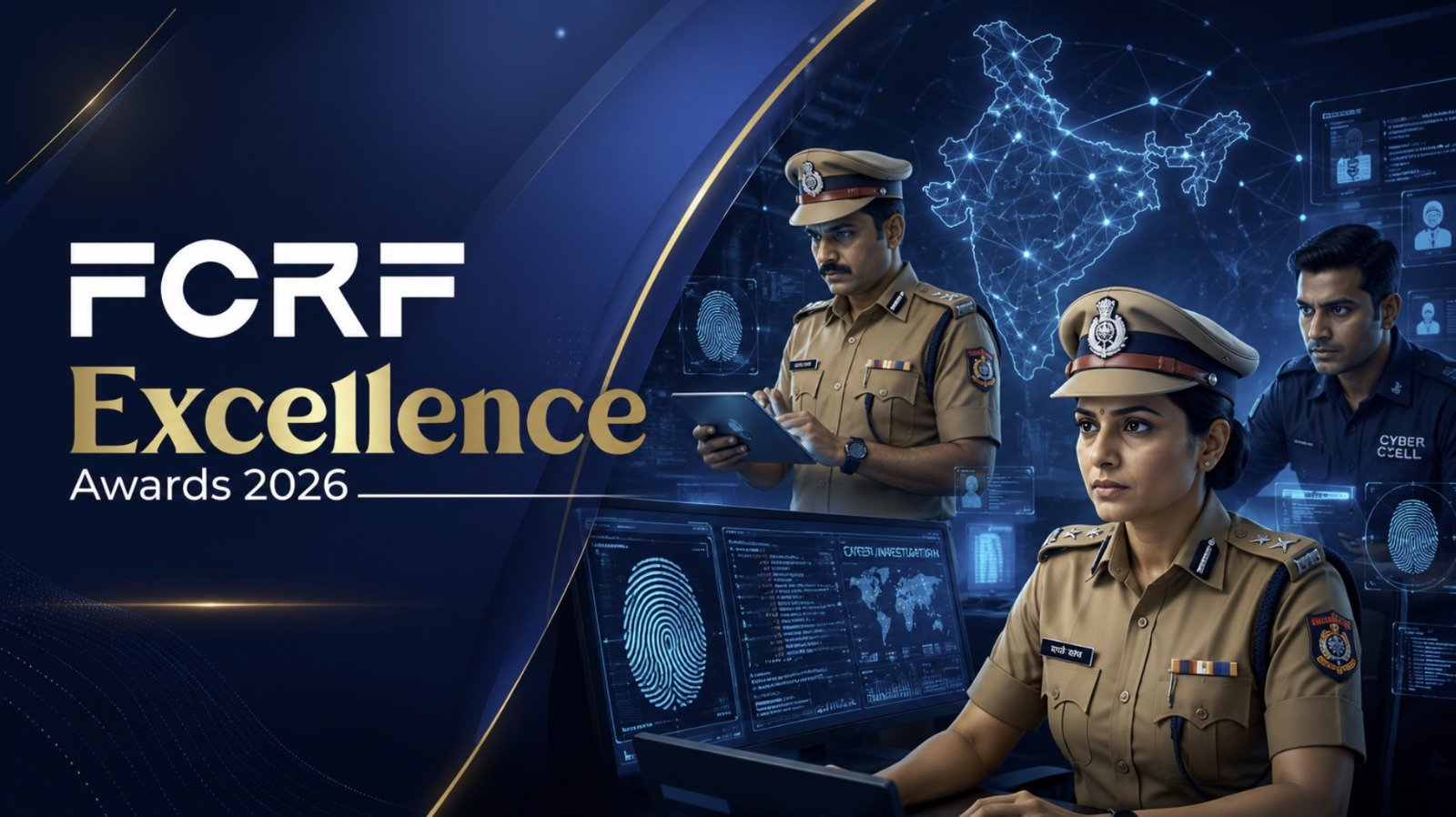

In police stations, cyber cells and district headquarters across India, much of the country’s cybercrime response is built quietly: a frozen bank account before stolen money disappears, a traced digital trail in a fraud case, a rescued victim of online blackmail, a cyber awareness drive in a village, a forensic report that holds up in court.
These interventions rarely become public stories. They are often buried in daily policing routines, shaped by understaffed units, fast-changing technology and victims who arrive after their savings, identity or dignity have already been compromised.
The FCRF Excellence Awards 2026 are attempting to bring some of that work into public view. Under the Cyber Policing and Law Enforcement Awards category, nominations are now open for police officers of all ranks, police units, cyber cells, police stations, cybercrime wings and law enforcement organisations that have made meaningful contributions in cyber policing, cybercrime investigation, cyber fraud response, digital evidence handling, cyber forensics, citizen cyber safety, cyber training and law enforcement innovation.
The awards will be presented during the FutureCrime Summit 2026, scheduled for 6–7 August 2026 at Bharat Mandapam in New Delhi. The summit is positioned as India’s largest conference on cybercrime, bringing together law enforcement, government, industry, academia, digital forensics experts, cybersecurity professionals and policy voices.
Click here to apply for the FCRF Excellence Awards 2026.
Registration Begins for FutureCrime Summit 2026, India’s Largest Cybercrime Conference
Why Recognition Matters in Cyber Policing
For years, cyber policing in India has moved faster than institutional recognition. Officers at the field level now routinely deal with financial fraud, social media impersonation, digital arrest scams, sextortion, phishing, mule accounts, cryptocurrency trails, cyberstalking, child safety cases and complex cross-border platform requests.
Yet the public imagination of policing still often remains tied to conventional crime. The officer who solves a burglary or murder case may be more visibly recognised than the cyber team that prevents hundreds of victims from losing money through rapid account-freezing coordination.
That imbalance matters. Recognition is not merely ceremonial. For police officers and cyber units, credible awards can validate difficult work, help document institutional best practices, encourage innovation and signal to the larger policing ecosystem that cybercrime response is no longer a peripheral function.
The FCRF Excellence Awards appear designed around that gap. The nomination framework allows not only self-nominations, but also nomination of another officer, a police unit, a cyber cell, a police station or an entire department. That structure is important because many impactful cybercrime initiatives are not individual achievements alone. They are built through teams, district-level coordination, forensic support, technical officers, helpline operators and investigators working together.
The openness of the awards across ranks is also significant. In cyber policing, innovation does not always come from the top. A constable managing digital complaint intake, a sub-inspector handling victim coordination, a cyber cell analyst tracing mule accounts, or a district officer building awareness systems may all contribute to measurable public impact.
Click here to apply for the FCRF Excellence Awards 2026.
Categories Built Around the Real Work of Cybercrime Response
The awards cover a wide range of cyber policing functions, reflecting the increasingly specialised nature of technology-enabled crime enforcement.
The listed categories include FCRF Excellence Award in Cyber Policing, Cyber Crime Investigation, State Cybercrime Response, Cyber Forensics, Cyber Intelligence Operations, Social Media Crime Investigation, Cyber Patrol and Monitoring, Digital Policing Innovation, Cyber Helpline Operations and Cyber Lab Development.
Each category points to a different pressure point in the cybercrime ecosystem.
Cybercrime investigation remains the most visible function, involving the tracing of accused persons, recovery of evidence and coordination with banks, platforms and telecom providers. Cyber forensics, by contrast, operates deeper in the evidentiary chain, where devices, metadata, logs, screenshots, chats and financial trails must be preserved and examined in ways that can withstand legal scrutiny.
Cyber intelligence operations and cyber patrol work reflect the growing need for proactive policing. Officers are no longer waiting only for FIRs. Many cyber teams monitor emerging fraud patterns, social media threats, fake investment networks, illegal content and repeat offender infrastructure.
Cyber helpline operations, often overlooked, are among the most critical public-facing components. In digital financial fraud, the first few hours can determine whether money is recovered or permanently lost. A responsive helpline or quick district-level escalation can make the difference between a successful freeze and a failed recovery.
The inclusion of cyber lab development and digital policing innovation also suggests a recognition that policing now depends heavily on institutional infrastructure: tools, trained personnel, case-management systems, forensic capacity, inter-agency coordination and repeatable workflows.
Click here to apply for the FCRF Excellence Awards 2026.
A Jury With Policing, Cybersecurity and Legal Depth
The credibility of any award depends heavily on who evaluates it. The FCRF Excellence Awards 2026 jury brings together senior figures from policing, cybersecurity, law, defence and public-sector technology governance.
The jury includes Dr. Vikram Singh, former Director General of Police, Uttar Pradesh, and Chancellor of Noida International University; Arun Kumar, former Director General of the Railway Protection Force; Dr. Gulshan Rai, former Director General of CERT-In; Dr. Pavan Duggal, advocate at the Supreme Court of India and a prominent voice in cyber law; Maj Gen Sandeep Sharma (Retd.); AVM (Dr.) Devesh Vatsa, adviser at the Data Security Council of India; and Prof. Triveni Singh, former IPS officer and Chief Mentor of FCRF.
That composition gives the awards a broader institutional frame. Cyber policing today sits at the intersection of law enforcement, national security, digital evidence, cyber law, incident response, platform accountability and citizen safety. A jury that includes former police leadership, cyber governance experts, military veterans and legal practitioners is better placed to assess not only the outcome of a case, but also the depth of process, innovation and replicability behind it.
This matters because cyber policing awards must avoid becoming a mere numbers exercise. The best cybercrime work is not always the biggest seizure or the most dramatic arrest. Sometimes it is a sustainable helpline model, a district-level awareness campaign, a forensic workflow that reduces delay, a cyber lab that improves evidence quality, or an investigation that exposes a larger fraud network.
A serious evaluation process should therefore ask harder questions: Was the work original? Did it help victims? Can it be replicated elsewhere? Did it improve institutional capacity? Did it strengthen digital evidence handling? Did it build public trust?
Click here to apply for the FCRF Excellence Awards 2026.
Bharat Mandapam and the Larger Stage of FutureCrime Summit 2026
The awards will be conferred during the FutureCrime Summit 2026 at Bharat Mandapam, New Delhi, on 6–7 August 2026. The setting is not incidental.
FutureCrime Summit has been framed as India’s largest conference on cybercrime, a forum where police officers, policymakers, prosecutors, forensic experts, cybersecurity professionals, academics, industry leaders and technology specialists discuss the changing nature of digital crime. For awardees, that offers more than a trophy or certificate. It offers visibility before a national and international audience that understands the operational difficulty of cyber policing.
In recent years, the nature of cybercrime has shifted from isolated technical offences to organised, professionalised and often transnational criminal activity. Digital arrest scams, mule account networks, investment fraud rings, SIM-based impersonation, social media extortion and deepfake-driven harm require a level of response that traditional police systems were not originally built for.
That is why recognition platforms such as the FCRF Excellence Awards can serve a practical purpose. They can identify good models, encourage peer learning and help departments see cyber policing not as an add-on, but as a core policing function.
For officers and units considering whether to nominate themselves or others, the question is not merely whether they have done award-winning work. It is whether their work deserves to be documented, examined and shared with the wider policing community.
The strongest nominations are likely to be those that go beyond general claims and present measurable impact: cases solved, victims helped, funds recovered or frozen, forensic capacity created, response time improved, awareness delivered, systems developed, or innovations adopted by other units.
In that sense, the FCRF Excellence Awards 2026 are not just an invitation to apply. They are a call for cyber police units and officers across ranks to make visible the work that often remains hidden inside case files, call logs, lab reports and district-level operations.
Click here to apply for the FCRF Excellence Awards 2026.
Follow for daily updates on cybercrime, corporate fraud, DFIR, hacking, investigations, and digital forensics
