
Stay ahead with our breaking stories and exclusive coverage prioritized on Google.
Add The420 on Google →Former Chief Justice of India DY Chandrachud has warned that artificial intelligence must never replace judges in deciding bail, assessing witnesses or determining a person’s liberty. He has proposed five safeguards to ensure that technology improves India’s justice system without compromising constitutional rights.
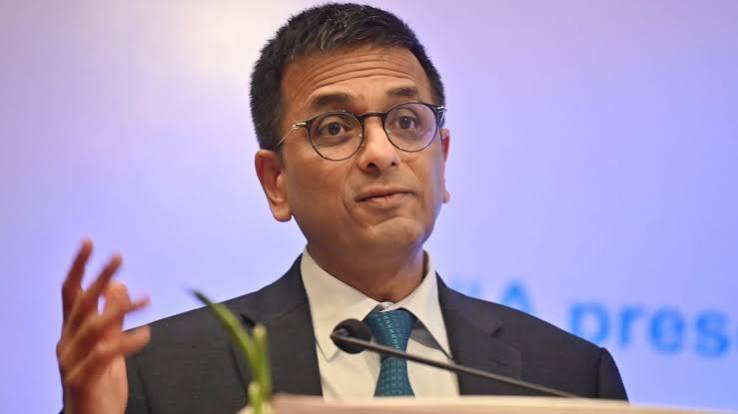
Speaking at the India Law, AI & Tech Summit 2026 in New Delhi on Saturday, November 28, Chandrachud said AI could help courts handle routine tasks such as translating judgments, preparing transcripts and organising case records.
However, decisions affecting people’s rights must remain the responsibility of human judges.
His remarks come as the Supreme Court considers draft regulations governing the use of AI across Indian courts, amid growing concerns about fabricated legal citations, unreliable automated decisions and the protection of sensitive judicial information.
FCRF Launches Certified Chief Risk Officer (CRO) Program for India’s Risk Leaders
Five Tests To Keep AI Under Human Control
Chandrachud outlined five conditions that judicial AI systems should satisfy before being used in courts.
The first requires every judicial decision to be made and signed by a human judge. AI may assist with legal research or documentation, but it cannot independently determine the outcome of a case.
The second concerns personal liberty. Chandrachud warned against using computer-generated probability scores to decide whether an accused person should receive bail.
The third requires transparency. Litigants should know when AI has been used in their cases and must have an opportunity to challenge inaccurate translations, summaries or other outputs.
The fourth focuses on accessibility. Technology should help people who struggle to access courts because of language barriers, poverty, disability or limited digital connectivity.
The fifth addresses data security. Chandrachud advocated secure judicial databases and greater attention to India-developed AI systems to protect confidential court information.
These principles are intended to ensure that technology remains accountable to the people affected by its use.
Why AI Risk Scores Cannot Replace Bail Decisions
One of Chandrachud’s strongest warnings concerned the use of algorithms to predict criminal behaviour.
Some AI systems can examine past records and generate a score estimating the likelihood that an accused person might commit another offence or fail to appear before a court.
Such assessments are known as risk scores.
For example, an automated system might classify someone as high-risk based on patterns found in historical criminal justice data.
However, those patterns may reflect existing social inequalities, incomplete records or biased enforcement practices.
Chandrachud argued that bail decisions require judges to examine the individual, the allegations, available evidence and circumstances of each case.
He linked this responsibility to Article 21 of the Constitution, which protects life and personal liberty.
An algorithm cannot replace the constitutional duty of a judge to provide reasons for a decision and remain accountable through the appeals process.
The warning is particularly significant because an incorrect assessment could contribute to someone remaining in custody unnecessarily.
Fake AI Judgments Create Another Serious Legal Risk
Chandrachud also raised concerns about AI systems producing fabricated judgments and legal references.
This problem is commonly called an AI hallucination.
It occurs when an AI system generates information that appears convincing but is inaccurate or entirely invented.
In legal proceedings, the consequences can be serious.
Chandrachud referred to an Andhra Pradesh case involving reliance on four Supreme Court judgments that did not exist.
He also discussed another case in which genuine judgments were cited alongside passages that had been fabricated.
These examples show why automated legal research requires careful verification.
The Supreme Court’s AI Committee published draft regulations on June 3, 2026, addressing similar concerns.
The proposed framework permits AI assistance in case management, translation, transcription and research while restricting its use in sensitive judicial decision-making.
Chandrachud called for independent audits, better training for district judges and mechanisms allowing litigants to challenge AI-generated errors.
His speech does not mean these recommendations have already become binding rules.
Can AI Help Reduce India’s Massive Court Backlog?
Despite the warnings, Chandrachud strongly supported using technology to improve judicial efficiency.
Referring to figures presented in Parliament, he said approximately 5.64 crore cases were pending across Indian courts.
India has roughly 15 judges for every 10 lakh people, compared with the Law Commission’s earlier recommendation of 50.
The former CJI argued that AI could reduce the time judges spend on repetitive administrative work.
He highlighted existing initiatives, including the Supreme Court’s SUVAS translation tool, which supports judgments in 18 Indian languages.
He also referred to AI-assisted courtroom transcription and technology used to identify defects in legal filings.
These tools could make proceedings easier to understand and reduce procedural delays.
However, Chandrachud stressed that digital services must not become the only way citizens can access justice.
Physical courts, human assistance and affordable legal support remain essential for people without reliable internet access.
His central message was that AI should improve the delivery of justice without taking control of judicial decisions.
What this means for you:
If AI-generated translations or summaries are used in your court proceedings, ask your lawyer to verify them against the original records. Never rely on an AI-generated judgment or legal citation without checking its authenticity through official court sources.