
Follow us on Google News

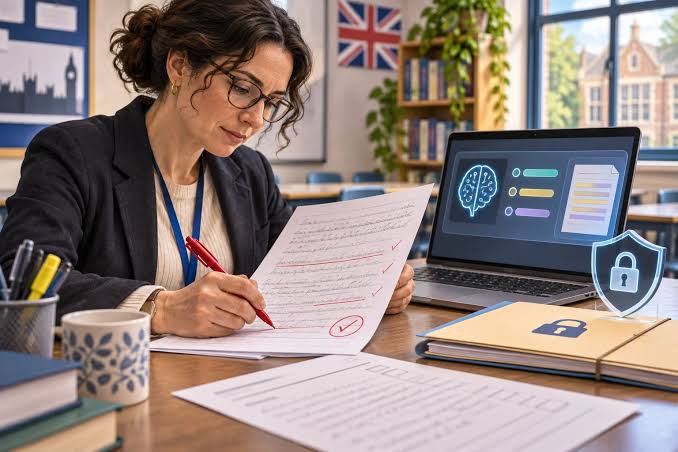
Teachers in the United Kingdom have been permitted to use artificial intelligence chatbots such as ChatGPT to grade important exam coursework, including homework and project work, sparking sharp criticism from educationists. According to a report in The Mail on Sunday, academic experts have strongly condemned the new guidelines, describing the move as deeply shameful. While students face strict punishment if they are caught using AI tools to prepare their coursework, the Joint Council for Qualifications (JCQ), the body overseeing exam boards in Britain, has quietly introduced rules allowing teachers to rely on AI assistance while marking papers.
Dr. Will van Reyk, Director of Innovation at the prestigious St Paul’s Girls’ School in London, where using AI to grade papers is banned, called the recently issued directive absurd. He stated that the policy crosses a red line that should never have been crossed.
Concerns Over Regulatory Oversight and Grading Accuracy
Warning the exam regulator Ofqual, Dr. van Reyk said that granting permission to use AI for marking, despite widespread concern over students misusing the technology, shows that the regulatory body is losing its grip. He noted that the rule essentially gives teachers a green light to feed student coursework into AI platforms, subject only to a minor condition that a human conducts the final oversight.
Dr. van Reyk also expressed surprise that there are currently no restrictions on which specific AI tools teachers may use, nor have educators been given any formal training to operate them. He pointed out that teachers will not be using specially designed educational chatbots, but will instead input student coursework into general mainstream bots like ChatGPT or Microsoft Copilot. According to him, there is no evidence proving that any mainstream AI chatbot can be reliably used to grade exam papers, raising serious possibilities of suspicious and inaccurate marks being awarded.
Questions Raised Over Double Standards for Students
Questioning why teachers’ unions have not raised this issue, Dr. van Reyk accused Britain’s Education Secretary, Lucy Powell, of making statements that contradict the official guidelines. He noted that while she told Parliament she does not believe AI has a place in marking, the guidelines clearly permit teachers to use it. He argued that if teachers themselves are using AI to evaluate work, they cannot credibly tell students not to use the technology.
Regulators and Government Defend the Guidelines
Responding to the backlash, regulatory bodies and the government issued clarifications defending their stance on human oversight. A spokesperson for the Joint Council for Qualifications stated that their guidance aligns with the regulator’s position and makes clear that AI will not be used as the primary or sole medium for marking.
Similarly, a spokesperson for Ofqual stated that awarding bodies have been instructed to ensure that expert human involvement, monitoring, and accountability remain intact. A spokesperson for the Department for Education added that AI must not replace a teacher’s professional judgment. While safe use of AI has the potential to reduce teachers’ workloads, the department emphasized that it cannot be made the main method for determining grades.