

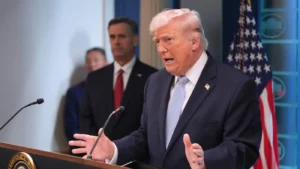
President Donald Trump has declared a national emergency over risks linked to the foreign supply of equipment used in the United States’ bulk-power system, warning that vulnerabilities in foreign-produced technology could expose critical electricity infrastructure to sabotage, unauthorized access, malicious remote actions and supply disruptions.
The executive order says the rapid expansion of advanced manufacturing, data centers, artificial intelligence and defense production has increased the country’s dependence on abundant and reliable electricity. It argues that this growing reliance has also increased the potential consequences of a successful attack or major disruption to the bulk-power system.
Algoritha Security Launches ‘Make in India’ Cyber Lab for Educational Institutions
Why has the US declared a national emergency over the power grid?
The order identifies foreign dependence in bulk-power system electric equipment as a national security concern. It says some foreign entities may be able to create or exploit vulnerabilities in equipment supplied to the United States.
One concern highlighted in the order is the possibility of digital backdoors that could allow equipment to be accessed remotely by a foreign country. It also warns that dependence on foreign sources can create supply-chain vulnerabilities that could reduce the availability of replacement products during international trade disruptions or other emergencies.
Trump determined that the foreign supply of bulk-power system electric equipment presents an “unusual and extraordinary threat” originating substantially outside the United States and affecting national security, foreign policy and the economy.
What foreign power equipment can be restricted?
The order prohibits certain transactions involving foreign-produced bulk-power system electric equipment when a foreign country or foreign national has an interest in the property involved and the equipment is linked to a “Covered Foreign Entity.”
Transactions may be restricted if they pose an undue risk of sabotage, subversion, unauthorized access, malicious remote action or supply disruption. Restrictions can also apply where equipment poses a risk of catastrophic effects on US critical infrastructure or the economy, or otherwise creates an unacceptable national security or public safety risk.
The scope covers equipment and associated components, software, firmware, digital services, maintenance services and remote-access capabilities.
Authorities may also impose conditions on the continued use, operation, maintenance or updating of previously acquired foreign-manufactured equipment. Measures could include identifying, isolating, monitoring, securing, disconnecting, replacing or removing equipment considered a risk.
What equipment falls under the order?
The order defines bulk-power system electric equipment broadly. It includes equipment used in substations, control rooms and power-generating stations.
Among the items listed are reactors, capacitors, substation transformers, utility-scale and other grid-connected inverters, battery energy storage systems, uninterruptible power supplies supporting critical infrastructure, generators, voltage regulators, automatic circuit reclosers, instrument transformers, high-voltage circuit breakers and generation turbines.
The definition also covers industrial control systems, including remote terminal units, programmable logic controllers and intelligent electronic devices, along with distributed control systems and safety instrumented systems.
Authorities may additionally consider associated software and firmware, remote-access capabilities, lifecycle maintenance and update mechanisms, and other supply-chain dependencies when deciding whether equipment poses an unacceptable risk.
How will the US identify risky foreign suppliers?
The responsible Secretary is authorized to establish criteria for identifying particular equipment and vendors that may qualify for future transactions.
Rules may also determine which countries or persons qualify as Covered Foreign Entities and identify equipment or countries requiring particular scrutiny.
A Covered Foreign Entity can include a country or person owned, controlled by, or subject to the jurisdiction or direction of a government covered by certain US arms embargoes or sanctions. The definition can also cover entities determined by relevant US authorities to have engaged in conduct detrimental to US national security or foreign policy.
The order also prohibits attempts to evade or avoid its restrictions and prohibits conspiracies formed to violate its requirements.
What happens to equipment already installed?
The government has been given authority to address foreign-manufactured or operated equipment acquired or installed before the order when it presents national security concerns.
Officials may require measures to identify, isolate, monitor, secure, disconnect, replace or remove such equipment. Before ordering isolation, disconnection, replacement or removal, the Secretary is directed to consider reliability and safety, the availability of secure replacements and continuity of essential services.
The order also allows for phased compliance where appropriate.
How will federal procurement rules change?
The order directs the government to strengthen federal procurement policies for energy infrastructure.
Within 180 days, the Secretary, working with the Federal Acquisition Regulatory Council and other appropriate officials, is directed to develop and submit recommended revisions to the Federal Acquisition Regulation.
The changes are intended to ensure that national security risks are properly considered when the federal government procures energy infrastructure and to prioritize the acquisition of US-manufactured energy infrastructure.
Within 90 days of receiving those recommendations, the FAR Council is directed to propose appropriate amendments to federal procurement rules.
What happens next?
Within 120 days of the order, rules or regulations are to be published to implement the authorities delegated under it.
Officials are also directed to identify foreign-produced bulk-power equipment that presents unacceptable risks and develop recommendations for identifying, inventorying, isolating, monitoring or replacing such equipment.
The order authorizes recurring and final reports to Congress regarding the national emergency and gives federal agencies authority to take appropriate measures within their respective jurisdictions to implement its provisions.
About the author — Ayesha Aayat writes on cybercrime, digital safety, and emerging online threats. Her work focuses on public awareness, legal clarity, and technology-driven risks.
