


Financial cyber crime has emerged as a serious challenge across the globe. Due to this, lots of innocent people are being duped by cyber criminals. Amounts debited fraudulently are routed through multiple bank accounts which makes investigation more complex. Law enforcement agencies issue notices to banks for freezing bank accounts involved in cyber fraud. Bank accounts of many innocent people are also frozen based on suspicious transactions trail.
Indian Cyber Crime Coordination Centre (I4C) is established by Ministry of Home Affairs (Government of India) is envisaged to act as the nodal point to curb cyber crime in the country. I4C has developed the Grievance Redressal Module (GRM) for bank account holders whose bank accounts are frozen, amount put on hold or suspension of digital banking services due to suspicious transactions. GRM is working as a transparent and effective solution for aggrieved bank customers. The aggrieved account holder can raise grievance in hassle free manner. If aggrieved account holder is a senior citizen, especially abled or terminally ill and unable to visit a branch, then any other person on his behalf can raise the grievance. Grievance can be lodged through account holder’s bank branch where account is held or any other designated branch/office. The aggrieved customer needs to visit his bank branch for KYC reverification.
Grievance Redressal Module (GRM) is an online grievance redressal portal that operates under the National Cyber Crime Reporting Portal (NCRP) and Citizen Financial Cyber Fraud Reporting and Management System (CFCFRMS). Its main objective is to provide relief to genuine bank account holders by conducting a fair review of bank accounts that have been frozen or placed under a lien during cyber crime investigations.
For raising the grievance through Grievance Redressal Portal, account holder (aggrieved person) visits his bank branch and gives application along with KYC documents and a passport size photograph for unfreezing the bank account or removing the lien from his account. Subsequently, the bank verifies the customer’s KYC documents and transactions. After verification of KYC documents, bank registers customer’s complaint on the Grievance Redressal Portal https://ncrp-grievanceredressal.mha.gov.in within 7 calendar days after receiving the application from aggrieved customer. During complaint registration process, bank uploads customer’s application, KYC documents, passport size photograph and transaction statement. Bank also selects present account status from following options whatever applicable:
- Debit Freeze
- Put on hold
- Suspension of digital banking services
- Put on hold and Suspension of digital banking services
- Put on hold and Debit freeze
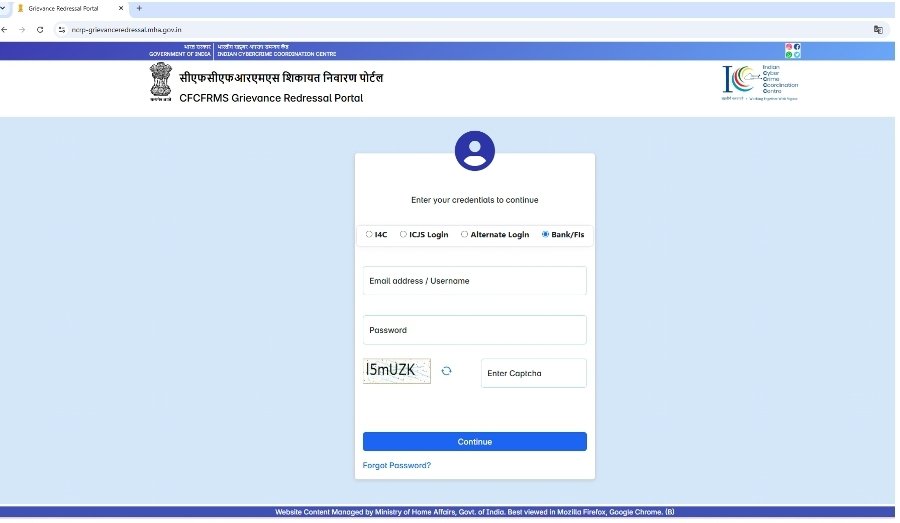
After submitting the complaint, the same is visible to the investigating police officer. Subsequently, investigating police officer examines the suspicious transactions trail and account holder’s involvement in fraud and issues notice to the aggrieved account holder and his bank for appearing through video conferencing. After investigation, investigating police officer decides whether to unfreeze the account, remove the lien or reject the complaint and informs the bank accordingly.
If investigating police officer satisfies with the justification given by the aggrieved account holder, he issues order to bank within 15 calendar days for removing lien, unfreezing of account or restoration of digital banking services. If investigating police officer does not take any action on complaint within 15 calendar days, the complaint auto escalates to the District Grievance Officer.
If the complaint is rejected by the investigating police officer at police station level, aggrieved account holder can appeal to the District Grievance Officer within 15 calendar days. If review request is rejected by the District Grievance Officer, he can appeal to the State Grievance Officer within 15 calendar days. Further, if appeal is rejected by the State Grievance Officer, or aggrieved account holder is not satisfied with the decision, he may approach jurisdictional court.
Disclaimer: “All contents presented in this article are the personal views of the author. These materials can not be considered as official views of the author.”
Author: Satyendra Sharma (Chief Manager- IT), Punjab National Bank, Head Office: Centre for Learning & Innovation
