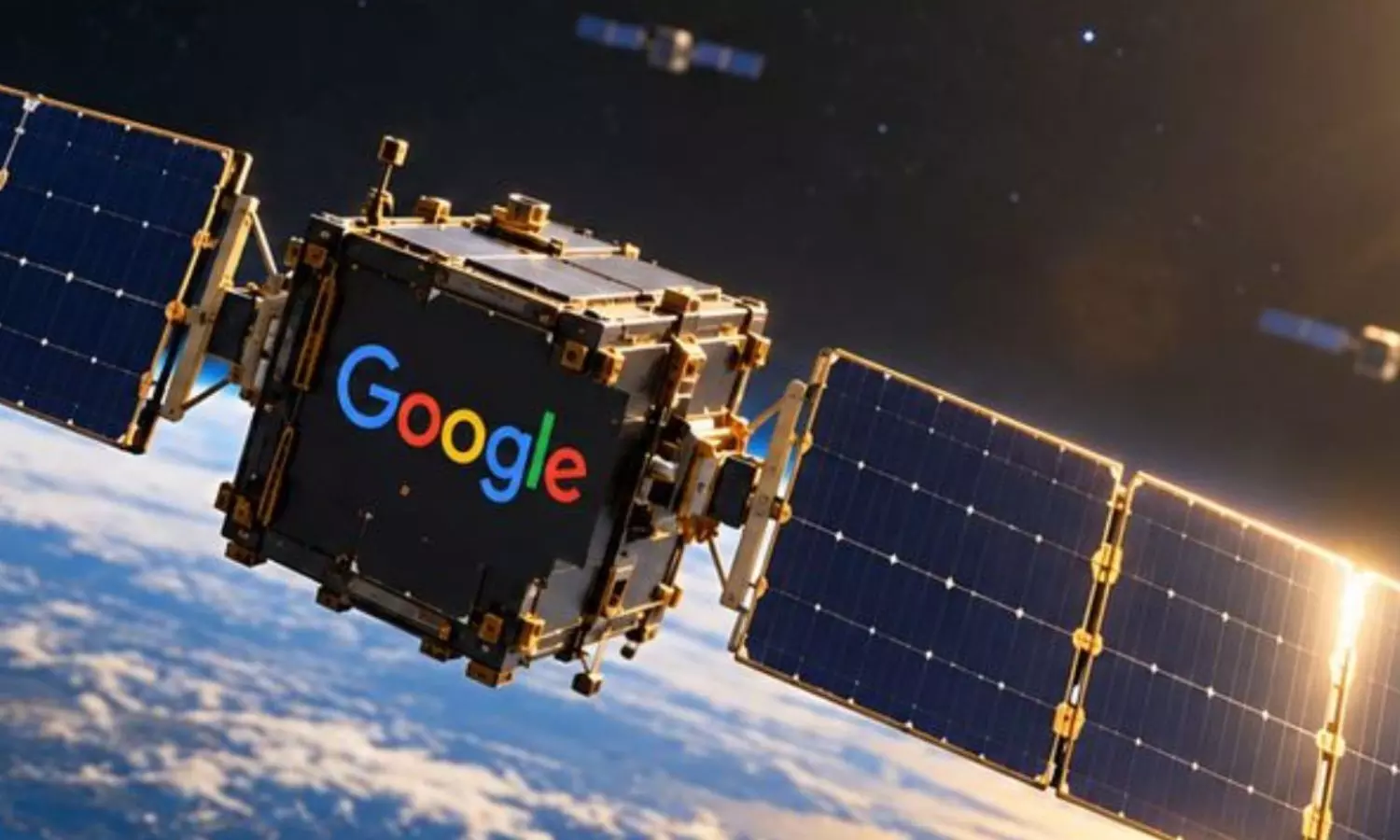

Google has successfully received its first artificial intelligence response from an experimental satellite operating in orbit, marking a new milestone in its effort to explore whether large-scale AI computing could eventually move into space.
The demonstration is part of Project Suncatcher, Google’s research initiative to develop satellite-based computing infrastructure powered by solar energy. The company said its prototype satellite ran the Gemma 4 open AI model on an onboard Tensor Processing Unit (TPU) and transmitted the model’s response back to Earth.
The milestone, announced on October 30, followed the satellite’s launch on October 1. Google described it as the first AI response generated by a data-centre-class TPU in orbit. The company has not claimed that this was the first time any AI system has operated in space.
Satellite Runs Gemma 4 And Sends Response To Earth
Google said its engineering team spent the weeks after launch completing initial checks, powering up the satellite’s onboard systems and running preliminary machine learning tests.
The first successful demonstration involved sending a prompt from a ground station to the satellite. The onboard Gemma 4 model was asked to generate a haiku about being in space.
As the satellite passed near Svalbard, Norway, the response was transmitted back to Earth. Google said the team subsequently tested the model with space-themed limericks and prompts asking it to report the technical status of the satellite’s onboard systems.
The experiment demonstrated that the satellite’s computing hardware could receive instructions, execute an AI workload in orbit and return the result to a ground station.
However, this remains an early technical demonstration. Google has not released detailed performance figures, processing speeds or information showing how the system compares with conventional data-centre infrastructure.
Project Suncatcher Aims To Move AI Computing Into Space
Project Suncatcher explores whether networks of satellites equipped with Google’s AI chips could eventually handle large computing workloads while orbiting Earth.
The idea is to use solar energy available in space to power computing systems. Satellites in low Earth orbit can receive sunlight for extended periods, potentially offering a different energy model from terrestrial data centres that depend on electricity grids and large-scale cooling infrastructure.
Google has been exploring this possibility through research into satellite design, hardware reliability and communication between spacecraft. The company has also worked with Planet, a satellite operator, to develop its prototype mission.
The longer-term concept involves connecting multiple satellites so they can share computing workloads. Such a network would require high-speed communication links, precise positioning and reliable coordination between spacecraft.
Google has previously discussed using laser-based communication to connect satellites. The technology would need to support high data-transfer rates over relatively short distances while both spacecraft are moving in orbit.
Radiation And Heat Remain Major Challenges
The successful AI response does not establish that space-based data centres are ready for commercial use. Google still needs to determine whether its processors can operate reliably under the physical conditions found in orbit.
The next phase of Project Suncatcher will examine how the TPUs perform under thermal stress and radiation exposure. These conditions can affect electronic components, cause computing errors and reduce the reliability of hardware over time.
Cooling is another major engineering challenge. Conventional data centres use airflow and cooling systems to remove heat generated by processors. In the vacuum of space, there is no surrounding air to carry heat away, so engineers must rely on systems such as heat pipes and radiators.
Google has previously described these challenges as central to its research. The company has conducted ground-based tests, but says actual orbital conditions are necessary to understand how the hardware performs over longer periods.
The next planned milestone is to test two interconnected satellites in 2027. That experiment would help establish whether separate spacecraft can communicate and work together while carrying out computing tasks.
What This Means For The Future Of AI Infrastructure
The demonstration comes as technology companies face growing demand for computing power to train and operate increasingly capable AI models. Building new data centres on Earth requires substantial investment in electricity, land, cooling and supporting infrastructure.
Space-based computing is being explored as one possible way to address some of these constraints. Solar-powered satellites could eventually provide access to a different source of energy, although the costs of launching hardware, maintaining spacecraft and transmitting data remain significant obstacles.
For now, Google’s achievement is proof of an early technical capability, not evidence that orbital data centres are ready to replace facilities on Earth. The company must still demonstrate that its chips can withstand prolonged exposure to radiation and temperature extremes and that multiple satellites can operate as a connected computing network.
Project Suncatcher is therefore moving from an initial hardware test towards more demanding experiments. Whether the concept can become a practical part of the AI infrastructure industry will depend on what Google learns from those tests over the next several years.