

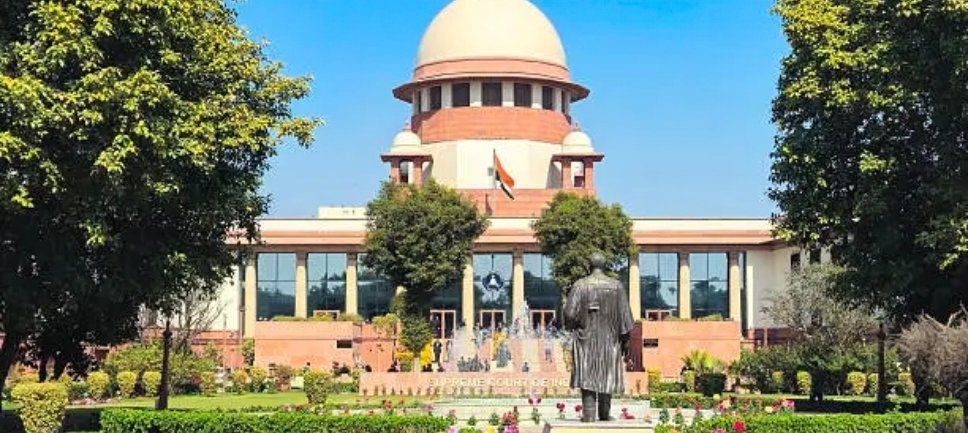
The Supreme Court has suggested linking unpaid traffic challans with electricity bills to improve recovery across India.
Why Did the Supreme Court Suggest a New Recovery System?
The Supreme Court has expressed concern over the large amount of unpaid e-challans across the country and suggested exploring a practical mechanism for recovering traffic penalties in states and Union Territories.
The court suggested examining whether traffic challan amounts could be added to electricity bills for recovery. It also made clear that this was only a suggestion and not a binding order.
The Bench of Justice J.B. Pardiwala and Justice K.V. Viswanathan was informed that e-challans worth nearly ₹45,000 crore had been issued across the country. Of this amount, about ₹25,000 crore had been recovered, while approximately ₹20,000 crore remained outstanding. The court observed that merely issuing a large number of e-challans was not enough and that effective recovery of penalties was also necessary.
FCRF Launches CP-FRM to Build India’s Next Generation of Fraud Risk Professionals
How Could Unpaid Challans Be Linked to Services?
The court also suggested considering restrictions on certain vehicle-related services for motorists who have outstanding challans. Among the possibilities discussed were withholding renewal of registration certificates, duplicate registration certificates and transfer of vehicle ownership until pending challans are paid.
The discussion reflected the court’s concern about ensuring that traffic penalties are not limited to being recorded electronically but are also effectively enforced. The suggestions are aimed at identifying mechanisms that could make recovery more practical while dealing with a substantial amount of unpaid traffic penalties.
What Other Measures Were Discussed?
Apart from electricity bills and vehicle-related services, the court discussed other possible mechanisms connected with regulatory requirements for vehicles.
These included Fastag statements and Pollution Under Control certificates. The proceedings considered whether such systems could potentially be connected with the recovery of pending traffic challans.
The court’s observations, however, were part of a broader discussion on possible methods of improving traffic fine recovery. The suggestion regarding electricity bills was not issued as a mandatory direction. The focus remained on finding workable ways to address the gap between challans issued and penalties actually collected.
How Is the Matter Linked to Road Safety?
The proceedings arise from a matter connected with a 2012 road safety public interest litigation. The PIL was filed by orthopaedic surgeon Dr S. Rajasekaran in connection with increasing road accidents and concerns over road safety.
During the hearing, the court sought practical suggestions from states for the recovery of unpaid traffic fines. The discussion on linking challans with electricity bills and restricting vehicle-related services emerged in this context.
With around ₹20,000 crore in traffic penalties still outstanding, the court highlighted the importance of effective collection alongside enforcement. Its observations indicate that authorities may need to examine systems that make payment of pending challans harder to avoid while remaining administratively workable.
The proposals discussed before the court cover both direct recovery mechanisms and restrictions linked to services used by vehicle owners. No mandatory order requiring traffic challans to be added to electricity bills was indicated, and the idea remains a suggestion for consideration.
Follow for daily updates on cybercrime, corporate fraud, DFIR, hacking, investigations, and digital forensics
