
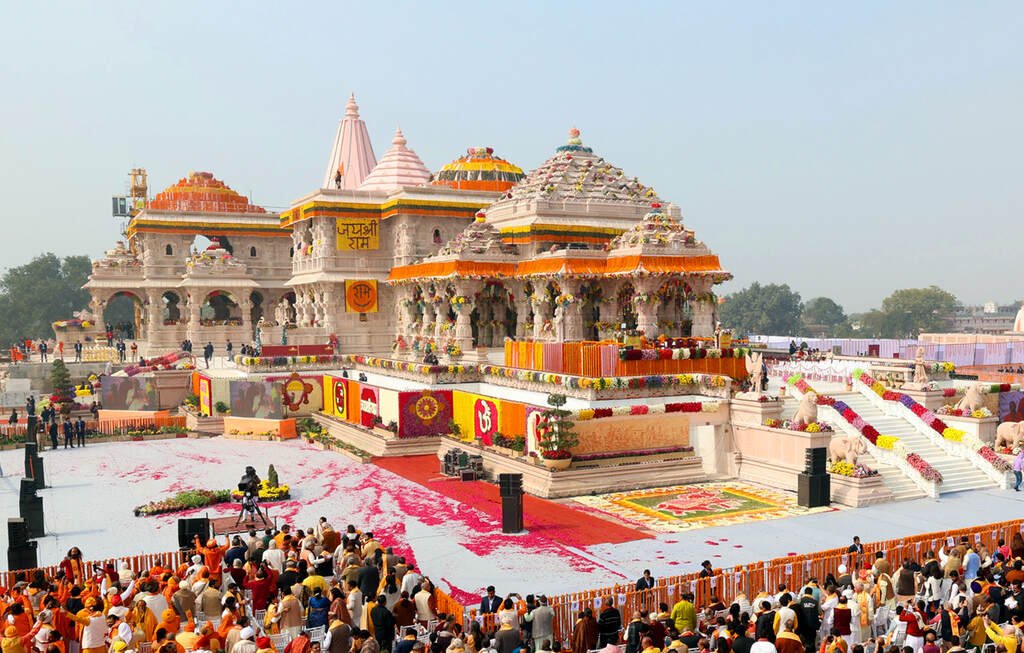

The investigation into alleged embezzlement of devotees’ donations at the Ram Mandir in Ayodhya has expanded significantly. Following the arrest of eight accused, police have widened the probe to include nearly 50 personnel involved in the temple’s day-to-day operations, individuals associated with the Shri Ram Janmabhoomi Teerth Kshetra Trust, and a range of related financial transactions, as investigators try to determine whether the alleged embezzlement was part of a long-running organised operation.
Who Was Arrested, and How the Alleged Theft Worked
The case was registered on June 25 following a Trust complaint, leading to the arrest of Avinash Shukla, Lavkush Mishra, Anukalp Mishra, Manish Kumar Yadav, Karunesh Pandey, Ramashankar Mishra, Ram Shankar Yadav alias Tinnu Yadav, and retired bank employee Subhash Srivastava. Investigators say Tinnu Yadav had previously served as driver to former Trust general secretary Champat Rai, and allegedly supervised the temple’s donation boxes, while his nephew Manish Yadav, recruited on Tinnu’s recommendation, was directly involved in counting the daily offerings.
Police consider CCTV footage central to the case, saying it allegedly shows six of the eight accused concealing bundles of cash inside their clothes, pockets and shoes while counting donations at the temple’s Pilgrim Facilitation Centre, where large volumes of cash offerings are processed daily. Investigators have already recovered ₹1 lakh from Tinnu Yadav’s residence and ₹2 lakh from Manish Yadav’s home, and plan to take both men to multiple locations during police remand in an effort to recover further cash, jewellery and other assets allegedly purchased with the siphoned funds.
A Widening Financial Trail and a ₹3 Crore Discrepancy
Sources say the investigation is no longer limited to the alleged theft of donation money itself. A Special Investigation Team is now examining a discrepancy of roughly ₹3 crore that reportedly surfaced through revelations from the Trust’s own treasurer, prompting a broader review of financial records tied to the Trust’s construction projects, land purchases and other transactions to ensure compliance with applicable procedures.
Around 50 people were engaged in counting cash donations at the temple, many reportedly recruited on the recommendation of Trust office-bearers or individuals closely associated with the Trust. Investigators are now examining their backgrounds, bank accounts, and whether any possess assets disproportionate to their known income, while also scrutinising the role of senior Trust-linked functionaries and government officials connected to the temple’s administration. However, no additional individuals have been formally accused at this stage, and officials stress the investigation remains ongoing.
A Trust That Has Faced Financial Scrutiny Before
This is not the first time the Trust’s finances have drawn public controversy. In 2021, Aam Aadmi Party Rajya Sabha MP Sanjay Singh and a Samajwadi Party leader alleged that the Trust, under Champat Rai, purchased land in Ayodhya’s Bagh Bijaisi area for ₹18.5 crore just minutes after the same plot had been registered to two individuals for ₹2 crore, demanding a CBI and ED probe into the transaction. Rai rejected the allegations at the time as politically motivated and said the land was purchased below market value.
Separately, the Trust’s bank accounts have previously been targeted through cheque-cloning fraud, with four men arrested in 2020 for siphoning off ₹6 lakh from the Trust’s State Bank of India account using forged signatures on cloned cheques, a scheme uncovered only after a third fraudulent cheque was intercepted at a bank clearing house. That history of scrutiny, spanning alleged land-deal irregularities and cheque fraud, forms the backdrop against which the current donation-counting investigation is unfolding.
Political Fallout and What Comes Next
Two senior Trust-linked functionaries have already resigned from their positions since the case first surfaced in early June, and Opposition parties have indicated they intend to raise the issue during Parliament’s Monsoon Session, which begins July 20, a signal that the case is likely to draw national political attention well beyond Ayodhya. Police had previously questioned six of the arrested accused during custodial remand, and cash, jewellery and property documents recovered after interrogating former bank employees Subhash Srivastava and Ramashankar Mishra have already been submitted before the court for forensic examination and financial analysis. Authorities have maintained that the investigation is being conducted strictly on the basis of evidence gathered, and that further legal action will depend entirely on what the ongoing financial and forensic review uncovers.
Follow for daily updates on cybercrime, corporate fraud, DFIR, hacking, investigations, and digital forensics
