

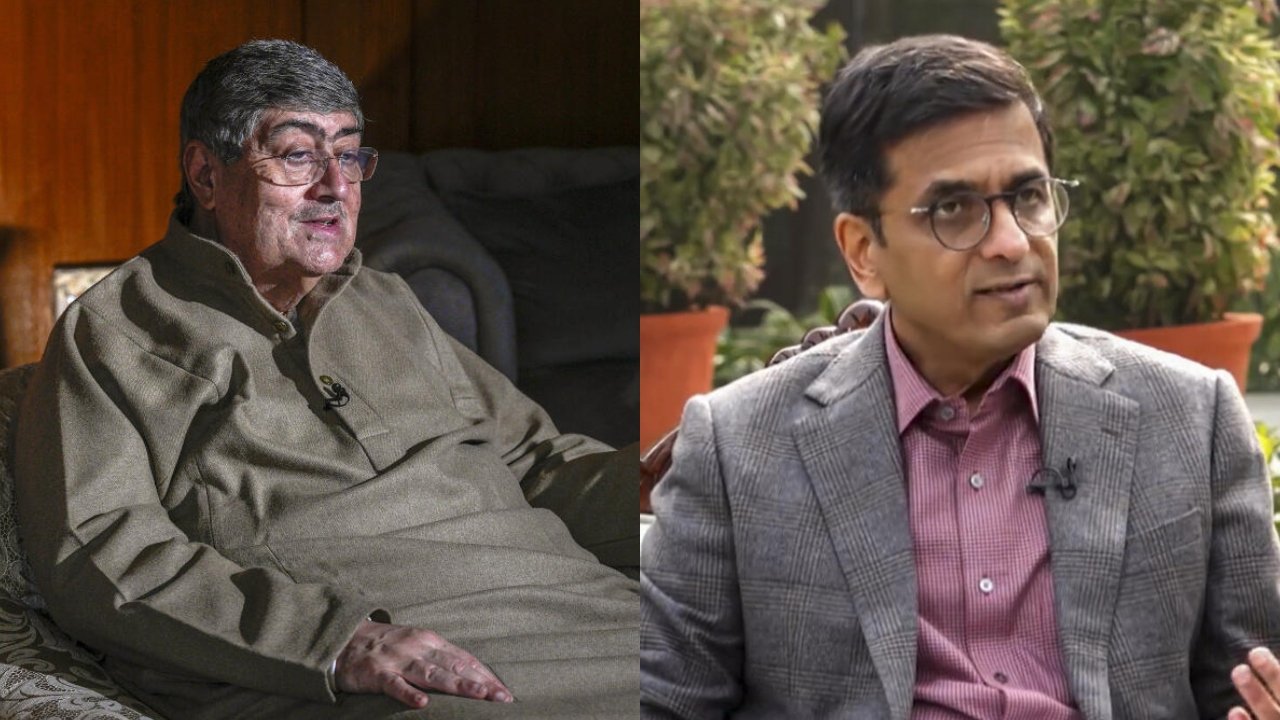

Former Supreme Court judge Sanjay Kishan Kaul has raised fresh questions over how judicial appointments were handled during former Chief Justice of India D.Y. Chandrachud’s tenure, alleging that government views were sometimes sought before the Supreme Court collegium had formally discussed candidates.
Kaul said he regarded such discussions as a form of “pre-approval” and believed the judiciary should have been firmer while dealing with the executive on appointments.
His remarks appear in his forthcoming memoir Without Fear or Favour and were expanded upon during an interview with journalist Karan Thapar.
Chandrachud has said he cannot give a detailed response until he reads Kaul’s account in full, while stressing that the government legitimately has a role in the judicial appointment process.
FCRF’s Chief AI Officer Certification Returns on November 14 to Prepare Future AI Leaders
Kaul Says Government Views Were Sought Too Early
The central disagreement concerns the stage at which the government should be consulted.
Kaul said consultation itself was not the problem.
His objection was to discussions with the executive taking place before the collegium had formally considered and approved names.
Under India’s collegium system, the Chief Justice of India and senior Supreme Court judges collectively recommend appointments to the higher judiciary.
The government can examine those recommendations, seek clarifications and return names for reconsideration.
Kaul argues that seeking the government’s informal view before the collegium reaches its own decision changes that balance.
He said such a practice gives the political executive a greater role than the formal appointment structure envisages.
Dispute Emerged Over Sixth Supreme Court Candidate
Kaul described one collegium meeting in which members had broadly agreed on five candidates for elevation to the Supreme Court.
According to his account, Chandrachud proposed a sixth name shortly before or during the meeting.
The other collegium members were reportedly not prepared to approve that candidate.
Kaul said Chandrachud then suggested checking the government’s view.
He opposed that approach.
Kaul later said he suspected that the government’s position on the names may already have been informally discussed.
He described this as part of a wider practice in which names sometimes moved through informal discussions before formal collegium consideration.
These are Kaul’s recollections and interpretation of internal judicial deliberations.
Chandrachud has not accepted that characterisation.
Chandrachud Says Government Dialogue Is Part of Process
Chandrachud told The Indian Express that he would need to read Kaul’s memoir before responding fully.
He said his collegium meetings were generally respectful and involved reasoned discussion.
He also said he did not recall Kaul walking out of a collegium meeting, despite Kaul describing an instance in which he says he left a discussion after objecting to how a candidate’s identity was being considered.
Chandrachud also pointed out that the executive has a recognised role in judicial appointments.
The President formally appoints judges, while the government processes collegium recommendations and can raise objections.
The dispute is therefore not about whether the government can participate at all.
It is about whether consultation should take place before the collegium reaches its own institutional decision.
Minority Judge Candidate Also Became Point of Conflict
Kaul’s memoir describes another disagreement involving a candidate from a minority religious community.
He alleges that questions were raised about whether further minority representation was needed and, later, about the candidate’s caste background.
Kaul described that line of inquiry as inappropriate and said he objected strongly.
According to his account, the disagreement caused the collegium process to stall temporarily before the candidate was eventually cleared.
Kaul uses the episode to argue that judicial appointments should not become overly influenced by informal political considerations.
The government’s precise version of that episode has not been publicly detailed.
Collegium System Already Faces Transparency Questions
The controversy comes amid a long-running debate over the collegium system itself.
The current system evolved through Supreme Court judgments rather than legislation.
The Chief Justice of India and senior judges recommend appointments, while the government can conduct background checks, raise objections and return recommendations.
If the collegium reiterates a name, established Supreme Court precedent limits the government’s ability to block the appointment indefinitely.
Critics of the collegium say the system is opaque and concentrates too much authority within the judiciary.
Supporters argue that it is necessary to protect judicial independence from political influence.
Kaul himself has called the collegium deeply imperfect.
He has also said the National Judicial Appointments Commission, which would have given the executive a larger formal role, should perhaps have been allowed to operate before being struck down by the Supreme Court in 2015.
Kaul Also Raises Questions Over Case Allocation
The former judge has separately described tensions with Chandrachud over the handling of sensitive cases.
Kaul said a matter involving delays in judicial appointments was removed from his bench while he was pressing the government to act on pending collegium recommendations.
He said he was told there had been a procedural issue relating to how the case was originally assigned.
Kaul also recalled discussions over litigation seeking reconsideration of parts of the Supreme Court’s earlier Prevention of Money Laundering Act judgment.
He said Chandrachud advised taking a “middle path”.
Kaul has not claimed he can prove that the government directly pressured Chandrachud over either matter.
He has instead presented the episodes as examples of broader institutional tension between the judiciary, the Chief Justice’s administrative authority and the executive.
The disclosures are significant because internal collegium discussions are rarely described publicly in this level of detail.
They are likely to add to the wider debate over how transparent judicial appointments should be and where informal government consultation should begin and end.
What this means for you:
The controversy is not simply about two former judges disagreeing. It raises a larger constitutional question over how much informal influence the executive should have before the collegium formally decides who is recommended for appointment to India’s higher judiciary.
Follow for daily updates on cybercrime, corporate fraud, DFIR, hacking, investigations, and digital forensics
