
Follow us on Google News

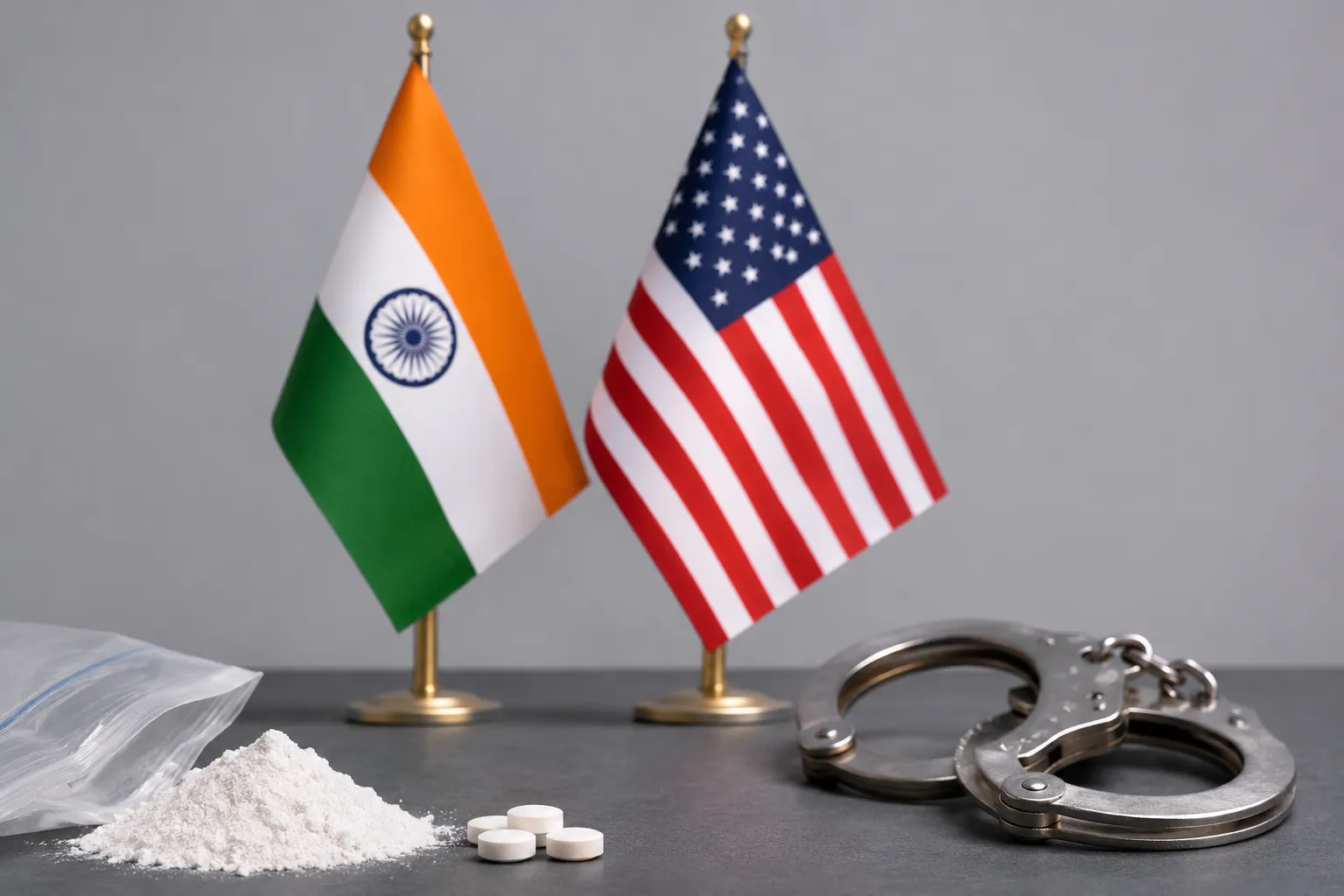
India and the United States have agreed to strengthen cooperation against drug trafficking, focusing on criminal supply networks.
What Was Discussed at the India-US Meeting?
The second India-US Drug Policy Executive Working Group meeting, held in New Delhi on November 2 and 3, focused on intelligence sharing, coordinated investigations, synthetic drugs and the diversion of precursor chemicals used in narcotics manufacturing.
The Indian delegation was led by Narcotics Control Bureau (NCB) Director General Anurag Garg, while Debbie Seguin, Acting Deputy Director of the White House Office of National Drug Control Policy, headed the US delegation.
Officials reviewed progress since the working group’s first meeting in Washington in January 2026. Both countries agreed to strengthen cooperation against cross-border trafficking networks, particularly those using legitimate commercial and pharmaceutical channels to facilitate illegal drug distribution.
https://the420.in/fcrf-certified-chief-ai-officer-second-cohort-november-2026/
How Will India Target Drug Trafficking Networks?
India outlined its Vision Document on Narcotics Control for 2026-2029, which places greater emphasis on intelligence-led enforcement and dismantling organised criminal networks rather than concentrating solely on seizures and arrests.
The roadmap identifies four priorities: intelligence-based enforcement, tighter control of precursor chemicals and synthetic drugs, demand and harm reduction, and stronger coordination among enforcement agencies.
Authorities are increasingly examining the financial, chemical and logistical systems supporting trafficking operations. These include financiers, chemical suppliers, transport operators and intermediaries who help criminal networks move drugs across borders.
Why Are Online Platforms Under Scrutiny?
The discussions examined the misuse of online marketplaces and pharmaceutical distribution channels for illegal drug trafficking. Officials reviewed India’s Operation MedMax and Operation WIPE, two enforcement initiatives targeting the unlawful movement and sale of regulated pharmaceutical substances.
Operation MedMax exposed a transnational pharmaceutical trafficking network in 2025. Investigations indicated that the operation involved a call centre in Karnataka and business-to-business platforms used to supply tramadol and other psychotropic substances to overseas buyers.
Operation WIPE, launched by the NCB in April 2026, targets illegal online listings of pharmaceutical drugs regulated under the Narcotic Drugs and Psychotropic Substances Act. Authorities have also worked with digital platforms to identify and remove suspicious listings.
What Are the Next Steps in Cooperation?
Both countries agreed to continue exchanging intelligence, sharing enforcement practices and coordinating responses to emerging narcotics threats. Discussions also covered India’s Voluntary Code of Conduct aimed at preventing the diversion of precursor chemicals from legitimate industrial and pharmaceutical supply chains.
US officials highlighted the importance of international coordination in disrupting criminal supply networks. ONDCP Director Sara Carter described trafficking organisations as sophisticated logistics operations, while US Ambassador to India Sergio Gor emphasised cooperation against illicit chemical supplies.
The partnership also covers prevention, rehabilitation and demand reduction, extending cooperation beyond criminal investigations.
The discussions reflect a broader approach to narcotics enforcement, with India and the US seeking to identify and disrupt the financing, distribution networks and commercial infrastructure that enable international drug trafficking.