

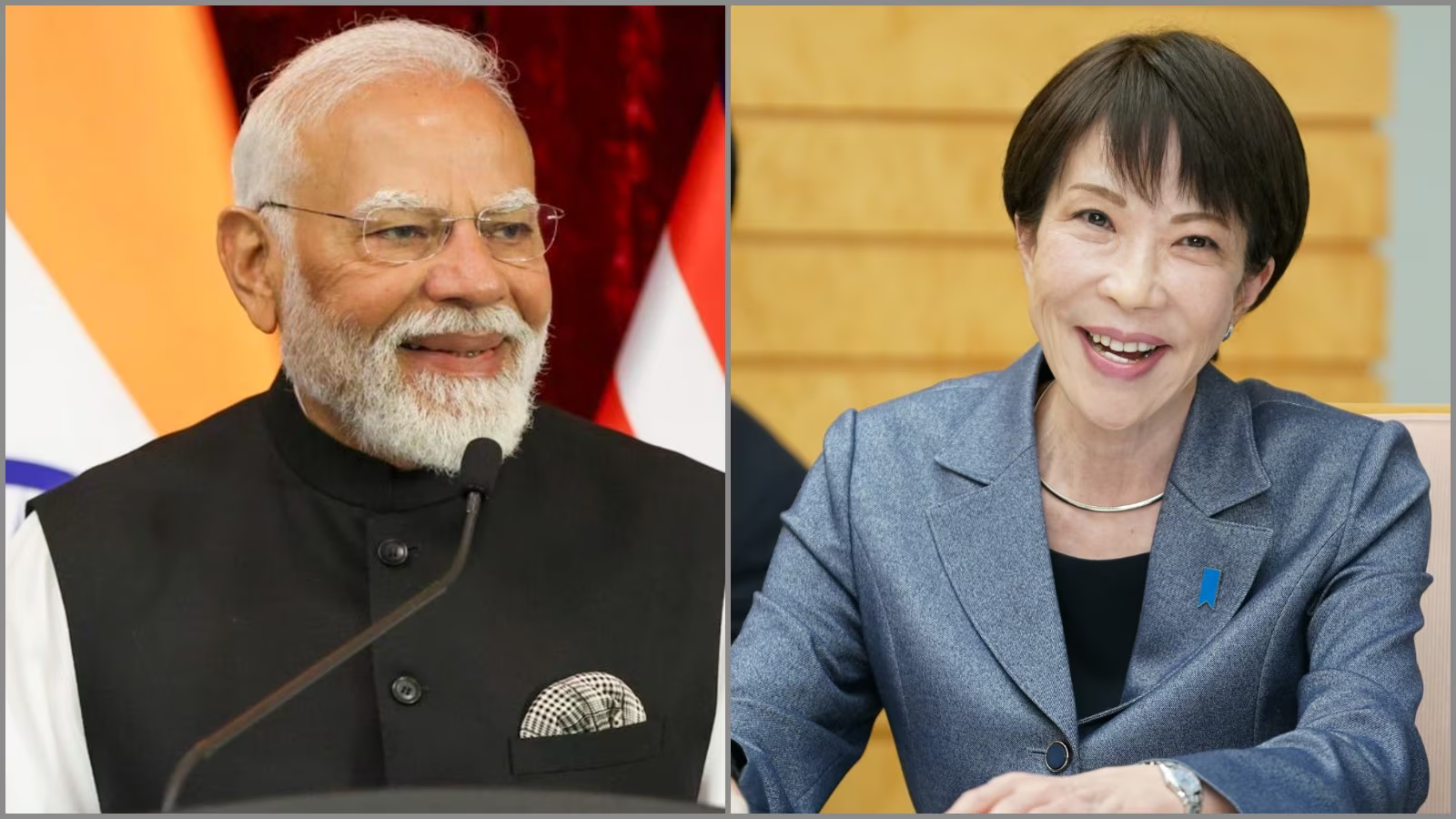

Japanese Prime Minister Sanae Takaichi is scheduled to arrive in New Delhi on Wednesday evening for her first official visit to India since assuming office, with talks with Prime Minister Narendra Modi planned for Thursday at Hyderabad House. The visit marks the 20th annual summit since India and Japan began meeting regularly at the highest levels, a milestone that lends it added diplomatic weight beyond the immediate agenda.
In a special gesture reserved for a Head of Government rather than a Head of State, Takaichi will be welcomed at the Forecourt of the Rashtrapati Bhavan on Thursday morning before the bilateral talks begin. The summit was originally planned to include a visit to Guwahati, where the meeting with Prime Minister Modi had been proposed, but those plans were cancelled just days before the visit, with the engagement shifted entirely to New Delhi.
The timing of the summit is shaped by an unusually charged strategic environment. India and Japan are expected to focus on cooperation in the Indo-Pacific as well as new projects on critical and emerging technologies, against what diplomatic sources described as the backdrop of conflict in the Persian Gulf region, which has injected fresh urgency into the conversation around energy security, maritime stability, and supply chain resilience.
The Strategic Framing: A New Indo-Pacific Policy
A central feature of the summit will be Takaichi’s introduction of the updated version of Japan’s Indo-Pacific policy, which she unveiled in May this year during a visit to Vietnam. The shift in emphasis is significant. While the previous policy, announced by former Prime Minister Fumio Kishida during a visit to Delhi in 2023, had focused on cooperation with India and Bangladesh through the Bay of Bengal, the latest version is more focused on Japan’s policy in the Western Pacific, where tensions with China have been growing since last November.
The reorientation of Japan’s Indo-Pacific policy toward the Western Pacific, combined with its continued emphasis on India as an indispensable partner, reflects a clear strategic calculation: India’s weight in the Indo-Pacific architecture cannot be substituted, regardless of where the most acute near-term tensions are concentrated.
What Is Being Signed and Why It Matters
The two sides are finalising details on approximately ten memoranda of understanding that they hope to complete and announce after the summit talks. The MoUs are expected to cover energy resilience, biogas, upstream development of oil and gas, exploration of critical minerals, batteries, artificial intelligence, and pharmaceuticals, a portfolio that spans both the immediate pressures created by the Persian Gulf crisis and the longer-term economic security agenda both governments have been building toward.
The energy resilience agreement is particularly significant in the current context. The two sides are expected to sign it specifically to avoid future situations like the oil crisis faced by many countries after the blockade of the Strait of Hormuz. Diplomatic sources said discussions have focused on diversifying sources of energy and building energy reserves, a response that goes beyond crisis management to address the structural vulnerability that the Hormuz episode exposed in both countries’ energy architectures.
The critical minerals dimension connects to an agenda that has been building since January 2026, when the two countries formally launched the India-Japan AI Dialogue and established a Joint Working Group on Critical Minerals under the Economic Security Initiative. The summit is expected to advance both tracks with concrete deliverables.
Defence and Maritime Cooperation Take on New Momentum
Beyond the formal agreements, the visit arrives against a backdrop of accelerating operational engagement between the two countries’ defence establishments. In recent months, Japan and India have ramped up cooperation against the backdrop of instability in the Persian Gulf. The Indian Navy refuelled the Japanese Maritime Self Defence Forces ships Kashima and Shimakaze in the Arabian Sea in May, and sources indicated that more such engagements are expected to be planned in the months ahead.
The refuelling operation, a practical demonstration of interoperability between the two navies in one of the world’s most strategically sensitive waterways, carries significance beyond its logistical dimension. It signals that the India-Japan defence relationship has moved from dialogue and hardware agreements into active operational coordination, a progression consistent with the Joint Declaration on Security Cooperation signed at the Tokyo summit in August 2025.
As both governments prepare for the 20th annual summit, its outcomes will be measured not only by the agreements signed but by whether they accelerate the trajectory of a relationship that both sides have described as foundational to their respective visions of a stable and rules-based Indo-Pacific. With Persian Gulf instability, Western Pacific tensions, and a shifting global supply chain architecture all pressing simultaneously, the timing of this summit gives its agenda an urgency that anniversary diplomacy alone rarely generates.
Follow for daily updates on cybercrime, corporate fraud, DFIR, hacking, investigations, and digital forensics
