

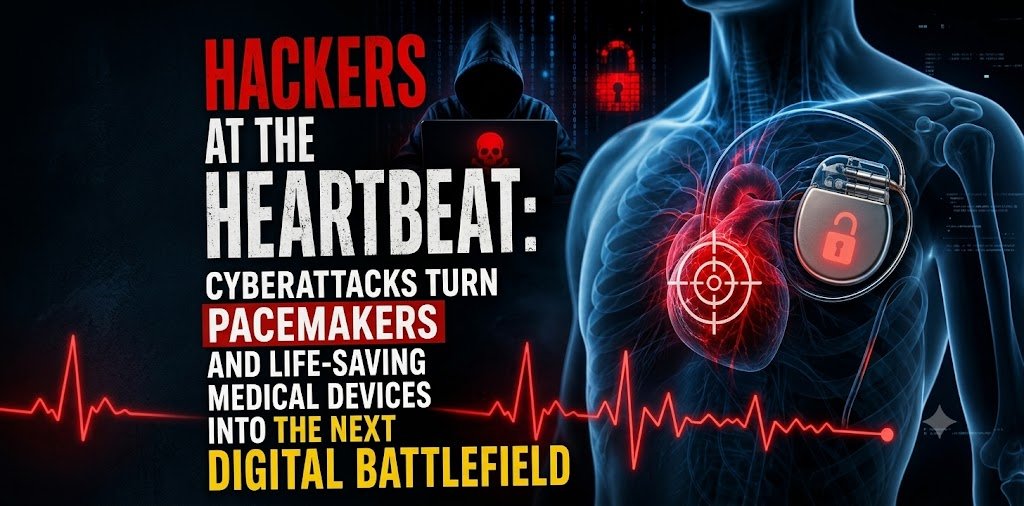
New Delhi: Cybersecurity in healthcare is no longer limited to protecting hospital databases or preventing ransomware attacks. As pacemakers, implantable cardiac devices, infusion pumps, patient monitors, glucose sensors, smartwatches and remote-care platforms become increasingly connected, a cyber incident can potentially move beyond data theft to disrupt healthcare services and create patient-safety risks.
A fresh warning emerged from the United States in late August 2026, when medical-device manufacturer Boston Scientific disclosed a cyberattack that disrupted parts of its global operations. Subsequent reporting indicated that the incident affected the activation of new remote-monitoring communicators used with certain cardiac rhythm management implants, temporarily preventing those communicators from transmitting available device data to remote patient-management systems.
Importantly, the incident should not be described as hackers taking control of patients’ pacemakers. The reported disruption involved supporting IT and remote-monitoring infrastructure rather than the direct control of implanted devices.
The episode follows other cyber incidents affecting the medical-technology ecosystem. Medtronic disclosed an April 2026 intrusion involving corporate systems containing patient information. The company said the incident did not affect the safe operation or intended therapy of its medical devices, although personal and health information was potentially exposed.
From Data Breach to Patient-Safety Risk
The larger concern is the rapidly expanding attack surface created by connected healthcare.
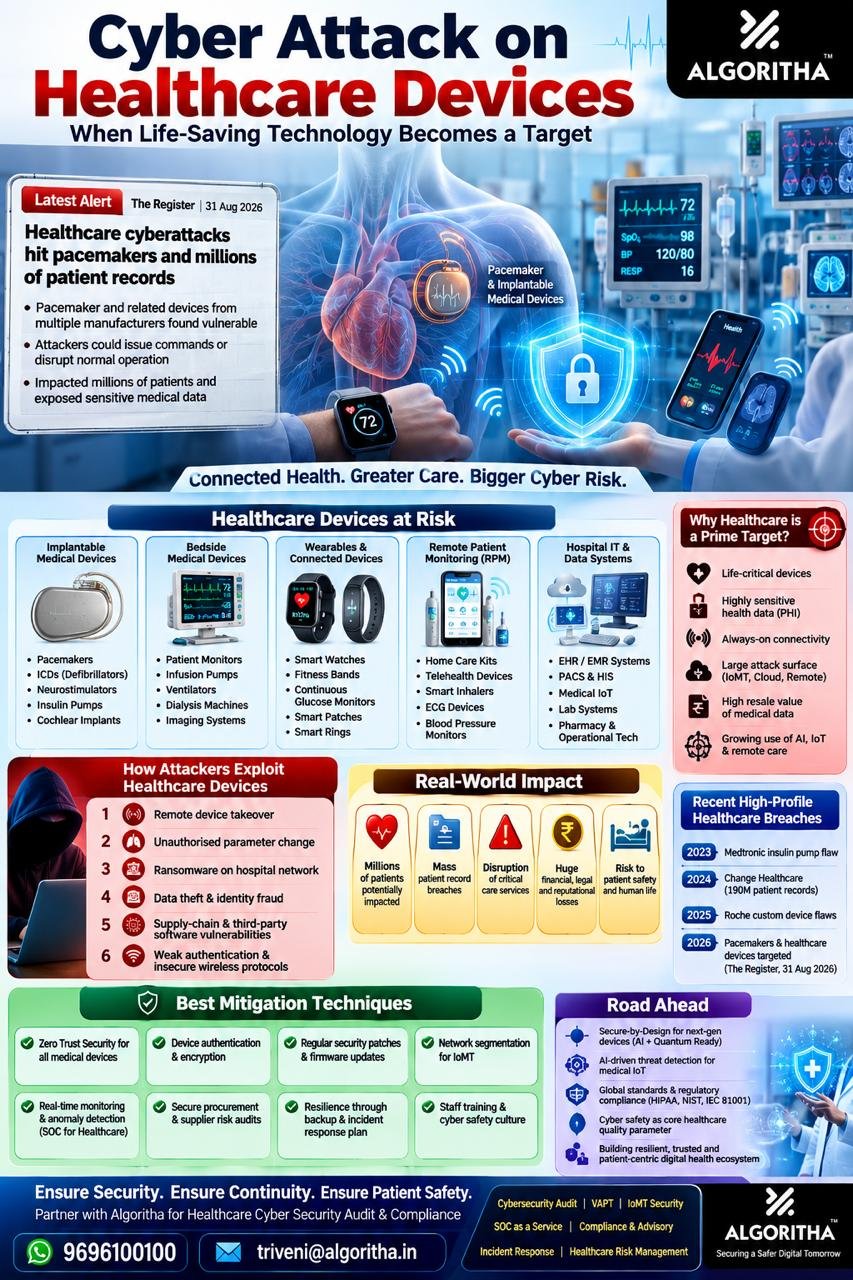
Modern hospitals can simultaneously operate pacemakers and implantable cardioverter-defibrillators, neurostimulators, insulin pumps, cochlear implants, infusion pumps, ventilators, dialysis equipment, diagnostic imaging systems, bedside monitors, electronic health records, remote-patient-monitoring systems and other Medical IoT devices.
The wearable ecosystem adds another layer. Smartwatches, fitness bands, continuous glucose monitors, smart patches, smart rings, hearing aids and other connected sensors can collect or transmit highly personal physiological and behavioural information.
The US Food and Drug Administration has acknowledged this cybersecurity trade-off. Connecting medical devices to the internet, hospital networks and other devices can improve healthcare delivery, but the same connectivity can introduce vulnerabilities that may affect device safety and effectiveness.
Potential attack paths include insecure Wi-Fi or Bluetooth connections, compromised credentials, weak or default passwords, unpatched firmware, vulnerable APIs and cloud services, phishing, third-party and supply-chain compromise, insecure remote access and lateral movement from compromised hospital IT infrastructure.
The consequences can therefore be considerably more serious than the loss of a computer file. Healthcare cybersecurity guidance identifies risks involving patient safety, the integrity and privacy of health information, and the possibility of compromised medical devices being used as entry points into wider healthcare networks.
Why Healthcare Is an Attractive Cybercrime Target
Healthcare combines several characteristics that make it attractive to cybercriminals: highly sensitive medical information, operations that cannot easily tolerate downtime, interconnected legacy and modern technologies, third-party vendors, remote connectivity and a rapidly expanding number of IoT endpoints.
A successful intrusion can therefore create several consequences simultaneously, including exposure of protected health information and personally identifiable information, identity fraud, extortion, disruption of clinical services, reputational damage, regulatory consequences and potential patient-safety concerns.
This makes it increasingly important for security teams to treat connected medical devices not simply as clinical equipment, but as endpoints operating within a life-critical digital environment.
How Hospitals Can Build a Cyber-Safe Environment
Healthcare institutions should begin with a complete inventory of connected medical and IoT assets. This should include device models, software and firmware versions, network connectivity, ownership and vendor-support status.
Security teams should also establish network-behaviour baselines, segment medical-device networks appropriately, apply security patches in a timely manner, enforce strong access controls, use encryption, continuously monitor connected devices and maintain tested incident-response procedures.
Zero Trust principles can further restrict unnecessary access. Medical IoT networks should be appropriately separated from corporate IT environments, privileged access should be tightly controlled and strong authentication should be deployed where technically appropriate.
Procurement is equally important. Cybersecurity should become a lifecycle requirement, beginning with device selection and secure configuration and continuing through operation, patching, maintenance and eventual decommissioning.
The US FDA’s February 2026 guidance further reinforces the importance of cybersecurity-by-design and resilience for medical devices that carry cybersecurity risks.
Healthcare organisations should also maintain incident-response and business-continuity procedures specifically covering connected medical devices. Security logging and forensic capabilities can help organisations investigate configuration changes, login attempts, network anomalies and unusual device traffic following a suspected incident.
Medical IoT Security Requires More Than Technology
Technology alone cannot secure a connected healthcare environment.
Doctors, nurses, biomedical engineers, administrators, IT teams, cybersecurity professionals and medical-device vendors all form part of the healthcare cyber-defence chain.
Regular cyber-awareness programmes, phishing simulations, Medical IoT security assessments, vulnerability assessment and penetration testing, configuration reviews, tabletop exercises and cyber-crisis drills can help organisations convert security policies into practical preparedness.
Healthcare organisations should also ensure that cybersecurity teams and biomedical engineering departments work together. A security control that protects an IT system but interferes with the operation of a medical device could itself create operational risks.
The emerging principle is straightforward: if technology can influence diagnosis, monitoring or treatment, cybersecurity becomes part of clinical risk management.
Hospitals should therefore move beyond periodic IT audits towards continuous Healthcare Cyber Risk Management. This requires coordination among biomedical engineering, IT, security operations, privacy, compliance, clinical leadership, vendors and incident-response teams.
For hospitals, diagnostic centres, healthcare providers and medical-device organisations seeking support in areas including Cybersecurity Audit, VAPT, Medical IoT and Connected-Device Security Assessment, Cyber Awareness, SOC and Monitoring, Compliance Advisory, Incident Response, Cyber Crisis Exercises and Healthcare Cyber Safety, Algoritha Security can be contacted at:
Algoritha Security
WhatsApp/Connect: 9696100100
Email: triveni@algoritha.in
The next healthcare cyberattack may not begin at a hospital computer. It could begin with the connected device beside—or inside—the patient.
Follow for daily updates on cybercrime, corporate fraud, DFIR, hacking, investigations, and digital forensics
