

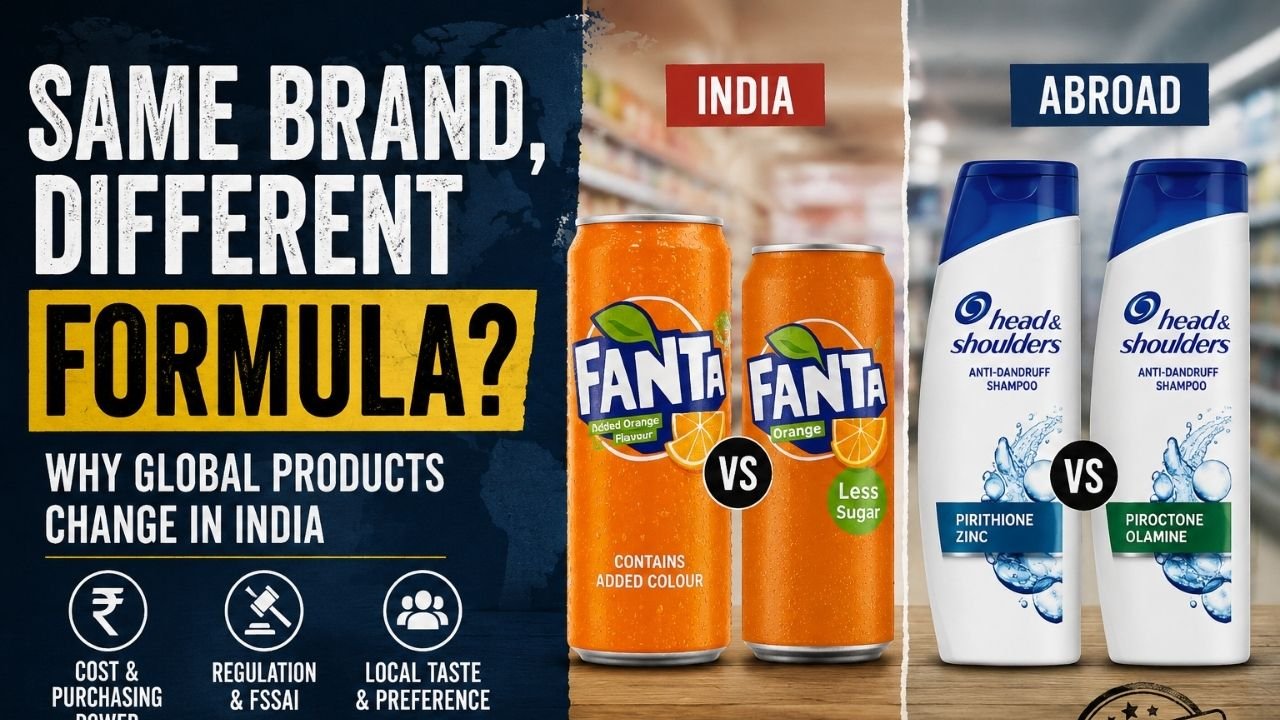

Global food, beverage and personal care brands often sell products in India that differ in formulation, taste, texture or fragrance from versions carrying the same name overseas, a distinction driven by local sourcing, regulation, manufacturing costs, consumer preferences and purchasing power. The differences have become increasingly visible to Indian consumers, particularly as imported products make side-by-side comparisons easier.
Aerated drinks can taste sweeter in India, while products such as petroleum jelly, shampoos and lotions may have different textures or chemical compositions from versions sold in the United States, the United Kingdom or Europe. Food scientist Gauri Chemburkar said there is no requirement for multinational companies to maintain identical specifications in every market.
Fanta is one example highlighted in the debate. A Reuters report cited in the material found that the soft drink sold in the UK contains significantly less sugar than the version sold in India. The Indian product also contains an artificial colourant whose use in food in Europe requires a prominent health warning.
Similar questions have emerged around chocolates, cereals, instant foods and baby formula, with nutrition advocates arguing that formulations sold in India can contain different amounts of sugar, cocoa, milk, fats or additives. Maharashtra Food and Drugs Administration Commissioner Tukaram Mundhe, speaking to Reuters on August 28, questioned the ethics of multinational food and beverage companies selling products with differing nutritional standards across countries.
Why the Same Brand Can Have a Different Formula
The differences do not necessarily mean that one country receives a superior product and another an inferior one. Experts cited several practical reasons why multinational companies alter formulations across markets, including the availability of raw materials, manufacturing methods, regulatory requirements and local consumer expectations.
Chemburkar said ingredients themselves can vary significantly by geography. Even a basic commodity such as honey may differ depending on climate and source. Companies manufacturing in several countries also often procure ingredients locally to reduce costs, meaning that a product’s formulation can begin to diverge even before manufacturing starts.
Regulations can make standardisation difficult. Requirements concerning raw materials, ingredients and additives differ between countries, making it impractical in some cases to produce a single formulation in one location and distribute it worldwide.
Consumer purchasing power is another major consideration. Economist Taniya Sah, an assistant professor at Vidyashilp University in Bengaluru, said being sold under the same brand does not necessarily mean a product will be identical everywhere.
World Bank figures cited in the report put India’s GDP per capita at about $2,700 in 2025, compared with around $57,600 in the UK and $90,000 in the US. That purchasing-power gap can influence the price a manufacturer believes consumers will accept and, in turn, the ingredients and specifications used.
Chemburkar said manufacturers routinely try to balance consumer expectations with production costs. If a particular ingredient becomes too expensive, companies may seek alternatives that remain within regulatory requirements.
Regulation can also create direct financial incentives for reformulation. Chemburkar recalled that companies operating in Ireland had to consider measures such as a sugar tax, with the sugar concentration of beverages affecting taxation. Such rules can encourage manufacturers to reduce sugar levels or use alternative ingredients.
These factors mean that a different formulation cannot automatically be treated as evidence of poorer quality. Food quality, Chemburkar said, involves safety, chemical composition and sensory characteristics such as taste, smell and texture. A product may therefore meet safety and quality requirements while still tasting noticeably different from its overseas counterpart.
Local Tastes Shape Food and Personal Care Products
Consumer preference can play as large a role as price or regulation. Products containing less salt or sugar may not always match the taste expectations of Indian consumers, encouraging manufacturers to adapt recipes after conducting market research.
The same approach extends beyond food. Global personal care companies may change ingredients, fragrances and textures depending on regulations, climate, hair and skin characteristics and local preferences.
Head & Shoulders shampoo illustrates how regulatory differences can alter a familiar product. In the US and several other markets, its anti-dandruff formulations typically use pyrithione zinc. The European Union banned zinc pyrithione in cosmetic products in 2022 after regulators classified it as a reproductive toxicant. Head & Shoulders products sold in the EU consequently use other anti-dandruff ingredients, including piroctone olamine.
Fragrance is another area where local preference matters. Some Bioderma, Cetaphil and Vaseline products in Western markets are fragrance-free or have relatively little noticeable scent. In India, however, fragrance can be a significant factor in purchasing beauty and personal care products.
Market research cited from Mintel indicates that scent influences consumer choice in India’s beauty and personal care market. That can result in creams, face washes and moisturisers having more noticeable fragrances even when they carry the same global brand name.
Companies have responded to these differences by investing in local product development. Unilever, for instance, has invested in fragrance innovation facilities in India, reflecting the importance of cultural preferences, climatic conditions and local consumer expectations.
The central distinction, experts said, is between a product being different and a product being inferior. Reformulation may reflect consumer preferences, taxation, ingredient supply or legal requirements rather than a deliberate effort to reduce quality.
FSSAI Faces Questions Over Nutrition and Labelling
The debate becomes more significant in food and beverages because these products are consumed routinely by millions of people. The Food Safety and Standards Authority of India determines what ingredients and additives may be used, what safety requirements manufacturers must meet and what information must be disclosed to consumers.
Sah argued that India’s regulatory discussion should increasingly examine nutritional quality alongside traditional food-safety concerns such as contamination and adulteration. A packaged food can comply with existing safety rules, she said, while still raising concerns about its nutritional impact when consumed frequently.
The issue is particularly relevant to ultra-processed foods as India confronts concerns around obesity, type-2 diabetes and nutritional deficiencies.
Labelling has become a major point of contention. Sachin Taparia, co-founder of LocalCircles, said the organisation’s 2022 survey submission led FSSAI to begin consultations on improving the information available to consumers. When the regulator subsequently proposed a star-rating approach in 2023, LocalCircles argued for a more direct warning system.
Taparia said FSSAI has since proposed moving towards red labelling for foods high in fat, sugar and salt following court intervention. A LocalCircles survey found that 94 per cent of consumers believed such red labels would help them make more informed choices.
Industry resistance, however, has remained strong. Reuters reported that food industry executives challenged proposed front-of-pack warnings during a tense meeting in March, arguing that such labels could confuse consumers and have limited impact on eating habits. The regulator ultimately stepped away from colourful warnings at that stage.
The contrasting treatment of Maggi products has also drawn attention. Packets sold in Britain, including products manufactured in India, carry red front-of-pack warnings concerning high salt levels. Such labels are voluntary in the UK, and Nestle has used them on its packs there since 2013. In India, Nestle has been among industry participants opposing mandatory front-of-pack warning proposals.
FSSAI has meanwhile taken enforcement action against major companies. More than 150 notices were recently issued to food businesses, including Nestle India, PepsiCo and Coca-Cola India, over alleged misleading advertisements, false claims and labelling violations. Other companies named included Abbott India, Red Bull India, Danone India, Monster Energy India, Hell Energy and Mondelez India.
The regulator has previously confronted major manufacturers. In 2015, it ordered the recall of all nine approved variants of Maggi noodles after declaring them unsafe for consumption.
The broader question, experts said, is not whether India should simply reproduce products sold in Western markets. Instead, scrutiny should focus on whether Indian consumers are receiving the best products that can reasonably be made with available resources, whether nutritional standards are adequate, and whether labels provide enough information for people to make informed choices.
Follow for daily updates on cybercrime, corporate fraud, DFIR, hacking, investigations, and digital forensics
