
Follow us on Google News

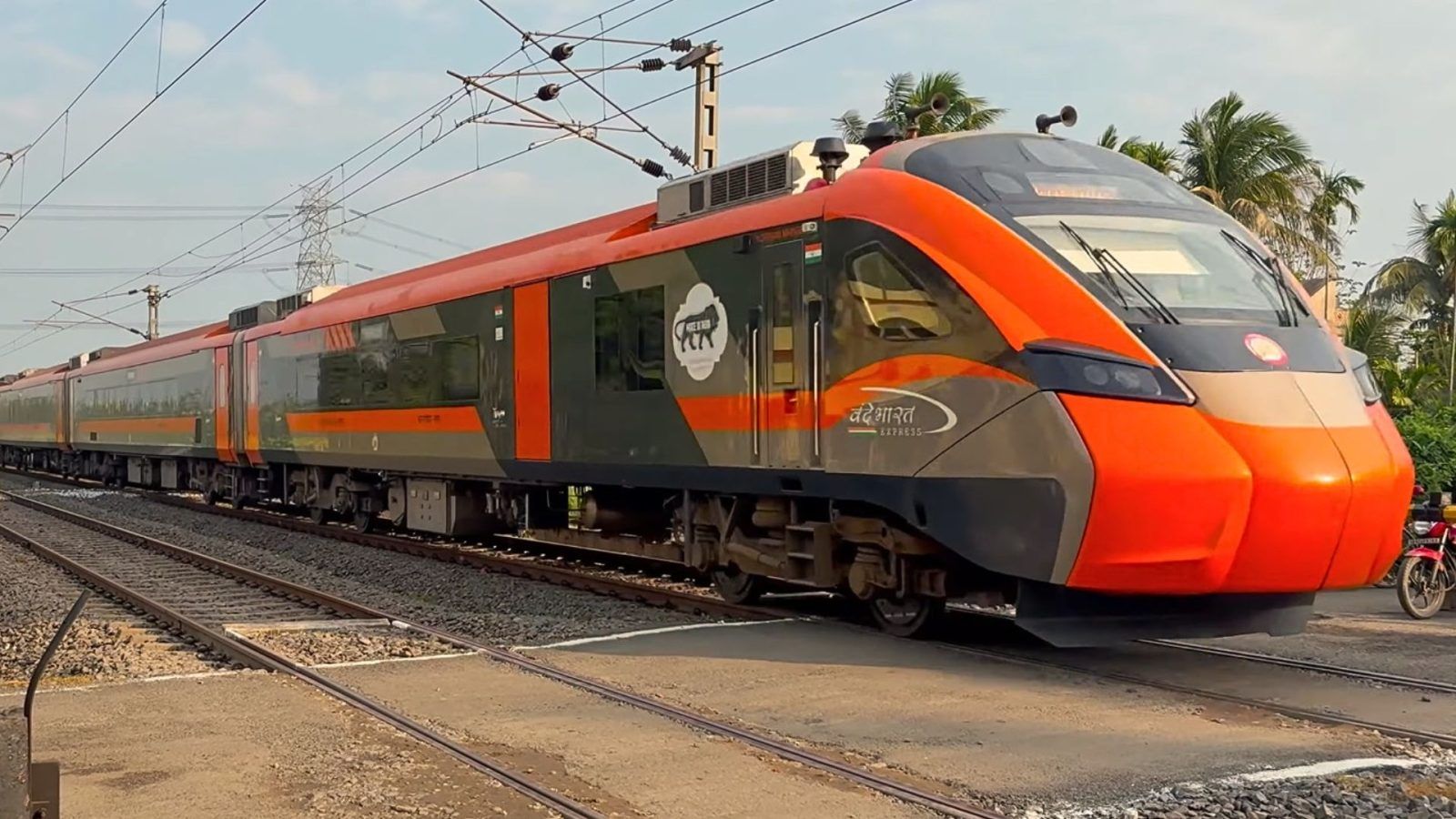
An empty Vande Bharat Express rake travelled nearly 463 kilometres from Hatia in Jharkhand to Deen Dayal Upadhyaya Junction in Uttar Pradesh without functional coach brakes, exposing a major safety lapse in Indian Railways. The braking systems of all coaches on the train remained isolated throughout the journey, leaving the rake reliant solely on the locomotive’s brakes and regenerative braking. Taking serious note of the incident, South Eastern Railway has ordered a detailed investigation into the lapse.
Warnings by Two Loco Pilots Ignored En Route
The incident occurred on October 24 when a goods locomotive was attached to haul the empty Vande Bharat chair car rake from Hatia to Jhansi in Uttar Pradesh. Under standard operating procedures, the rake’s braking system must be integrated with the locomotive’s brake system to ensure effective braking across the entire train. However, concerned staff failed to execute this coupling properly, resulting in the train being dispatched with inactive coach brakes.
Soon after departure, the loco pilot conducted mandatory brake feel and brake power tests in the Hatia-Ranchi section and detected that the braking capacity was severely compromised. The pilot lodged a written complaint at Ranchi station and alerted both the section controller and the traction loco controller. Despite these alerts, the rake was cleared to proceed in the same condition.
When a second loco pilot took charge of the train at Muri station, he also identified the critical defect, informing controllers that the coach brakes were failing to engage even after reducing brake pipe pressure. Yet the train was neither halted nor subjected to a technical inspection en route. Upon reaching Deen Dayal Upadhyaya station in Chandauli district, officials examined the rake and confirmed that the braking systems of all coaches had been isolated, meaning they were completely excluded from the braking process over the 463-kilometre stretch.
Preliminary Inquiry Flags Multi-Level Negligence
In an order issued on November 7, South Eastern Railway directed the Divisional Railway Manager of Ranchi division to conduct a comprehensive probe into the episode. Preliminary findings point to negligence at multiple levels, involving carriage and wagon maintenance staff, section and traction controllers at the concerned stations, and the crew operating the rake.
According to the findings, maintenance personnel failed to physically verify whether the brakes on all coaches were operational prior to departure. At the same time, the operating crew lacked adequate familiarity with the Vande Bharat braking system and could not verify whether the coach brakes were actually engaging. Railway officials noted that these cumulative failures allowed the train to run without adequate braking power.
Grave Safety Risks and Accountability Directives
The railway order emphasised that operating a train without sufficient braking capacity poses an extreme safety hazard capable of triggering a major accident and endangering the lives of railway staff and passengers. Although the Vande Bharat rake was empty, it operated along a busy corridor shared with other passenger and freight trains, meaning the risk extended well beyond the rake itself.
South Eastern Railway has instructed the Ranchi division to fix responsibility on all erring personnel and determine how the rake was permitted to continue its journey despite repeated warnings from two loco pilots. Authorities have also been told to implement corrective and preventive measures to avoid a recurrence. Coming days before the November 11 derailment of the Kolkata-Sairang Express in Assam, the episode has renewed scrutiny over technical inspections, crew training, and control room accountability in railway operations.