

The Future Crime Research Foundation has launched its Certified Chief AI Officer (C-CAIO) Program, a four-week professional certification that will begin on Saturday, 13 June, at 11 a.m. The program follows FCRF Academy’s familiar learning format: a structured 16-module certification designed for working professionals who need practical, leadership-oriented knowledge without stepping away from their regular responsibilities.
The launch comes at a moment when artificial intelligence is no longer confined to technology teams or innovation labs. Across sectors, AI is moving into customer service, banking, compliance, cybersecurity, marketing, fraud detection, legal research, human resources, public administration and decision-making systems. That shift has created a new organisational question: who is responsible for ensuring that AI is adopted safely, lawfully and strategically?
FCRF Academy’s answer is the Chief AI Officer, a professional who can sit at the intersection of technology, governance, risk, law, cybersecurity, privacy and business strategy. The C-CAIO program has been designed for CXOs, CISOs, DPOs, compliance officers, lawyers, cyber professionals, government officers, consultants, technology managers, policy professionals and founders who may not be AI engineers, but are increasingly expected to make informed decisions about AI adoption. Interested participants can click here to register now for the C-CAIO program.
Why the Chief AI Officer Role Is Becoming Urgent
The rise of generative AI has changed the nature of digital governance. Organisations are no longer dealing only with software procurement or data management. They are now confronting AI systems that can generate text, code, images, videos, decisions, predictions and synthetic identities. These systems can improve productivity, but they can also create new risks around privacy, bias, misinformation, hallucination, cyberattacks, deepfakes, vendor dependence and regulatory exposure.
India’s policy environment is also moving quickly. The IndiaAI Mission is built around pillars such as compute capacity, datasets, foundation models, future skills, startup financing and Safe and Trusted AI. The Safe and Trusted AI pillar specifically points to the need for India-specific governance tools, frameworks and standards for responsible AI adoption.

The Ministry of Electronics and Information Technology has also released material on AI governance guidelines for public consultation, reflecting the government’s increasing focus on safe, trusted and accountable AI systems. At the same time, the Digital Personal Data Protection Act, 2023 has placed personal data processing, consent, lawful use, obligations of data fiduciaries and individual rights at the centre of India’s digital compliance landscape.
For regulated sectors, the direction is even sharper. SEBI has already required reporting for artificial intelligence and machine learning applications used by market intermediaries and market infrastructure institutions, a sign that AI adoption in securities markets is not merely a technology issue but a regulatory visibility issue. In the financial sector, an RBI committee has proposed the Framework for Responsible and Ethical Enablement of Artificial Intelligence, commonly referred to as FREE-AI, with recommendations aimed at balancing innovation with risk management in finance.
In that environment, the need is not simply for more people who can use AI tools. The need is for professionals who can ask harder questions: What data is being used? Who approved the use case? What risks does the system create? Is there human oversight? Can the organisation explain the output? What happens if the AI system causes harm, leaks information or is manipulated?
What the C-CAIO Program Covers
The Certified Chief AI Officer program is designed to give learners a structured understanding of AI from a leadership and governance perspective. The curriculum covers the role of the Chief AI Officer, AI and generative AI fundamentals, AI strategy, responsible AI adoption, AI governance architecture, AI risk management, data governance, privacy, cybersecurity, vendor governance, audit readiness and sector-specific regulatory preparedness.
A significant portion of the program is India-focused. Learners will examine themes linked to the IndiaAI Mission, MeitY’s AI governance direction, the DPDP Act, CERT-In guidance on generative AI vulnerabilities, and regulatory expectations from institutions such as RBI and SEBI. CERT-In has also issued advisories on best practices for using generative AI solutions, underlining the security dimension of enterprise AI adoption.
The program also reflects FCRF’s core expertise in cybercrime and digital risk. Modules will examine deepfakes, synthetic identity, voice cloning, AI-enabled phishing, financial fraud, fake KYC, digital arrest scams, misinformation and AI-assisted cybercrime. These areas are no longer theoretical concerns. For Indian organisations, AI risk is increasingly tied to fraud prevention, public trust, consumer protection, incident response and reputational resilience.
Rather than presenting AI as a purely technical subject, the C-CAIO program treats it as a governance discipline. Participants will learn how to identify AI use cases, build AI use-case registers, classify risks, review vendors, understand AI-related privacy concerns, prepare internal policies, design oversight mechanisms and brief senior management on AI adoption.
The program is intended to help professionals move beyond basic AI awareness. Its central proposition is that the future of AI leadership will belong not only to those who can deploy AI, but to those who can govern it responsibly. Interested participants can click here to register now for the C-CAIO program.
FCRF Academy’s Expansion Into AI Governance
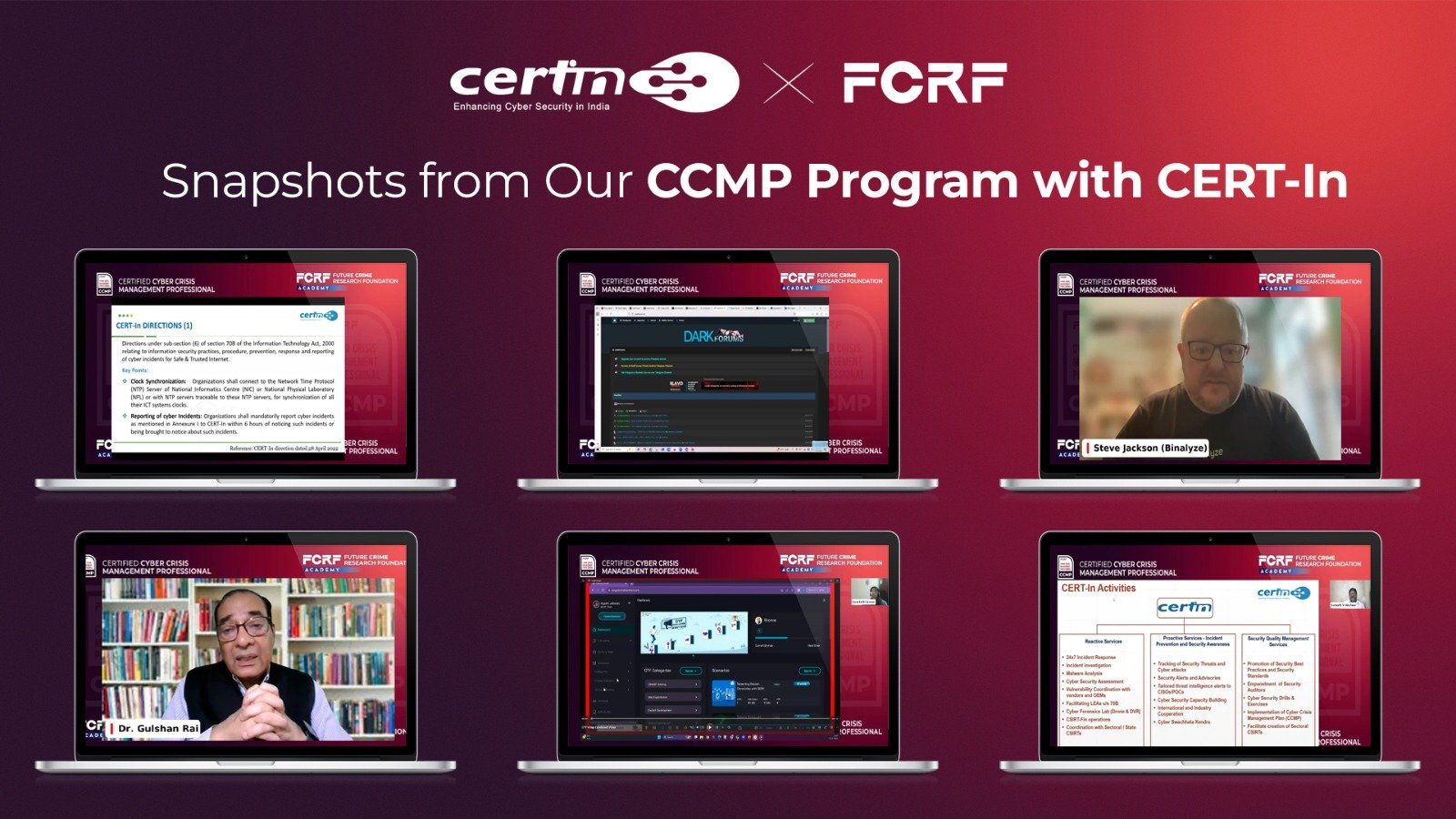
The launch of the C-CAIO program marks a natural expansion for FCRF Academy, the training and capacity-building arm of the Future Crime Research Foundation. FCRF has built its identity around cybersecurity, cyber law, digital forensics, data protection, fraud investigation, anti-money laundering, GRC, cyber crisis management and emerging technology risk.
Over the past several years, FCRF Academy has developed a portfolio of professional certifications, including programs in cyber law, data protection, fraud investigation, anti-money laundering, GRC, cyber crisis management and cybersecurity leadership. Its training ecosystem has attracted lawyers, police officers, government professionals, compliance leaders, cybersecurity practitioners, corporate executives and students seeking specialised knowledge at the intersection of law, technology and risk.
That background gives FCRF Academy a distinct position in the AI training market. Many AI courses focus primarily on tools, prompts or productivity. The C-CAIO program instead focuses on governance, regulatory readiness, cyber risk, privacy, fraud, accountability and responsible adoption, areas where Indian organisations are likely to need deeper institutional capacity.
The course also arrives at a time when AI adoption is spreading faster than internal governance structures. Many companies are already using AI informally through employees, vendors or embedded software systems. But internal policies, audit trails, vendor checks, data protection assessments and AI incident response mechanisms often lag behind adoption. This gap is precisely where a Chief AI Officer or AI governance leader can become valuable.
For FCRF Academy, the C-CAIO program is not simply an addition to its course catalogue. It signals a broader recognition that AI governance is becoming part of the same risk universe as cybercrime, data protection, compliance, fraud and digital regulation. As AI becomes more embedded in organisational life, professionals will need to understand not just the opportunity, but the accountability that comes with it. Interested participants can click here to register now for the C-CAIO program.
Follow for daily updates on cybercrime, corporate fraud, DFIR, hacking, investigations, and digital forensics
