
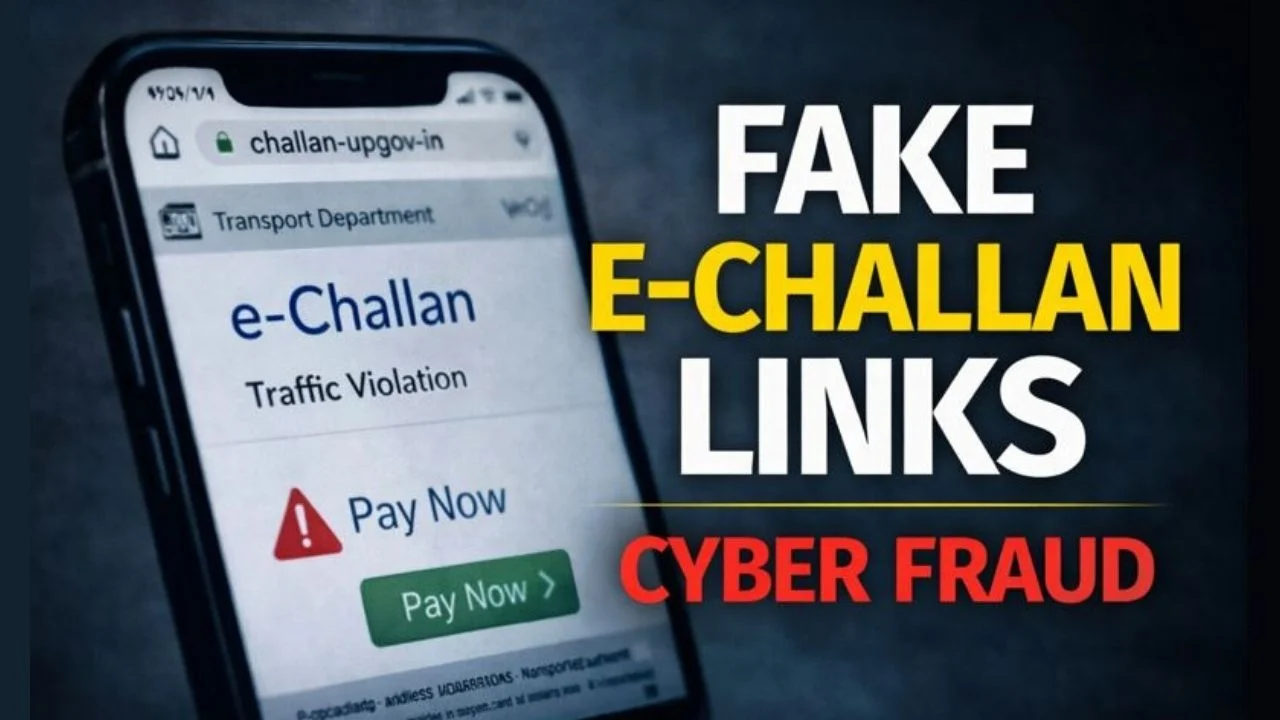
New Delhi. A new and highly dangerous cyber fraud trend is rapidly spreading across India, where scammers are exploiting the fear of traffic violations to target unsuspecting vehicle owners. Advisories issued across multiple states have warned citizens against fake e-challan messages, after several cases surfaced in which victims lost large sums of money through a single careless click.
Fake Traffic Fine Messages Become New Cyber Weapon
According to officials, cyber criminals are now replicating government systems with alarming precision. Victims receive SMS or WhatsApp messages claiming that a traffic challan has been issued against their vehicle, along with a warning of legal action if payment is not made within a stipulated time. These messages often include a link that appears legitimate, prompting users to act quickly without verification.
Investigations have revealed that clicking on such links triggers the download of a malicious application file, typically in APK format. Once installed, the app silently takes control of the user’s mobile device. It gains access to sensitive information such as OTPs, banking credentials, messages, and stored personal data. Within minutes, fraudsters can initiate unauthorized transactions, leaving victims with emptied bank accounts and little time to react.
FCRF Academy Launches Premier Anti-Money Laundering Certification Program
Malicious APK Files Can Hijack Phones Within Minutes
Cyber experts point out that this method relies heavily on social engineering—using fear and urgency to manipulate user behavior. Renowned cybercrime expert and former IPS officer Prof. Triveni Singh has warned in similar cases that “cyber criminals increasingly exploit psychological triggers such as fear of penalties and authority impersonation to bypass rational decision-making,” emphasising how these scams are designed to provoke instant action rather than careful scrutiny.
Authorities have clarified that genuine traffic challans are never communicated through random links or unofficial applications. Citizens are advised to verify any such claims only through official government platforms or by visiting authorized RTO offices. Any link that does not carry a verified government domain—typically ending in “.gov.in”—should be treated as suspicious.
The advisory further highlights that downloading applications from unknown sources is one of the most common entry points for cyberattacks. Fraudsters often disguise these apps as payment tools or verification software, but in reality, they function as spyware. Once installed, they can monitor user activity in real time, intercept SMS alerts, and even bypass certain security layers.
Fear, Urgency and Authority: The Scam’s Dangerous Formula
Cases reported from cities such as Jaipur, Jodhpur, Kota, Delhi, Mumbai, and others indicate that the scam is spreading rapidly across the country. Victims have reportedly lost amounts ranging from thousands to lakhs of rupees. The pattern remains consistent—unsolicited message, urgency-driven pressure, malicious link, and immediate financial loss.
According to insights from Future Crime Research Foundation, APK-based frauds are among the fastest-growing cyber threats in India. The organization notes that attackers are increasingly impersonating trusted government services to gain user confidence before executing financial fraud.
To counter this growing threat, authorities have urged citizens to follow basic cyber hygiene practices. These include avoiding clicks on unknown links, downloading apps only from trusted sources, and regularly updating mobile security settings. Users are also advised to disable the “Unknown Sources” installation option on their devices to prevent unauthorized app downloads.
Officials Urge Citizens to Verify Before Clicking Any Link
In case of suspected fraud, victims should immediately report the incident through the national cybercrime portal or by contacting the helpline at 1930. Prompt reporting significantly increases the likelihood of blocking fraudulent transactions and identifying those responsible.
Officials stress that awareness remains the strongest defense against evolving cyber threats. As digital transactions become deeply embedded in everyday life, safeguarding personal data is increasingly a shared responsibility. A moment of caution, they emphasize, can prevent irreversible financial damage.
With cyber criminals continuously refining their tactics, this fake e-challan scam serves as a stark reminder that even the most routine-looking message can conceal a serious threat.
