

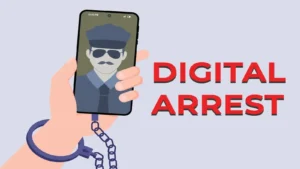
A call claiming you are under “digital arrest” can create instant panic. But under Indian law, there is no legal procedure called digital arrest, and no genuine agency can arrest someone through a video call or demand money to prove innocence.
What is a digital arrest scam?
Fraudsters pose as police officers, CBI officials, Enforcement Directorate officers or even judges.
They tell victims that their Aadhaar number, mobile number, bank account or a parcel linked to them has been connected to a serious criminal case.
The victim is then told to remain on a video call and follow instructions.
Can police arrest you through a video call?
No. A video call cannot replace a lawful arrest.
The Rajasthan High Court, while taking suo motu cognisance of the growing menace in January 2025, observed that digital arrest has no legal standing in India.
A genuine electronic summons, where legally permitted, is part of a formal process. It is not a demand to transfer money into a private account.
How do scammers make the threat look genuine?
Fraudsters may use fake identity cards, forged notices, police uniforms and official-looking logos.
Some create simulated police offices and involve additional callers posing as senior officials.
The objective is to make the victim believe that a genuine investigation is underway.
Why are victims kept on video calls?
Isolation is a major part of the fraud.
Victims may be instructed not to speak to family members, friends or lawyers and to remain connected continuously.
This prevents them from independently checking the claims and makes them easier to pressure.
Why do scammers demand money?
Victims may be asked to transfer money as a supposed “security deposit”, “verification amount”, “bail amount” or “investigation fee”.
Such payment demands are a major warning sign.
No genuine law-enforcement agency requires a person to transfer money to prove innocence during a video call.
Algoritha Security Launches ‘Make in India’ Cyber Lab for Educational Institutions
What does Indian law say about arrest?
The Bharatiya Nagarik Suraksha Sanhita, 2023 lays down the legal framework for arrests.
It specifies when police may arrest a person, the responsibilities of the arresting officer and safeguards available to the arrested person.
The law also provides for information about the grounds of arrest and communication with a relative or another nominated person.
An arrested person cannot ordinarily be detained for more than 24 hours without the required judicial authority, subject to statutory exceptions.
Which laws can apply to digital arrest scammers?
There is no separate offence called “digital arrest” under the Bharatiya Nyaya Sanhita.
The exact offences depend on how the fraud is carried out.
Section 318 of the BNS deals with cheating, while Section 319 can apply to cheating by personation when criminals pretend to be police or other officials.
Where threats or fear are used to obtain money, provisions relating to extortion may also become relevant.
More serious cases can involve forgery, forged electronic records, conspiracy, organised crime or provisions of the Information Technology Act, 2000.
Why should victims preserve digital evidence?
Deleting messages or call details can make an investigation more difficult.
Victims should preserve phone numbers, caller IDs, WhatsApp chats, screenshots, emails, forged notices, identity cards, bank account details, UPI IDs and transaction references.
URLs, social media profiles and other digital records can also help investigators trace the fraud network.
Who may be operating behind the caller?
The person making the call may only be one part of a larger cybercrime network.
Such operations can involve people procuring SIM cards, operating mule bank accounts, arranging forged documents and providing technical infrastructure.
Other members may be responsible for moving stolen money through different accounts.
What should you do when you receive such a call?
Do not make any financial decision while frightened.
Disconnect the call and independently verify the claim using the official contact details of the agency the caller claims to represent.
Never transfer money to a so-called safe account, security account or investigation account.
Where should digital arrest fraud be reported?
Cybercrime can be reported through the national cybercrime helpline 1930 and the National Cyber Crime Reporting Portal.
If money has already been transferred, the bank or payment service provider should also be informed immediately.
In an emergency, police assistance can be sought through 112.
Why are senior citizens especially vulnerable?
Fraudsters may exploit senior citizens’ respect for official authority and fear of legal consequences.
Families can adopt a simple rule that no major financial transfer should be made after an unexpected police or government call without first consulting another trusted person.
Independent verification can prevent panic from turning into financial loss.
What is the safest response?
The safest approach is simple: stop, disconnect, verify, do not pay, preserve the evidence and report the incident.
No genuine law-enforcement agency will place someone under “digital arrest” through a video call and demand money to establish innocence.
About the author — Ayesha Aayat writes on cybercrime, digital safety, and emerging online threats. Her work focuses on public awareness, legal clarity, and technology-driven risks.
Follow for daily updates on cybercrime, corporate fraud, DFIR, hacking, investigations, and digital forensics
