

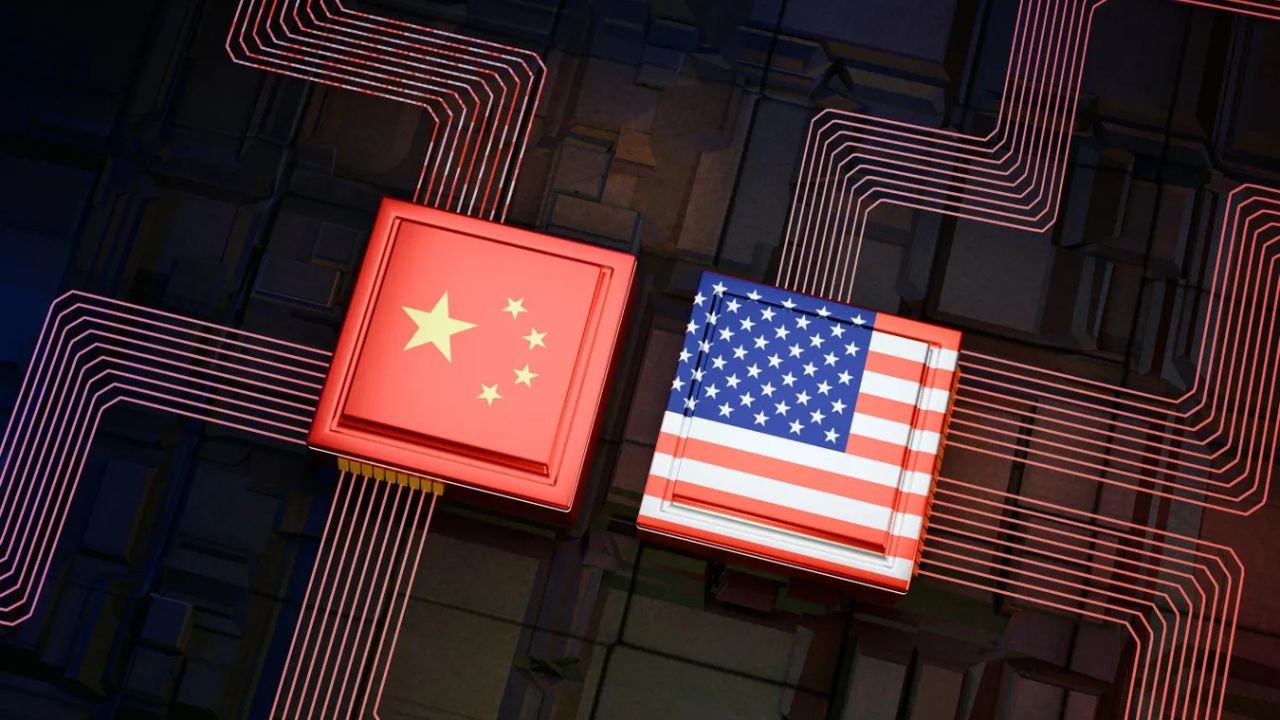

New Delhi | China has secured a significant advantage in the global artificial intelligence (AI) race, with new data indicating that Chinese AI models have surpassed their American counterparts in overall usage. Models developed by DeepSeek, MiniMax, Xiaomi and Tencent are being adopted at a rapid pace and have overtaken offerings from OpenAI, Google and several other major US technology companies in terms of token consumption. Industry observers view the shift as a sign of changing power dynamics in the global AI market.
According to data from AI model aggregation platform OpenRouter, Chinese models have recorded higher levels of usage since the beginning of 2026. Analysts attribute this growth to lower operating costs, greater energy efficiency and a stronger price-to-performance ratio. While many US AI companies continue to face substantial infrastructure and computing expenses, Chinese developers have been able to offer competitive services at comparatively lower costs.
FCRF’s Flagship Cyber Law Certification Returns With a New Four-Week Cohort
OpenRouter data shows that DeepSeek V4 Flash has emerged as the world’s most widely used AI model, recording approximately 4.63 trillion tokens in usage. MiniMax M3 followed with 4.13 trillion tokens, while Xiaomi’s MiMo-V2.5 registered around 3.8 trillion tokens. Chinese companies also maintained a strong presence across the top ten rankings. Among American firms, Anthropic was the only company with models occupying prominent positions in the list.
The findings are particularly notable because companies such as OpenAI and Google have long been viewed as leaders of the global AI industry. According to OpenRouter, Google’s Gemini 3 and OpenAI’s GPT 5.5 ranked 12th and 13th respectively in global token usage. Analysts say the trend suggests that AI competition is increasingly being shaped not only by technological capability but also by affordability, accessibility and operational efficiency.
Industry experts note that the growing adoption of token-based billing models has made cost differences more visible. While AI services were previously marketed largely through subscription plans, many providers now charge customers based on actual usage. Under this model, every query, response and data-processing task carries a measurable cost. As a result, corporate customers are becoming more selective and are increasingly gravitating toward models that offer better performance at lower prices.
Rising AI-related expenses have also prompted several major global corporations to reassess their usage strategies. Reports indicate that companies such as Amazon, Meta, Walmart, Uber and Cisco have introduced limits on employee use of AI tools or encouraged the adoption of less expensive models. Businesses are seeking ways to balance productivity gains with growing operational costs associated with large-scale AI deployment.
Financial services giant Goldman Sachs estimates that the rise of AI agents could increase global token consumption by as much as 24 times by 2030. Such growth is expected to drive demand for advanced semiconductors and computing infrastructure, potentially intensifying pressure on global chip supply chains over the next 12 to 18 months.
Technology analysts believe the growing popularity of Chinese AI models presents a serious competitive challenge for US firms. If the current gap in cost efficiency continues, it could influence investment flows, customer preferences and the broader direction of AI innovation worldwide. At the same time, companies such as OpenAI, Anthropic and Google are investing heavily in next-generation models, enhanced capabilities and revised pricing strategies to strengthen their market positions.
The contest in artificial intelligence is no longer defined solely by breakthroughs in technology. Cost efficiency, energy consumption, scalability and global accessibility are becoming equally important factors. Current trends suggest that these elements will play a decisive role in determining which companies and countries lead the AI industry in the years ahead.
Follow for daily updates on cybercrime, corporate fraud, DFIR, hacking, investigations, and digital forensics
