

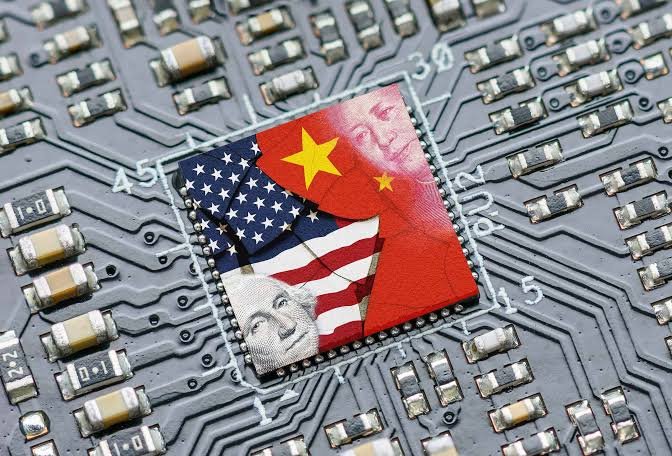

China is challenging Washington’s attempt to set the rules of the global AI race, warning that national-security concerns should not become a tool for restricting ordinary technological competition.
The latest confrontation comes ahead of expected US-China discussions on artificial intelligence, with Beijing signalling that it wants any definition of AI security to be agreed jointly rather than imposed by Washington.
A commentary published by Yuyuantantian, a social media account affiliated with Chinese state broadcaster CCTV, said the distinction between genuine security threats and normal technological competition must be drawn by all sides.
The message reflects a deeper shift in US-China rivalry.
Artificial intelligence is no longer being treated simply as a commercial technology. Both countries increasingly see control over advanced chips, AI models, computing infrastructure and military applications as directly connected to national power.
Proposal for Conducting Cyber Crisis Drill, Tabletop Exercise (TTEx) & CCMP Readiness Exercise
China Says AI Safety Cannot Become a Trade Barrier
Beijing’s immediate complaint is about who gets to define what counts as an AI security threat.
The CCTV-linked commentary argued that Washington cannot demand transparency, audits and safety controls from others while allowing American AI companies to shape the standards.
It also criticised US AI developer Anthropic, accusing the company of problematic data and security practices and arguing that American firms should face the same scrutiny that Washington expects from Chinese companies.
Anthropic has previously restricted access for Chinese-controlled companies on national-security grounds.
Chinese commentary has portrayed moves like this as evidence that the United States is blending safety policy with industrial competition.
That disagreement matters because the US and China are expected to hold dedicated AI talks before President Xi Jinping’s planned visit to Washington on September 24.
The negotiations are unlikely to be only about preventing dangerous AI systems.
They are also about who controls the technologies needed to build them.
Advanced Chips Sit at the Centre of the Rivalry
The most important physical resource in advanced AI is computing power.
Training and running powerful AI models requires large numbers of high-performance graphics processors and other specialised chips.
The United States has spent years restricting China’s access to some advanced semiconductors and manufacturing equipment.
Those restrictions have evolved rather than disappeared.
In January 2026, the US Commerce Department changed its policy to allow licence applications for Nvidia H200, AMD MI325X and similar processors to be reviewed on a case-by-case basis for approved Chinese customers, subject to security conditions.
Other advanced-computing exports remain subject to extensive controls.
Washington argues that such restrictions are necessary because powerful chips can support military AI, surveillance, cyber operations and other national-security applications.
Beijing sees the same restrictions as an attempt to preserve American technological leadership.
That difference is at the heart of the dispute.
Why People Call It an AI ‘Arms Race’
An AI arms race does not mean the US and China are simply competing to build an AI-powered weapon first.
The competition is much broader.
AI can improve intelligence analysis, autonomous systems, battlefield targeting, logistics, cyber operations, drones and command systems.
The same underlying technology can also strengthen civilian industries, scientific research and economic productivity.
That makes AI a classic dual-use technology.
A powerful model developed for civilian applications can potentially be adapted for military or intelligence purposes.
This is why semiconductor export controls and AI-model restrictions increasingly sit inside national-security policy rather than ordinary trade policy.
The Trump administration itself has repeatedly described competition with China as an AI race. US officials have argued that maintaining American leadership is necessary for both economic and national-security reasons.
China, meanwhile, has made technological self-reliance a strategic priority.
Its latest five-year economic roadmap calls for accelerated scientific breakthroughs and wider use of AI across industries, with technology increasingly tied to national security.
The Two Countries Are Competing Differently
The rivalry is not simply a mirror-image contest.
The US currently benefits from leading AI companies, advanced chip designers, cloud platforms and a large private investment ecosystem.
China has built strength through industrial policy, domestic manufacturing, state-directed investment and rapid adoption of AI across physical industries such as robotics and manufacturing.
Brookings researchers have warned that describing the situation as one simple “race” can obscure these differences.
The competition is also increasingly creating pressure for technological separation.
If the two sides establish different rules for chips, models, data and cybersecurity, businesses operating globally could eventually face two partially incompatible AI ecosystems.
That would have consequences far beyond Washington and Beijing.
Countries such as India would have to navigate access to US technology while maintaining commercial links with Chinese hardware, manufacturing and AI companies.
The Next Battle Is Over the Rules
The coming US-China discussions could therefore matter even if they produce no major agreement.
The two governments first need to agree on basic definitions.
What counts as a dangerous frontier AI system?
When does an export control protect national security, and when does it become economic protectionism?
What information should an AI company disclose to another government?
Those questions have no easy answers.
But without common rules, every new model, semiconductor or export restriction risks becoming another point of geopolitical confrontation.
What this means for you: The US-China AI rivalry could eventually affect which AI products, chips and digital services are available in different countries and at what price. For India, the bigger issue is maintaining access to advanced technology without becoming overly dependent on either side’s AI ecosystem.
The420 Insight: The real AI contest is not just about building the smartest model. It is about controlling the chips, standards, infrastructure and security rules surrounding those models. Washington wants to preserve a technological lead while limiting capabilities it considers dangerous. Beijing increasingly sees those controls as containment. If the two countries cannot agree on where legitimate security ends and commercial competition begins, AI could become another permanently divided technology system, much like telecom equipment and advanced semiconductors already are.
https://www.linkedin.com/company/policetechnology/
Follow for daily updates on cybercrime, corporate fraud, DFIR, hacking, investigations, and digital forensics
