
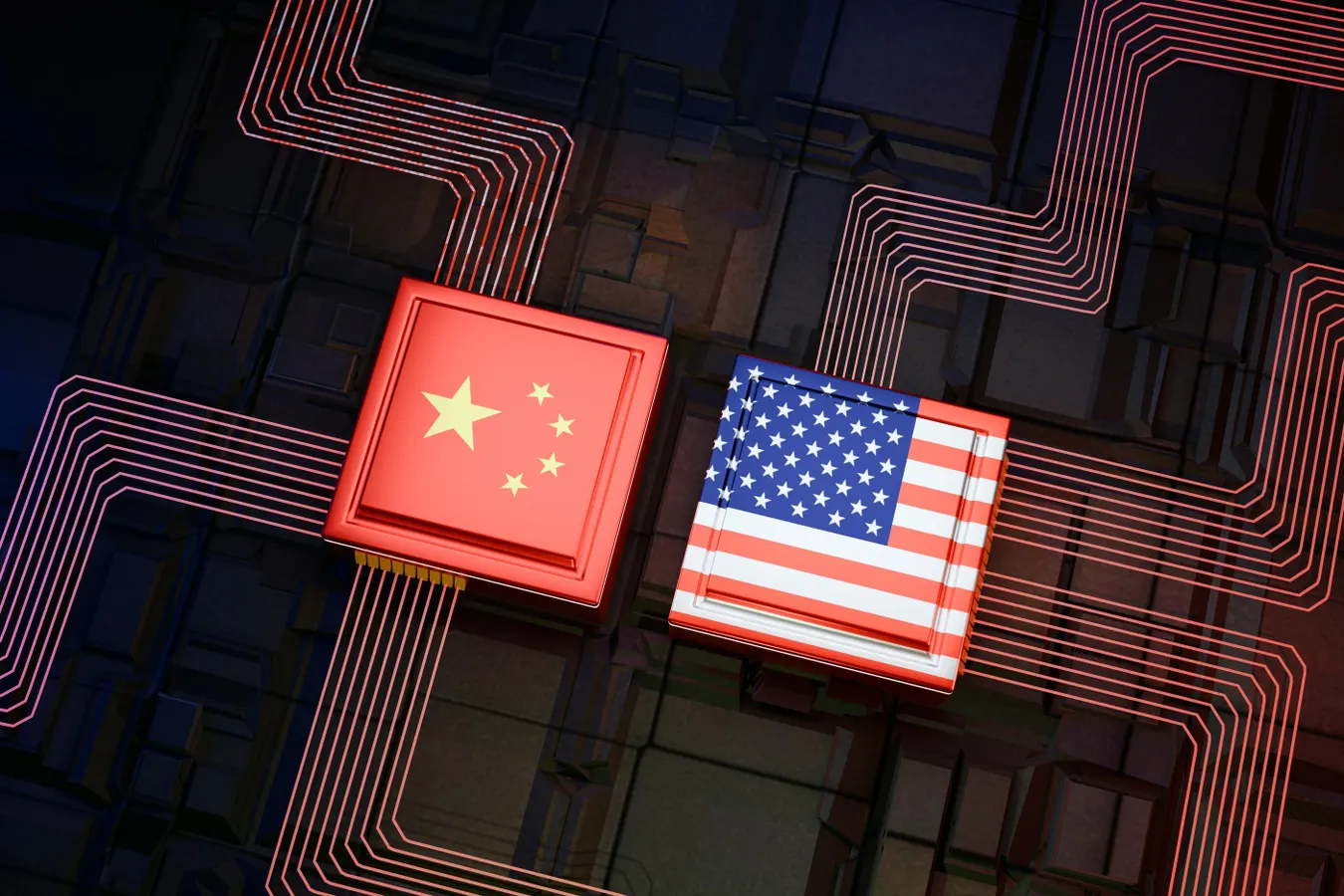

China appears to have moved into a leading position in the global artificial intelligence race, with recent reporting and research cited in the material showing stronger performance in publications, citations, patent grants and industrial robot deployment, while the United States retains a large lead only in private investment.
The argument traces China’s rise back to a long-term state strategy first outlined in 2017, when its State Council said the country should build AI industry competitiveness to a world-leading level by 2030. Nearly a decade later, that policy direction is described as producing clear results, at a time when concerns are growing that America’s earlier advantage is narrowing sharply.
Stanford Report Points to Shift in Global AI Balance
The material cites Stanford University’s Institute for Human-Centered AI and its recently released 2026 report as evidence that the balance has changed. It says China now leads the world in AI research publications and citations, and is deploying industrial AI-integrated robots at nearly nine times the rate of the United States.
Patent data is presented as an even sharper measure of the shift. In 2024, China accounted for more than 74 percent of the world’s AI patent grants, compared with 12 percent for the United States and 3 percent for the European Union. The same conclusion is said to have been reached by international economists in a paper that argued American AI patents are relatively sparse and concentrated among a small number of large private firms.
FCRF Returns With CDPO, Its Premier Data Protection Certification for Privacy Professionals
US Technical Edge Narrows as China Gains Ground
The text notes that top American AI models still retain a technical lead in Arena scores, a ranking used to measure the quality of AI systems. Even so, that advantage is described as having shrunk considerably by early 2025.
Stanford’s summary, as quoted in the material, says Chinese and American models have exchanged places at the top of performance rankings several times since early 2025. It adds that in February 2025, DeepSeek-R1 briefly matched the leading US model, while by March 2026 the top American model was ahead by 2.7 percent, with the gap fluctuating over the past year but remaining in single digits.
The broader conclusion presented is that China has steadily emerged as a counterweight to the United States in AI and now appears to have nearly erased what was once a more substantial American lead.
Investment Remains America’s Strongest Advantage
The United States is described as leading decisively in private investment. Last year, US private interests spent $258.9 billion on AI, compared with China’s $12.4 billion.
That spending gap, however, is presented as an exception rather than the overall rule. Across model performance, research output, citations and patents, the material argues that China’s long-term strategy is delivering stronger results and that the global AI contest is no longer defined by clear American dominance.
Taken together, the figures and assessments in the material portray a competition that has become much tighter. China is presented not only as a challenger, but as a country that may now be setting the pace in several of the most important measures of AI strength.
