
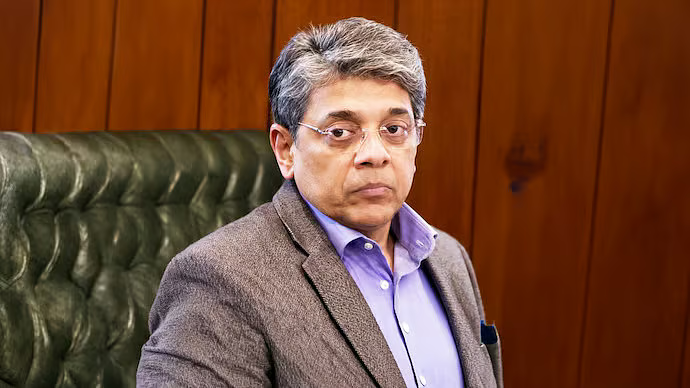

Mahesh Dixit, currently the second-in-command at the Intelligence Bureau, was appointed its next Director. Prime Minister Narendra Modi chaired the Appointments Committee of the Cabinet that cleared the decision. Dixit gets a two-year tenure.
He takes over from Tapan Kumar Deka, a 1988-batch IPS officer of the Himachal Pradesh cadre, whose second extended term concludes on June 30. Deka led the agency since July 2022. During his tenure, the IB strengthened its counter-terrorism focus and expanded its coordination on emerging security threats. He received successive service extensions, a reflection of the government’s desire for continuity at the top of the country’s oldest intelligence organization.
Dixit is a 1993-batch IPS officer from the Andhra Pradesh cadre. A significant part of his career was spent in Jammu and Kashmir, where he led the Intelligence Bureau’s Subsidiary Intelligence Bureau in Srinagar, overseeing intelligence operations across Jammu, Kashmir and Ladakh.
That posting is not a routine assignment. The SIB in Srinagar sits at the most operationally sensitive node of India’s internal intelligence network. Officials credit Dixit with playing a crucial role in stabilizing the region and tracking security threats following the abrogation of Article 370 in 2019. He handled ground-level intelligence during one of the most consequential moments in the state’s recent history.
His work has included tackling Pakistan-backed infiltration networks, monitoring radicalization activities and addressing threats linked to Left-Wing Extremism. These are not desk assignments. They are the kind of operational postings that define an intelligence career.
Last year, Dixit moved from Jammu and Kashmir to the IB headquarters in New Delhi and was elevated as the agency’s second-in-command, a move widely seen as positioning him for the top role. Thursday’s appointment confirmed what the promotion had signaled
Dixit takes charge at a moment when the Intelligence Bureau’s mandate is broader and more technically complex than at any point in its history. Cyber threats, AI-powered surveillance risks, cross-border digital influence operations and the growing intersection of terrorism with financial crime all fall within the IB’s operational ambit. The agency that once relied almost entirely on human intelligence now operates in a landscape where signals intelligence, digital forensics and real-time data analysis are central to its work.
The government’s grant of a service extension under Fundamental Rule 56(d) to enable Dixit to serve in the position reflects the standard mechanism for retaining experienced officers beyond superannuation in critical national security roles. It is a procedural formality, but one that underlines how seriously the government treats the continuity of leadership at the IB.
The Intelligence Bureau is India’s primary internal security and counter-intelligence agency. It operates under the Ministry of Home Affairs and carries responsibility for domestic intelligence gathering, counter-terrorism operations and critical infrastructure protection. It is widely regarded as one of the oldest continuously operating intelligence organizations in the world.
With Dixit at its head, the bureau carries into its next chapter a leadership defined by ground experience in the country’s most challenging security environment. The appointment signals that the government values operational credibility over administrative pedigree at the top of its domestic intelligence apparatus.
Follow for daily updates on cybercrime, corporate fraud, DFIR, hacking, investigations, and digital forensics
