

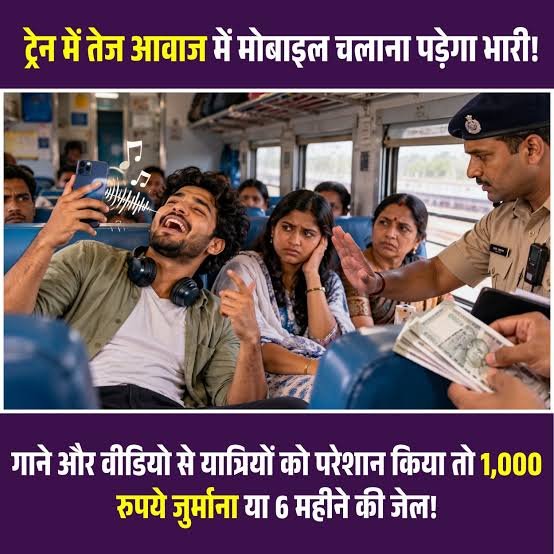

Indian Railways has initiated a coordinated drive across multiple zones to curb the nuisance of passengers playing loud videos, music, and using speakerphones during train journeys. Prompted by growing grievances registered through the Rail Madad portal, railway authorities are stepping up passenger awareness campaigns and reviewing legal mechanisms to discourage disruptive mobile phone use on trains and station premises. Southern Railway issued an advisory circular on October 6 urging travellers to avoid loud volume settings, while Northern Railway and Western Railway have also committed to tackling noise disturbances that disrupt the comfort of passengers resting or sleeping, particularly inside air-conditioned coaches.
Legal Provisions and Penalty Clarifications
While public information surrounding the Southern Railway circular has highlighted potential penalties of up to Rs 1,000 and imprisonment for up to six months, officials have clarified that punitive measures will not apply automatically to every complaint. Any legal action remains contingent on the specific circumstances of an incident, the applicable statutory framework, and established enforcement procedures. Senior railway authorities noted that recent modifications have been made to the relevant legal provisions to allow for firmer action against persistent offenders, though passengers are advised to distinguish between broad behavioral advisories and statutory penalties imposed under specific provisions.
Passenger Grievances and Changing Travel Habits
The proliferation of mobile internet access and widespread video consumption has significantly intensified noise complaints inside train compartments. Travelers have repeatedly reported instances where fellow passengers watch digital content without headphones or conduct conversations on speakerphone, compelling nearby passengers to listen to unwanted audio throughout journeys. Railway authorities emphasize that public announcement systems will now be deployed to encourage the use of earphones and foster greater mutual consideration. Officials maintain that widespread awareness and basic courtesy are particularly vital on long-distance trains, where passengers share confined spaces for hours at a time.
Staff Shortages and Enforcement Obstacles
Despite the stepped-up warnings, questions have emerged regarding the operational feasibility of enforcing mobile phone discipline across a vast passenger network. Basant Kumar Shukla, a representative of a Nagpur-based railway passenger association, observed that issuing circulars alone will achieve little without adequate personnel on the ground. Highlighting persistent shortages of Railway Protection Force personnel and train ticket examiners, Shukla pointed out that existing staff are already heavily burdened with handling unauthorized entry, berth occupations, and sanitation issues. These operational limitations raise serious doubts over whether railway teams can monitor noise violations effectively on congested routes, making the success of the initiative heavily dependent on voluntary passenger cooperation.
Follow for daily updates on cybercrime, corporate fraud, DFIR, hacking, investigations, and digital forensics
