
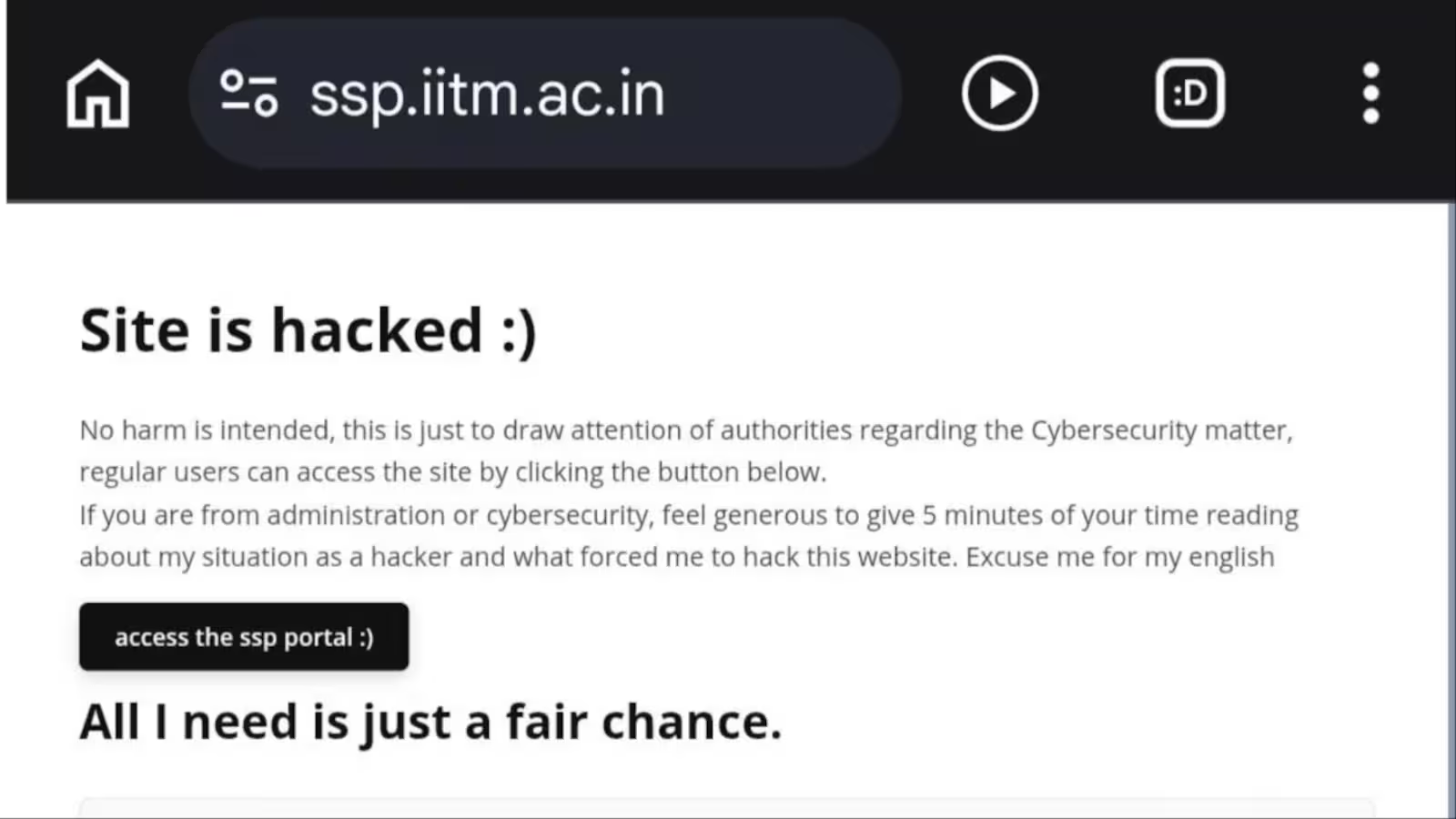

In an unprecedented demonstration of practical skills, a young tech enthusiast who was denied admission to a cybersecurity program at the Indian Institute of Technology Madras (IIT Madras) breached the institute’s official portal. The applicant left behind a message stating that all they needed was a fair chance to prove their capabilities. The incident has ignited a national debate over the traditional academic criteria used by elite institutions versus hands-on technical proficiency in specialized fields like computer security.
Breach Details and Security Vulnerability Assessment
According to reports, the candidate bypassed authentication protocols on an IIT Madras portal and accessed administrative controls without causing destructive payload damage or compromising sensitive personal data. Instead of manipulating databases or altering academic records, the hacker posted a simple, single-line petition on a prominent index page: “All I need is just a fair chance.” The breach highlighted a critical vulnerability within the web infrastructure, drawing immediate attention from the institute’s IT security team, who quickly isolated the compromised sub-domain and initiated a security audit.
Initial investigations suggest that the intruder exploited an authorization bypass vulnerability to gain unauthorized privileges. Rather than exfiltrating private student records or demanding ransom, the individual demonstrated proof-of-concept access to make a point about their technical qualifications. Security experts and cybersecurity professionals have noted that while unauthorized access remains illegal under Indian cyber law, the demonstration clearly proved the candidate possessed high-level practical exploitation skills that standard written entrance examinations often fail to capture.
Academic Credentials versus Hands-On Expertise
The incident has triggered widespread discussion across online forums, tech communities, and academic circles regarding admission methodologies for technical courses. Traditional entrance systems in India, such as the Joint Entrance Examination (JEE), rely heavily on standardized theoretical testing in physics, chemistry, and mathematics. Critics argue that these examinations can penalize self-taught programmers and cybersecurity specialists who excel at practical vulnerability research, penetration testing, and software development, but may fall short on standardized academic metrics.
Several industry leaders and cybersecurity professionals have weighed in on the ethics and implications of the breach. While acknowledging that illegal hacking cannot be condoned or incentivized by academic institutions, commentators emphasize the growing divide between legacy educational benchmarks and real-world tech capabilities. Some security experts suggested that institutions could introduce specialized performance-based assessments or bug bounty programs to scout talent legally, bridging the gap for non-traditional candidates seeking admission into elite computer science departments.
Institutional Response and Broader Implications
In response to the intrusion, IIT Madras patched the exploited security flaw and strengthened internal network monitoring across all sub-domains. Officials maintained that academic admissions must adhere to established statutory guidelines, standardized testing, and regulatory frameworks to maintain transparency and fairness for millions of applicants across the nation. Institutional representatives stated that bypassing security systems, regardless of motive, constitutes a violation of cybersecurity laws and cannot guarantee admission privileges.
The incident highlights a growing challenge facing technology education worldwide. As cyber threats become increasingly sophisticated, educational institutions are under pressure to identify and nurture self-taught technical talent while upholding strict ethical standards and institutional security. The candidate’s daring exploit has forced a conversation on whether top-tier universities need flexible pathways to evaluate practical genius alongside traditional academic transcripts.
Follow for daily updates on cybercrime, corporate fraud, DFIR, hacking, investigations, and digital forensics
