
New Delhi: With banks, NBFCs, insurers, securities-market entities and other financial institutions facing increasingly sophisticated cyber threats, Algoritha Security Pvt. Ltd. is offering SOC as a Service specifically for the BFSI sector, combining continuous security monitoring, threat detection, incident response, regulatory readiness and Digital Forensics & Incident Response (DFIR).
The service is designed around a technology-agnostic security architecture rather than dependence on a single proprietary platform. Its technology stack can integrate SIEM, SOAR, EDR/XDR, Network Detection & Response, threat-intelligence feeds, vulnerability management, malware detection, file-integrity monitoring, cloud-security monitoring, identity and access logs, firewall telemetry and security analytics.
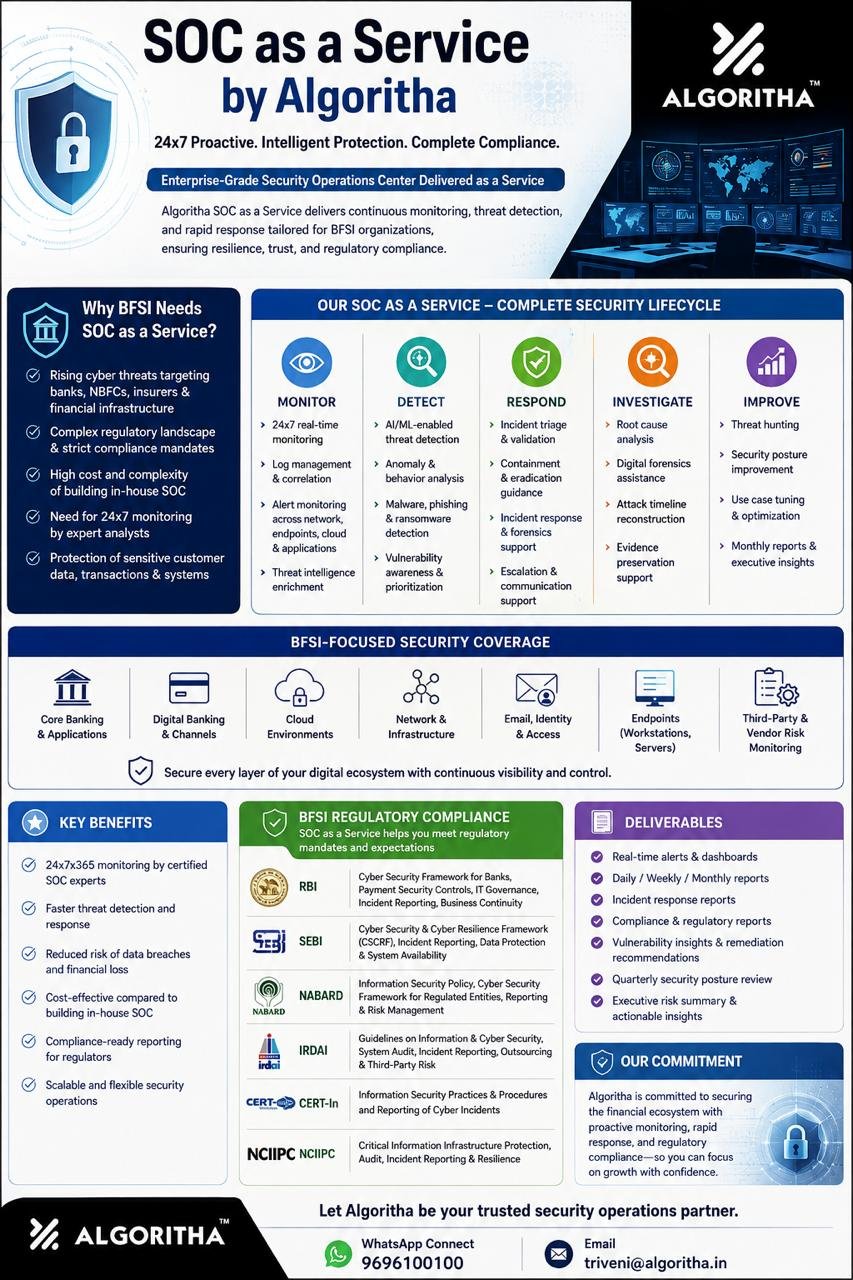
The objective is to establish centralized visibility across endpoints, servers, networks, applications, cloud infrastructure and critical financial systems. The underlying SOC model also incorporates centralized log collection, correlation, threat intelligence, automated alerting and escalation workflows.
SOC as a Service for BFSI Cybersecurity
Algoritha’s SOC offering is designed to address the specific cybersecurity requirements of banks, NBFCs, insurance companies, securities-market entities and other financial organisations.
By bringing security monitoring and response capabilities into a centralised SOC environment, the service aims to provide organisations with greater visibility into threats across their digital infrastructure.
The approach covers security monitoring, threat detection, incident response and compliance-oriented security operations within a single framework.
24×7 Security Monitoring and Threat Detection
The SOC model is built around continuous monitoring of security events across an organisation’s IT environment.
Data from endpoints, servers, networks, applications, cloud platforms and other critical systems can be collected and correlated to identify potentially suspicious activity.
Centralised log collection, threat intelligence and automated alerting are used to help security teams identify and prioritise potential threats before they escalate into major incidents.
SIEM, SOAR, EDR and XDR Integration
Algoritha’s technology-agnostic architecture can integrate multiple security technologies rather than requiring customers to depend on a single proprietary platform.
The technology stack can include:
- Security Information and Event Management (SIEM)
- Security Orchestration, Automation and Response (SOAR)
- Endpoint Detection and Response (EDR)
- Extended Detection and Response (XDR)
- Network Detection and Response
- Threat-intelligence platforms
- Vulnerability management
- Malware detection
- File-integrity monitoring
- Cloud-security monitoring
- Identity and access logs
- Firewall telemetry
- Security analytics
This integrated approach is intended to provide a consolidated view of security events across multiple technology environments.
L1, L2 and L3 SOC Analyst Support
Algoritha’s SOC model provides layered analyst support based on the complexity of security alerts and incidents.
L1 analysts continuously monitor security alerts, conduct initial triage and identify events requiring further investigation.
L2 analysts investigate suspicious activity, correlate events and support containment and response activities.
L3 specialists handle advanced threat hunting, malware analysis, detection engineering and complex incident investigations.
This tiered model allows routine alerts to be handled efficiently while advanced incidents can be escalated to specialised cybersecurity teams.
Proposal for Conducting Cyber Crisis Drill, Tabletop Exercise (TTEx) & CCMP Readiness Exercise
DFIR Support for Ransomware and Data Breaches
When a ransomware attack, data breach, account compromise or other cyber crisis occurs, the SOC can transition into Digital Forensics and Incident Response (DFIR) mode.
The response capability can support:
- Incident containment
- Forensic acquisition and analysis
- Root-cause investigation
- Attack-timeline reconstruction
- Evidence preservation
- Indicators of Compromise identification
- Post-incident remediation
The combination of SOC monitoring and DFIR capabilities can help organisations move from detecting an incident to understanding how it occurred and determining the appropriate remediation measures.
BFSI Cybersecurity and Regulatory Compliance
For BFSI organisations, cybersecurity operations are increasingly connected with regulatory expectations.
RBI’s IT Governance Directions cover areas including IT governance, controls, business continuity and disaster recovery for specified regulated entities.
SEBI’s Cybersecurity and Cyber Resilience Framework establishes a standardised cyber-resilience approach for regulated entities and recognises SOC capabilities, including Market SOC arrangements for smaller entities.
IRDAI has separately issued Information and Cyber Security Guidelines and, in 2025, a circular specifically addressing cyber-incident or crisis preparedness.
RBI, SEBI and IRDAI Cybersecurity Requirements
The regulatory landscape makes continuous monitoring, incident preparedness and cybersecurity governance increasingly important for financial institutions.
A SOC can support organisations in maintaining visibility over security events, generating alerts, preserving relevant logs and coordinating incident-response activities.
For BFSI organisations operating under different regulatory frameworks, integrating security operations with compliance requirements can also help create a more structured approach to cyber-risk management.
Technology-Agnostic Security Architecture
Rather than relying on a single security platform, Algoritha’s SOC model is designed around a technology-agnostic architecture.
This allows security tools already deployed within an organisation to potentially be integrated into the SOC environment.
The approach can bring together data from security products, infrastructure and applications to provide centralised monitoring and correlation across the organisation.
Integrated Cyber Defence for Financial Institutions
SOC as a Service by Algoritha brings together People, Process, Technology, DFIR and Regulatory Compliance into an integrated cyber-defence capability for the BFSI ecosystem.
For banks, NBFCs, insurers and securities-market organisations, the model is designed to combine continuous monitoring with specialised investigation and incident response.
As financial institutions continue to face ransomware, account compromise, data breaches and increasingly sophisticated cyber threats, integrated SOC capabilities can play an important role in strengthening detection, response and overall cyber resilience.
Follow for daily updates on cybercrime, corporate fraud, DFIR, hacking, investigations, and digital forensics
